
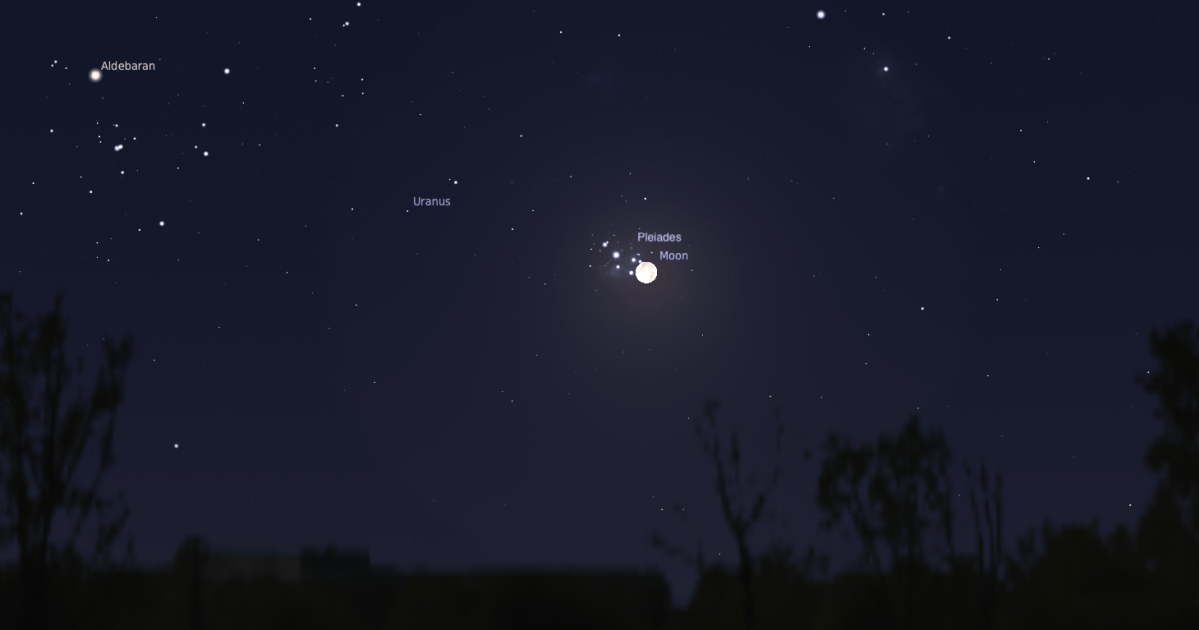
November’s Full Beaver Moon — a Super Moon — passes through the Pleiades star cluster before dawn. | Published: November 24, 2026 The occultation of the Pleiades by the Moon will vary by location — this shows the view from the U.S. Midwest, just after the lunar disk has hidden Celaeno and moments before it covers Taygeta. Note that more stars are visible on this chart than will likely be seen in the sky, due to the Moon’s brightness. Credit: Stellarium/USGS/Celestia/Clementine Looking for a sky event this week? Check out our full Sky This Week column. November 23: Double star Kurhah in Cepheus Full Moon occurs at 9:54 A.M. EST, bringing us our second Super Moon of the year. A Super Moon occurs when the Moon reaches Full phase close to perigee, its closest point to Earth, making our satellite appear larger and brighter than average. The November Full Moon is also called the Beaver Moon. A few hours earlier, before dawn, the Full Moon passes through the Pleiades star cluster (M45) in Taurus, occulting several of its bright stars. This is an easy event to watch, visible to the naked eye — or you can get a closer view with binoculars or a telescope (just note that you may want a Moon filter if available, as our satellite is so big and bright). The timing of the event will depend heavily on your location; note that it begins right around sunrise along the East Coast, so observers there may only see the Moon approaching the famous group of stars. The 5th-magnitude star Celaeno (16 Tauri) disappears behind the Moon’s leading edge just moments before 6 A.M. CST, followed minutes later by 4th-magnitude Taygeta (19 Tau). Next to vanish is 4th-magnitude Maia (20 Tau) just before 6:20 A.M. CST, followed quickly by Sterope (21 Tau) a few minutes later. The latter two may be difficult to catch from the Midwest without optical aid, as sunrise is fast approaching. If you are using binoculars or a telescope in this region, make sure to put them away several minutes ahead of sunrise from your location. Celaeno reappears around 6:40 A.M. CST, 15 minutes or so before sunrise. For specific timings from your location, visit the International Occultation Timing Association at http://www.lunar-occultations.com/bobgraze/index.html. Sunrise: 6:55 A.M.Sunset: 4:38 P.M.Moonrise: 4:24 P.M.Moonset: 7:10 A.M.Moon Phase: Waning gibbous (99%)*Times for sunrise, sunset, moonrise, and moonset are given in local time from 40° N 90° W. The Moon’s illumination is given at 10 P.M. local time from the same location. Alison Klesman is senior editor of Astronomy magazine. She holds a Ph.D. in astronomy and has studied a variety of topics, from minor planets to supermassive black holes.
The Sky Today on Tuesday, November 24: A Super Beaver Moon occults the Pleiades
Full Article
Original Source
Read the full article at Astronomy →KhanList aggregates and links to publicly available news content. We do not host full articles from third-party sources. Always verify important information with original sources.