
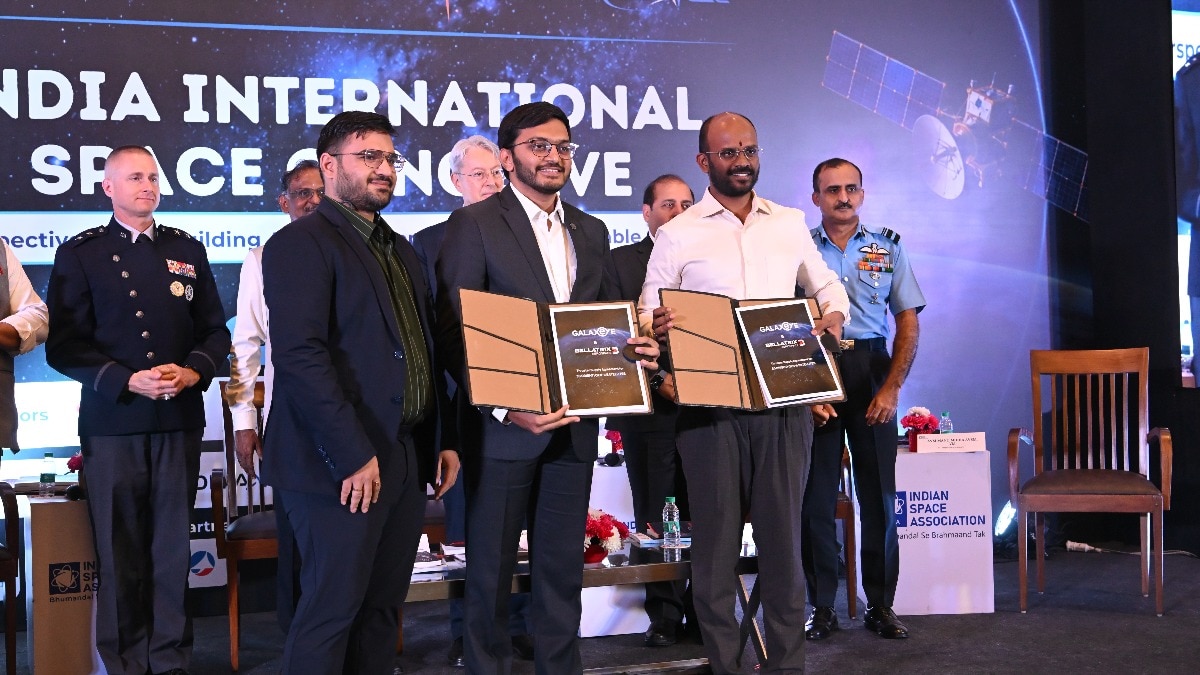
GalaxEye has partnered with Bellatrix Aerospace to supply propulsion systems for its next 30 Drishti Gen-II satellites, marking a major deal between two Indian private space companies.GalaxEye and Bellatrix are also strengthening India's ability to build and operate satellite networks independently. (Photo: GalaxEye)New Delhi,Nov 24, 2026 15:01 ISTIn a major boost to India's private space industry, Bengaluru-based GalaxEye has partnered with Bellatrix Aerospace to equip its next 30 satellites with Indian-built propulsion systems.The agreement is the largest business-to-business order between two Indian private space companies by satellite count since the sector opened to private players in 2020.Announced at the 5th India International Space Conclave in New Delhi, the multi-year agreement will see Bellatrix design, build and deliver its Arka Hall-effect propulsion systems for GalaxEye's upcoming Drishti Gen-II satellite constellation. GalaxEye's Mission Drishti launched world's first OptoSar satellite combining optical cameras and all-weather radar. (Photo: PTI) WHY DO SATELLITES NEED PROPULSION SYSTEMS?Satellites need small engines to move into their assigned positions, maintain their distance from other spacecraft and avoid collisions with space debris. These systems also help guide satellites out of orbit safely when their working lives end. Bellatrix's Arka systems use electricity to accelerate charged particles and generate thrust, allowing satellites to make these movements while using less fuel than conventional engines.For GalaxEye, which plans to operate a network of 30 Earth-observation satellites, keeping spacecraft in their correct positions is particularly important. Not an upgrade. Not a variation. Something entirely new. Mission Drishti lifted off as the world's first OptoSAR satellite. Now it's time to break down what OptoSAR really is. Stay tuned. #OptoSAR #MissionDrishti #SpaceTech #EarthObservation #DeepTech https://t.co/nfju3Eqjcs— GalaxEye (@GalaxEye) November 13, 2026It will help ensure the satellites follow predictable paths and regularly capture images of the same locations on Earth.Bellatrix's propulsion technology has already been tested in space. Its Arka and Rudra systems completed in-orbit tests aboard Isro's PSLV-C58 mission in January 2024, while Rudra was tested again in January 2025.WHAT IS GALAXEYE BUILDING?GalaxEye is developing Drishti, an Earth-observation constellation that combines two types of imaging technology: radar and optical cameras.While conventional optical cameras struggle to capture clear images through clouds, smoke or darkness, radar can observe the Earth's surface in these conditions.Combining the two allows GalaxEye to provide images in different weather and lighting conditions.Its first satellite, Mission Drishti, was launched aboard a SpaceX Falcon 9 rocket on May 3, 2026, and became the world's first satellite to combine these two imaging technologies in orbit.However, contact with the spacecraft was lost following a geomagnetic storm.INDIA'S SPACE INDUSTRY GETS A BOOSTThe agreement reflects a growing shift towards Indian space companies sourcing critical technology from one another rather than depending entirely on overseas suppliers. Bellatrix Aerospace's ARKA Hall-effect thruster is seen on display. (Photo: Bellatrix Aerospace) India's space sector was opened to greater private participation through reforms introduced in 2020.The government aims to build a $44 billion space economy by 2033, with domestic companies playing a larger role in manufacturing satellites and their components.By sourcing propulsion systems locally, GalaxEye and Bellatrix are also strengthening India's ability to build and operate larger satellite networks independently.- Ends
GalaxEye signs biggest private space deal to power next 30 satellites
Full Article
Original Source
Read the full article at Indiatoday →KhanList aggregates and links to publicly available news content. We do not host full articles from third-party sources. Always verify important information with original sources.