
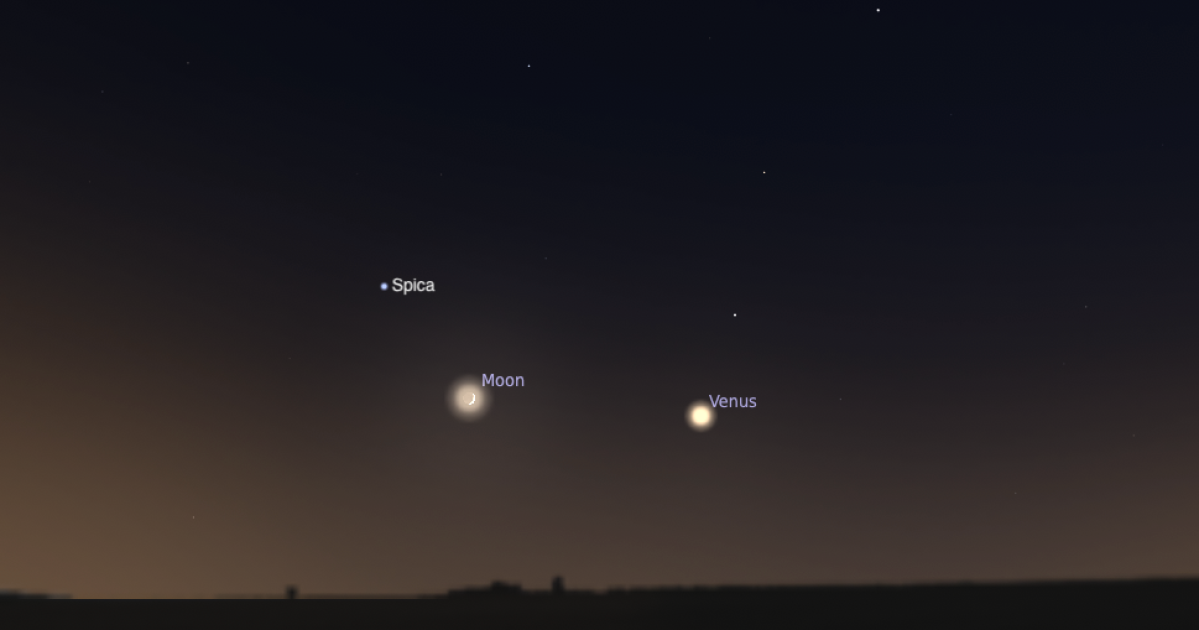
Catch our satellite side by side with bright planet Venus in the western sky after sunset, not far from the bright star Spica. | Published: August 16, 2026 The Moon and Venus hang side by side in the evening sky after sunset. See how soon you can spot the bright star Spica appear to their upper left as twilight fades. Credit: Stellarium/USGS/Celestia/Clementine Looking for a sky event this week? Check out our full Sky This Week column. August 15: A conjunction of Mercury and Jupiter The Moon passes 2° south of Venus at 5 A.M. EDT, although neither is visible at that time. Instead, the Moon rises around midmorning and remains visible until after sunset. By evening, it stands side by side with Venus in the twilit sky, both still within the bounds of the large constellation Virgo. As the sky grows darker, bright Venus will quickly appear, about 9.5° to the right of the crescent Moon. Observe the planet through a telescope and you will see that it is also a crescent, albeit one that is 48% lit. It reached dichotomy, when it appeared 50% lit, just last week, and will slowly wane even as its apparent angular diameter — now 25” — grows. To the upper left of the Moon is 1st-magnitude Spica, the brightest star in Virgo. See how soon you can pick it out as twilight fades. This star shines nearly 2,000 times brighter than our own Sun, from a distance of 250 light-years. Although we cannot split it visually, astronomers know it is a close binary system, with two stars just 0.12 AU apart, circling each other closer than the planet Mercury orbits the Sun. Sunrise: 6:13 A.M.Sunset: 7:55 P.M.Moonrise: 10:36 A.M.Moonset: 9:45 P.M.Moon Phase: Waxing crescent (22%)*Times for sunrise, sunset, moonrise, and moonset are given in local time from 40° N 90° W. The Moon’s illumination is given at 10 P.M. local time from the same location. Mars has been making its way eastward through the constellation Gemini, pulling away from open cluster M35 and approaching the two bright stars Eta (η) and Mu (μ) Geminorum. Eta shines at magnitude 3.3 and Mu at magnitude 2.9; both are fainter than 1st-magnitude Mars. Check out the view in the early-morning sky of August 17, when Mars sits just over 1° north of Eta Gem, to its upper left in the sky as this region rises. By 5 A.M. they are roughly 30° high in the east, easy to pick out shortly before twilight begins to brighten the sky. On the 17th, Mars sits due north of Eta (η) Geminorum, forming an upside-down capital L shape with that star and nearby Mu (μ) Geminorum. Credit: Stellarium This is a great chance to see for yourself our solar system in motion. Eta and Mu are excellent visual anchor points against which to measure the motion of Mars across the sky. Step outside at the same time over the next two days, and you’ll see that by the 19th, Mars has moved to assume a similar position some 1° north of Mu, now standing to that star’s upper left. Alison Klesman is senior editor of Astronomy magazine. She holds a Ph.D. in astronomy and has studied a variety of topics, from minor planets to supermassive black holes.
The Sky Today on Sunday, August 16: The Moon hangs with Venus
Full Article
Original Source
Read the full article at Astronomy →KhanList aggregates and links to publicly available news content. We do not host full articles from third-party sources. Always verify important information with original sources.