
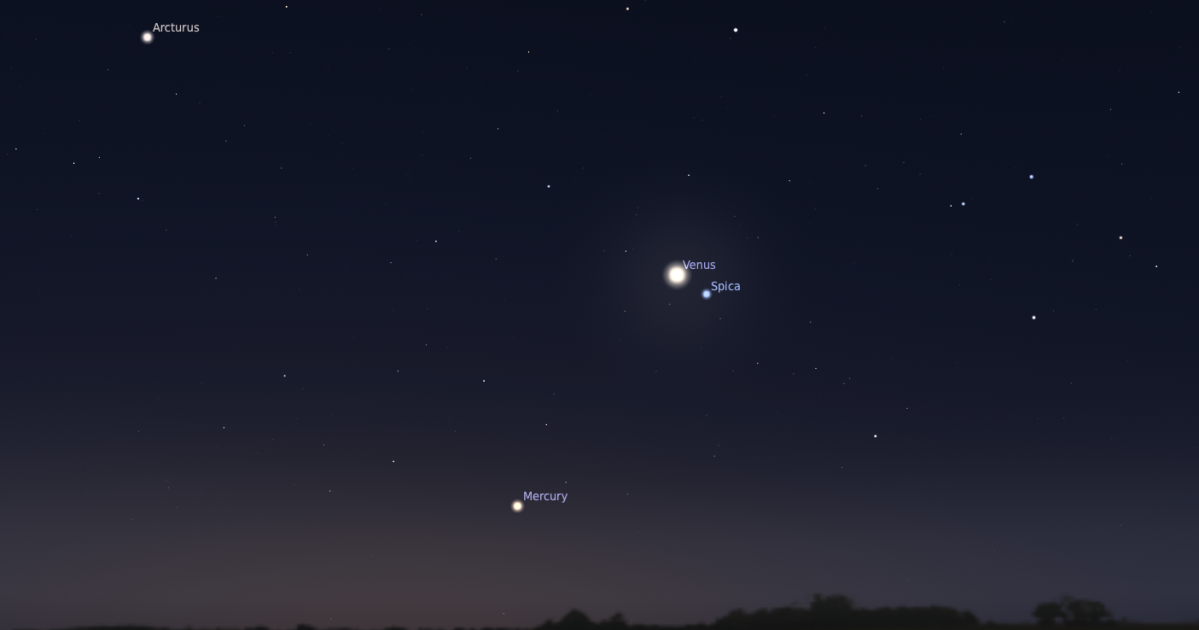
After reaching greatest western elongation yesterday evening, planet Mercury shines bright in the early-morning sky. | Published: November 21, 2026 Several bright lights adorn the predawn sky on November 21, including Mercury, which has just reached greatest western elongation from the Sun. Credit: Stellarium Looking for a sky event this week? Check out our full Sky This Week column. November 20: The Moon passes Saturn and Neptune If you’ve got a viewing site with a clear eastern horizon, this morning offers a great opportunity to spot the solar system’s innermost planet. Look for Mercury about an hour before sunrise, when it reaches 7° high and shines at magnitude –0.5. The planet reached its greatest western elongation from our Sun yesterday evening, and is now 20° west of our star in the sky. Located in Libra, the tiny world sits to the far lower left of bright Venus, higher in the sky. Venus is in the constellation Virgo, standing just north (to the upper left) of the bright star Spica. Another bright star, Arcturus in Boötes, hangs to that pair’s far upper left. Pull out a telescope to check out the size and phase of each planet. Start with Venus, whose disk spans a hefty 46” — currently larger than Jupiter’s apparent size in our sky. Despite its impressive width, however, the disk of Venus appears as just a sliver, only 19% lit. Slide down to Mercury for comparison, and see that its phase is much larger — 62% — while the planet’s overall apparent width is much smaller, just 7”. If you’re able, keep watching Mercury day by day in the morning sky. Its gibbous phase will continue growing, reaching 84% lit by the end of the month. Sunrise: 6:52 A.M.Sunset: 4:39 P.M.Moonrise: 2:29 P.M.Moonset: 3:22 A.M.Moon Phase: Waxing gibbous (92%)*Times for sunrise, sunset, moonrise, and moonset are given in local time from 40° N 90° W. The Moon’s illumination is given at 10 P.M. local time from the same location. Alison Klesman is senior editor of Astronomy magazine. She holds a Ph.D. in astronomy and has studied a variety of topics, from minor planets to supermassive black holes.
The Sky Today on Saturday, November 21: Mercury far west of the Sun
Full Article
Original Source
Read the full article at Astronomy →KhanList aggregates and links to publicly available news content. We do not host full articles from third-party sources. Always verify important information with original sources.