
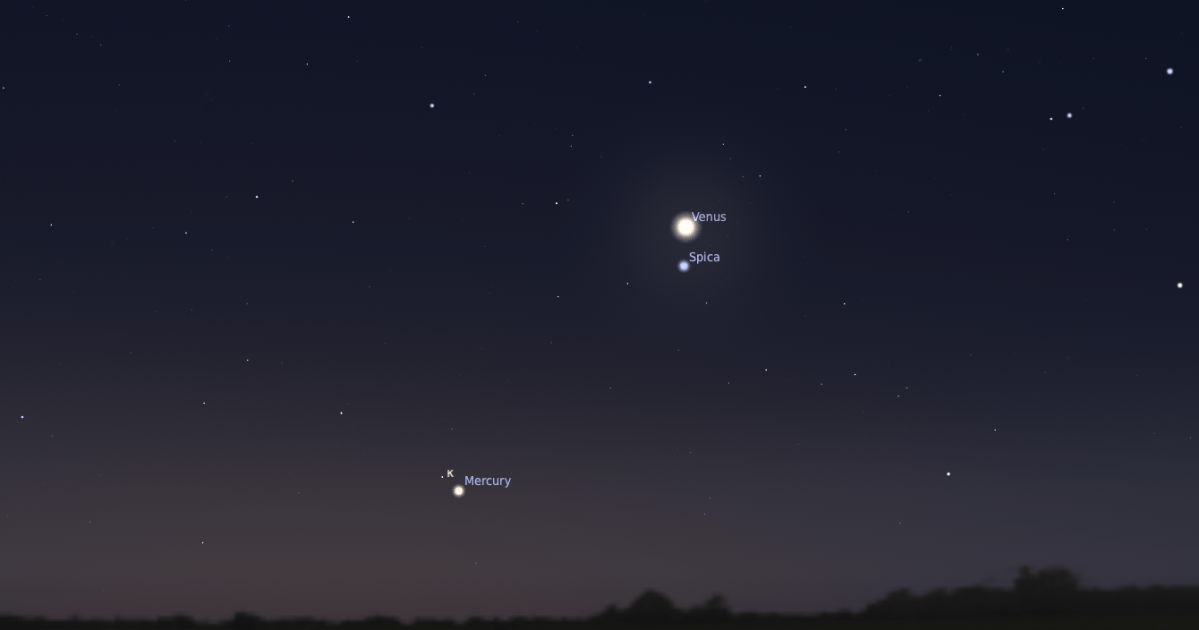
The two innermost planets are now visible in Virgo before the Sun rises, standing close to two of the Maiden’s stars. | Published: November 14, 2026 Mercury has made it into the morning sky, shining in the hour before dawn just below and to the left of Venus and Spica in Virgo. Look also for the fainter star Kappa Virginis, just north of Mercury. Credit: Stellarium Looking for a sky event this week? Check out our full Sky This Week column. November 13: Spot Mirach’s Ghost Following inferior conjunction early this month, Mercury has reappeared in the morning sky. Now magnitude 0.3, you can find the small planet some 5° above the eastern horizon an hour before sunrise. It lies to the lower left of brighter Venus (magnitude –4.8), which sits alongside Virgo’s luminary Spica, about 12° to Mercury’s west. This morning, Mercury is less than 1° south of 4th-magnitude Kappa (κ) Virginis, which should be visible until the sky brightens enough to wash out the star. You can capture both in the same field of view in either binoculars or a telescope. Mercury now appears as a 32%-lit disk that is 8” across. Compare that with Venus, which features a narrower phase just 13% lit but stretches 51” by comparison. The brighter planet lies just 1.4° northwest of Spica, the brightest star in Virgo. Both Spica and Kappa can act as guideposts to help you spot Venus’ and Mercury’s motion, respectively, over the next few days. Mercury is moving east and will pull away from Kappa to the lower left. Venus, which just recently reached a stationary point, is also moving east, but will swing slightly northeast (to the upper left) of Spica for a few days before tracking more directly east. Mars passes 1.2° north of Jupiter at 10 P.M. EST — we’ll focus on this pair in the early-morning sky tomorrow. Sunrise: 6:44 A.M.Sunset: 4:44 P.M.Moonrise: 11:33 A.M.Moonset: 8:56 P.M.Moon Phase: Waxing crescent (29%)*Times for sunrise, sunset, moonrise, and moonset are given in local time from 40° N 90° W. The Moon’s illumination is given at 10 P.M. local time from the same location. Jupiter and Mars are approaching opposition in February next year. They are now rising late in the evening and dominate the early-morning sky. By 3 A.M. local time on the 15th, the two planets are 40° high in the east. Mars sits just to the upper left (north) of Jupiter, having passed 1.2° due north of the gas giant late last night, shortly before rising. Both planets sit to the upper right (west) of Regulus, the brightest star in Leo the Lion. Io and Europa pass each other as the former heads for a transit and the latter pulls away from their parent planet Jupiter following an occultation early on November 15. Credit: Alison Klesman (via TheSkyX) In addition to spotting the pair of planets together in a telescope, you’ll want to zoom in on Jupiter in particular, as its Galilean moons are showing off this morning. Around 3 A.M. EST, Callisto stands alone west of the planet, with Io (closest) and Ganymede to the east. Twenty-two minutes later (at 3:22 A.M. EST), Io’s shadow appears at the eastern limb and begins to transit. Just over an hour later, with Io closing in on the same limb, Europa pops into view as it reappears from an occultation at 4:27 A.M. EST. It is just south of Io, which passes due north of Europa at 4:34 A.M. EST. Io then begins a transit two minutes later, slowly following its shadow. Io’s shadow reaches the western limb and disappears at 5:38 A.M. EST, while the moon takes a little over an hour to reach the same point, ending its transit at 5:52 A.M. CST (now daylight in the Eastern time zone). Alison Klesman is senior editor of Astronomy magazine. She holds a Ph.D. in astronomy and has studied a variety of topics, from minor planets to supermassive black holes.
The Sky Today on Saturday, November 14: Venus and Mercury in Virgo
Full Article
Original Source
Read the full article at Astronomy →KhanList aggregates and links to publicly available news content. We do not host full articles from third-party sources. Always verify important information with original sources.