
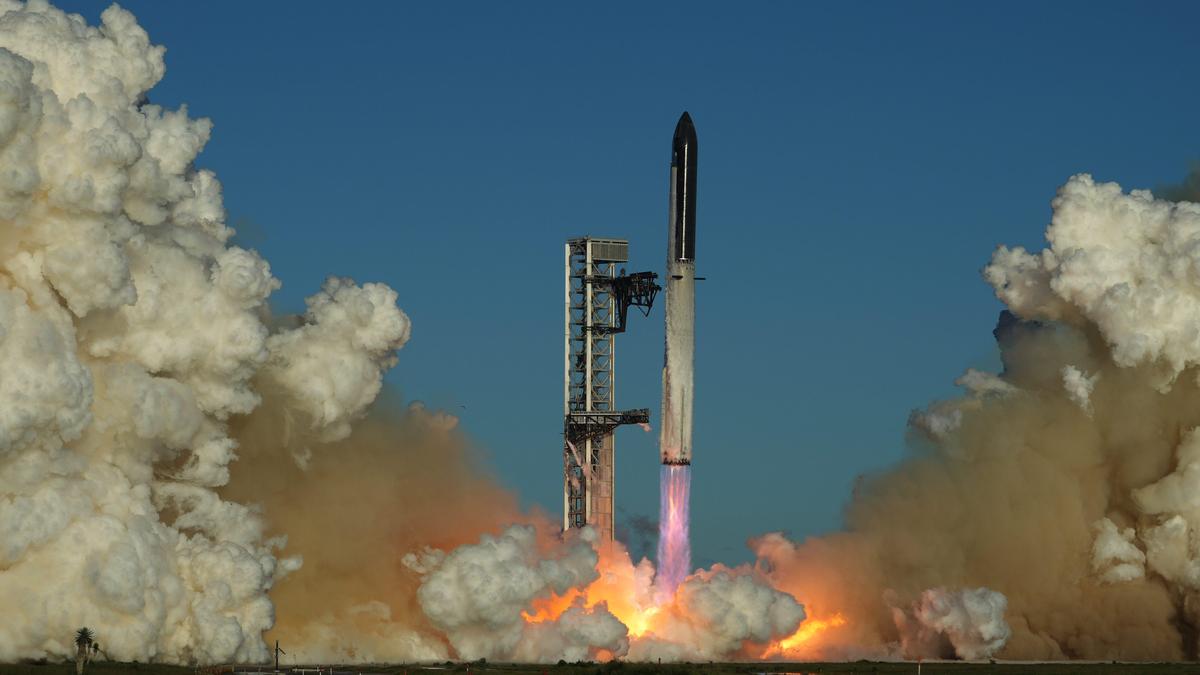
SpaceX launched the 15th flight of its Starship spacecraft from Texas on Friday (November 13, 2026) on a mission the company hopes will be the first round-trip rocket voyage to orbit and back to the very spot where it left Earth, a key test of Elon Musk’s effort to build a fully reusable rocket system.Plans call for Starship’s uncrewed upper-stage vessel to re-enter the atmosphere after nearly a day in orbit and return to its launch tower on Saturday (November 14, 2026) for an engine-controlled touchdown assisted by the giant mechanical arms of a pioneering catch-landing mechanism.SpaceX had intended to use the same return-flight and “chopstick”-arm technology to recover Starship’s lower-stage booster rocket shortly after the two parts of the spacecraft separated within minutes of the launch. But the Super Heavy booster, for reasons not immediately clear, was diverted from its return flight path to a fixed point over the Gulf of Mexico and momentarily hovered in the air before exploding a short distance over the sea surface. The booster for SpaceX's mega rocket Starship explodes after a catch attempt was aborted during a test flight from Starbase, Texas. | Photo Credit: AP SpaceX mission controllers hoped to have better luck in steering Starship’s upper stage back to home base at the end of its flight. The vehicle reached orbit about 27 minutes after launch, SpaceX said.Key test of reusabilityBringing the top portion of the spacecraft intact back to the platform where it was launched would mark a breakthrough in the ambitions of Musk, who founded SpaceX in 2002, to reduce spaceflight costs by developing a fully recyclable rocket system.The combined vehicle, consisting of the main Starship cargo-and-crew vessel perched atop its Super Heavy booster rocket and standing 40 stories high, roared off its launch pad from SpaceX’s South Texas Starbase complex along the Gulf of Mexico near Brownsville.The flight marked Starship’s 15th test flight since 2023 and the second to carry a batch of operational Starlink satellites to orbit. That makes the mission both a revenue-generating endeavor for SpaceX’s satellite-connectivity business and a high-stakes test for a rocket ship still under development.Starship 15 began releasing its cargo of 26 satellites about 36 minutes into its flight in a payload-delivery operation expected to take less than an hour to complete, the company said in a livestream presentation of the mission.Musk’s space and AI business views Starship as key to expanding its network of Starlink internet satellites and, in the future, deploying a swarm of orbital AI data-processing centers dubbed Starmind, as the company positions itself to become a high-tech infrastructure provider.SpaceX last launched Starship in September, taking the rocket and a payload of satellites to orbit for the first time despite some rocket engines shutting down mid-flight. That mission, planned to last 10 hours, ended after roughly three hours with an upper stage splashing down intact into the Pacific Ocean before bursting into flames.Return flight and recovery plansFor Friday’s (November 13, 2026) mission, the company was aiming for both the lower-stage Super Heavy and the upper-stage Starship to return to the spacecraft’s Texas launch site for safe landing and recovery. Plans called for the orbital cruise vessel to touch down about 22 hours after launch. SpaceX has said it would be a “breakthrough moment in making Starship a reliable, rapidly reusable rocket” if that feat is achieved.SpaceX has previously returned the 236-foot (72-meter) Super Heavy booster three times to its launch pad after sending Starship to space, with the booster flying itself back to Earth minutes after launch and gently descending upright into the grasp of a pair of large mechanical arms fixed to the launch tower. The last such “tower catch” was in March 2025.It was not immediately clear why Friday’s attempt failed.Starship was expected to descend from space after completing 14 orbits around Earth, setting up its debut catch landing for Saturday afternoon (November 14, 2026).Mr. Musk has said he expects to achieve a pace of weekly Starship launches by the first half of 2027.NASA has helped fund Starship’s development with roughly $3.2 billion since selecting the rocket ship in 2021 to serve as a lunar lander for its astronauts under the multibillion-dollar Artemis moon program. SpaceX has put at least $15 billion of its own funds into the rocket’s development.NASA and SpaceX expect Starship to land humans on the moon by 2028, though several major testing objectives remain that analysts and industry engineers believe will push that timeline back. Those milestones include demonstrating complex fuel transfers between Starship tanker rockets in orbit, a critical process that will enable Starship to travel beyond Earth’s orbit to the moon.Jeff Bezos’ Blue Origin is also developing a moon lander, Blue Moon, for NASA under the Artemis program. Blue Moon is poised to join Starship and another spacecraft, NASA’s Orion capsule, in Earth’s orbit next year for Artemis III, a docking test mission before NASA’s planned moon landing missions begin with Artemis IV.
SpaceX launches 15th Starship flight with hopes of achieving first round trip
Full Article
Original Source
Read the full article at Thehindu →KhanList aggregates and links to publicly available news content. We do not host full articles from third-party sources. Always verify important information with original sources.