
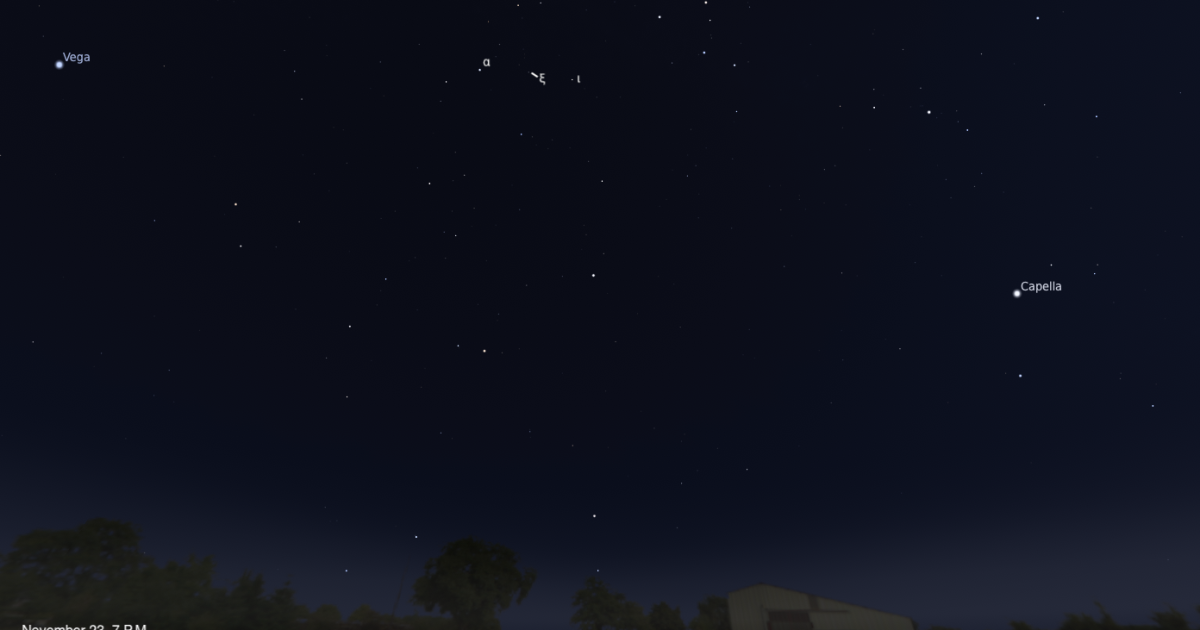
Cepheus the King is home to several double stars. Tonight, focus on Kurhah, an easy-to-split, bi-colored double. | Published: November 23, 2026 You can find the easy-to-split double star Kurhah (Xi [ξ] Cephei) in the north after dark, between the stars Alpha (α) and Iota (ι) Cephei. Credit: Stellarium Looking for a sky event this week? Check out our full Sky This Week column. November 22: Flat-floored lunar crater Schickard A few hours after sunset, the house-shaped constellation Cepheus stands on the point of its roof in the northern sky, above the Little Dipper. Cepheus is home to several lovely double stars, including Xi (ξ) Cephei, also known as Kurhah. Glowing at magnitude 4.3, Kurhah is not one of the stars in the house’s outline, but lies within the boxy base. You can find it about midway between Alderamin (Alpha [α] Cep) and Iota (ι) Cep, the western and eastern points in the house’s box, respectively. Kurhah’s two components are separated by just under 8” — once you find the star in binoculars or your finder scope, any telescope will split them. The pair consists of a brighter magnitude 4.4 primary, which glows white, and a fainter magnitude 6.5 secondary, which appears to many observers as yellow. If you happen to have a large telescope, you may want to give a nearby deep-sky treasure a try: planetary nebula NGC 7139 sits just 2° west-southwest of Kurhah, but it requires a large scope (8 inches at least) to spot, as this bubble of gas glows at magnitude 13.3. If available, an Oxygen-III filter will help bring it out by dimming the nearby stars. Sunrise: 6:54 A.M.Sunset: 4:38 P.M.Moonrise: 3:37 P.M.Moonset: 5:52 A.M.Moon Phase: Full*Times for sunrise, sunset, moonrise, and moonset are given in local time from 40° N 90° W. The Moon’s illumination is given at 10 P.M. local time from the same location. Full Moon occurs at 9:54 A.M. EST on November 24, bringing us our second Super Moon of the year. A Super Moon occurs when the Moon reaches Full phase close to perigee, its closest point to Earth, making our satellite appear larger and brighter than average. The November Full Moon is also called the Beaver Moon. A few hours earlier, before dawn, the Full Moon passes through the Pleiades star cluster (M45) in Taurus, occulting several of its bright stars. The occultation of the Pleiades by the Moon will vary by location — this shows the view from the U.S. Midwest, just after the lunar disk has hidden Celaeno and moments before it covers Taygeta. Note that more stars are visible on this chart than will likely be seen in the sky, due to the Moon’s brightness. Credit: Stellarium/USGS/Celestia/Clementine This is an easy event to watch, visible to the naked eye — or you can get a closer view with binoculars or a telescope (just note that you may want a Moon filter if available, as our satellite is so big and bright). The timing of the event will depend heavily on your location; note that it begins right around sunrise along the East Coast, so observers there may only see the Moon approaching the famous group of stars. The 5th-magnitude star Celaeno (16 Tauri) disappears behind the Moon’s leading edge just moments before 6 A.M. CST, followed minutes later by 4th-magnitude Taygeta (19 Tau). Next to vanish is 4th-magnitude Maia (20 Tau) just before 6:20 A.M. CST, followed quickly by Sterope (21 Tau) a few minutes later. The latter two may be difficult to catch from the Midwest without optical aid, as sunrise is fast approaching. If you are using binoculars or a telescope in this region, make sure to put them away several minutes ahead of sunrise from your location. Celaeno reappears around 6:40 A.M. CST, 15 minutes or so before sunrise. For specific timings from your location, visit the International Occultation Timing Association at http://www.lunar-occultations.com/bobgraze/index.html. Alison Klesman is senior editor of Astronomy magazine. She holds a Ph.D. in astronomy and has studied a variety of topics, from minor planets to supermassive black holes.
The Sky Today on Monday, November 23: Double star Kurhah in Cepheus
Full Article
Original Source
Read the full article at Astronomy →KhanList aggregates and links to publicly available news content. We do not host full articles from third-party sources. Always verify important information with original sources.