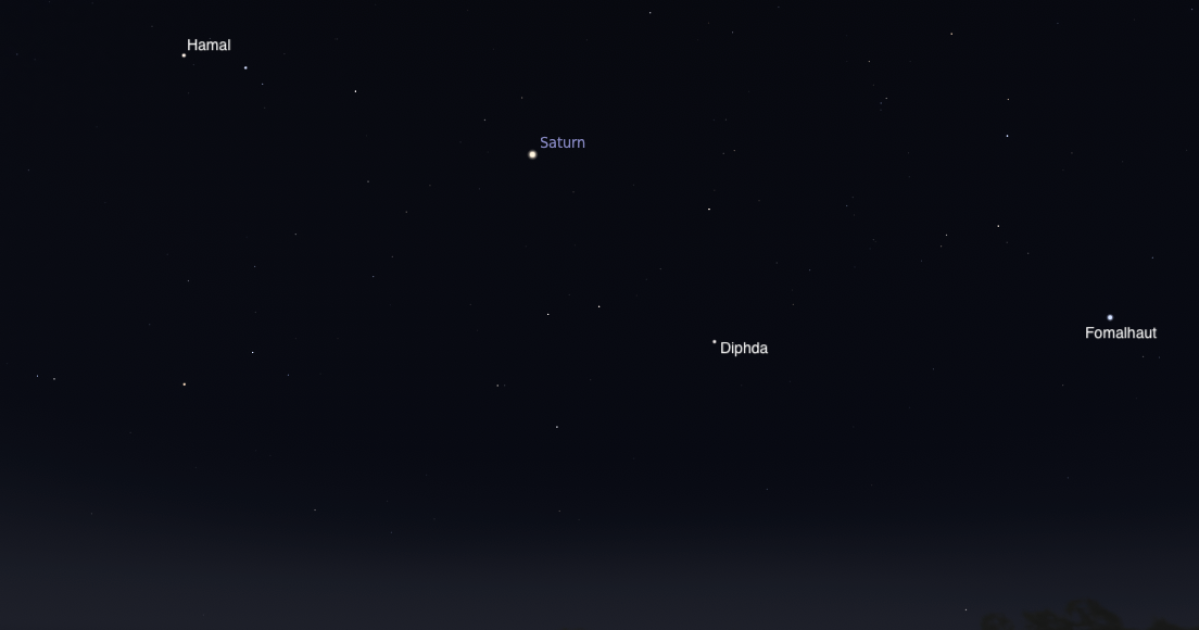
The ringed planet comes to a stop against the background stars of Pisces, switching its motion from eastward to westward. | Published: July 27, 2026 On early mornings this week, Saturn dominates the southeastern sky as the brightest point of light there. Credit: Stellarium Looking for a sky event this week? Check out our full Sky This Week column. July 26: Juno at opposition The ringed planet Saturn reaches a stationary point tonight at 7 P.M. EDT. Located in the constellation Pisces, it is highest around sunrise, so the best time to spot it is a few hours before dawn, with the sky still dark and the gas giant well above the horizon. Around 3 A.M. local daylight time on July 27, Saturn is roughly 40° high in the southeast, the brightest point of light here. It stands in southern Pisces, just above the lumbering constellation Cetus the Whale. Through a telescope, the planet’s disk stretches 18” across, while its rings are more than twice that: 41” across. Saturn is currently tilted by nearly 7°, showing off its south polar region and the underside of its rings. While several 10th-magnitude moons cluster near the planet, its largest — and brightest — moon, Titan, is a bit farther away. On the morning of the 27th, it lies about 1.7’ southwest of Saturn and is moving east. It should be easy to spot; Titan will pull closer in to the planet’s southwest tomorrow morning, then sit southeast of Saturn the morning of the 29th. If you’re an early riser, try to catch it over the next few days to see orbital mechanics in motion! Today’s halt brings Saturn’s prograde, or eastward, motion to an end. After this evening, the ringed planet will about-face and begin moving westward, or retrograde, relative to the background stars. Sunrise: 5:54 A.M.Sunset: 8:18 P.M.Moonrise: 7:31 P.M.Moonset: 3:39 A.M.Moon Phase: Waxing gibbous (98%)*Times for sunrise, sunset, moonrise, and moonset are given in local time from 40° N 90° W. The Moon’s illumination is given at 10 P.M. local time from the same location. By tomorrow morning, July 28, Mercury has reached magnitude 1.0 in the early-morning sky. Rising a little over an hour before the Sun, it reaches some 6° above the horizon 40 minutes ahead of sunrise. You’ll find it low on the eastern horizon, left of the fading stars of Orion the Hunter and far below and to the left of Mars in Taurus. Look for Mercury, now magnitude 1.0, low on the horizon about 40 minutes before sunrise, as dawn begins to brighten the sky. Credit: Stellarium The Red Planet, which shines a tad fainter at magnitude 1.3, will fade out of view first and may be harder to find in a broader swath of sky, while Mercury’s location just above the horizon will help in your search. If you use binoculars or a telescope to view the small planet, make sure you put them away well ahead of sunrise from your specific location. Alison Klesman is senior editor of Astronomy magazine. She holds a Ph.D. in astronomy and has studied a variety of topics, from minor planets to supermassive black holes.
The Sky Today on Monday, July 27: Saturn stands still
Full Article
Original Source
Read the full article at Astronomy →KhanList aggregates and links to publicly available news content. We do not host full articles from third-party sources. Always verify important information with original sources.