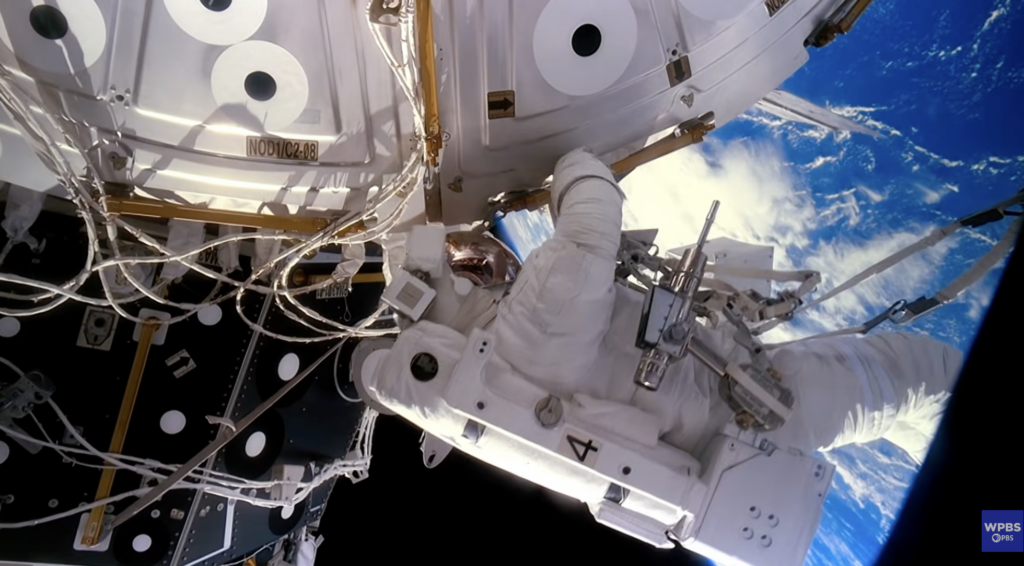
When people think of the space program, most Baby Boomers of a certain age recall the dramatic lunar landings of the Apollo program, which ended more than half a century ago. Younger Americans who watched the Artemis II mission earlier this year might contemplate the extraplanetary travel that NASA has planned for the decade ahead. But between the first race to the moon and our current attempts to move beyond low-Earth orbit lay a critical transitional epoch. In the decades before and after the end of the Cold War, travel in outer space became, if not exactly common — only about 800 individuals have traveled into space as of this writing — more democratized. Humans also engaged in important research about the long-term effects of life in zero gravity that will prove essential for travel to more distant destinations. James Bluemel, who directed first-person documentaries about conflicts in Iraq and Northern Ireland, reprised the genre with a more upbeat topic. In Once Upon a Time in Space, Bluemel shines a light on a period that, while unheralded and marred by several tragedies, also paved the way for future exploration of other worlds. Catastrophes (Barely) Avoided The series’ second episode, which examines the Shuttle-Mir missions conducted between American astronauts and Russian cosmonauts, explores the challenges associated with long-duration space travel. One batch of difficulties came from Mir itself, as the collapse of the Soviet Union in 1991 left the Russian Republic nearly bankrupt. NASA conducted the joint Shuttle-Mir missions in part to prop up the Russian space sector financially and prevent rocket scientists and other key personnel from defecting to work for “rogue states” like Iran and North Korea. But the dilapidated Soviet-era Mir space station still posed real problems for the scientists attempting to conduct experiments on board. First-person interviews recount two near-catastrophic incidents that took place on Mir in 1997: An oxygen canister caused a fire within the space station, and four months later, a collision by an unmanned Progress capsule punctured and depressurized part of Mir. As they describe the incident, one can only imagine the terror the astronauts and cosmonauts experienced during the 14 minutes in which the fire raged on board their spacecraft. Their efforts to extinguish the fire and to restore Mir following the collision with Progress not only saved their own lives, but prevented disasters that could have set back manned spaceflight for many years, if not longer. In 65 years of space exploration, the deaths in America’s space program have occurred on the ground (the Apollo 1 fire in 1967), while taking off (the Space Shuttle Challenger disaster in 1986), and while landing (the Shuttle Columbia in 2003). But as missions become longer with travel to other planets, the likelihood of equipment failures, medical events, or other unplanned emergencies taking place during spaceflight itself grows. Much as the crew of Apollo 13 survived a major explosion on board their spacecraft in 1970, future space voyagers will have to respond to the unexpected during long-duration spaceflight. Pain of Separation Once Upon a Time in Space also documents the human toll of extended space travel. One of the most poignant and heartbreaking scenes comes when astronaut Jerry Linenger reads a note to his young son, written during his nearly five-month stay aboard Mir. He notes that when his son sees Jerry’s picture, he shouts the word “Mommy.” The child had yet to learn the word “Daddy” — and Linenger writes his son to blame himself for that and ask for “forgiveness for times not spent together.” The absences associated with space exploration — not just the long mission in space, but the years of training (much of it in Russia) that precede it — place a hardship on all involved. Likewise, the family of Sasha Lazutkin, a cosmonaut on board Mir, recount that upon hearing of the collision with the Progress, they believed their husband and father had died. The uncertainty that followed, as the crew members struggled to regain command of an out-of-control spacecraft, also tested the nerves of their loved ones. Nearly three decades after the incident, Lazutkin’s wife attempted to place it in perspective: “The hours of waiting were just intolerable … Perhaps we are faced with such trials to learn how to endure them.” Endure them she did, but the trials took their toll; in the series, she openly contradicted her husband on-camera when he claimed that his advances in space didn’t burden his family. Space exploration satisfies the thirst for knowledge and adventure, which has made it glamorous in many people’s eyes since NASA first selected the Mercury Seven astronauts in 1959. But long-term travel brings joys and sorrows alike for people on the ground and those who remain behind on Earth. In examining humans’ first tentative steps at extended-duration journeys, Once Upon a Time in Space also prefigures the future triumphs and tragedies of the next generation of manned spaceflight. Once Upon a Time in Space is a four-part series that airs Tuesday evenings on most PBS stations (check your local listings) and is available on the PBS app. The first two episodes are already available. Chris Jacobs is founder and CEO of Juniper Research Group and author of the book "The Case Against Single Payer." He is on Twitter: @chrisjacobsHC. ApolloApollo 11Artemis IIastronautCold WardocumentaryHistoryRussiascience historySoviet UnionSpacespace explorationspace race
New TV Series Recounts Space Exploration History With The Astronauts Who Journeyed There
Full Article
Original Source
Read the full article at Thefederalist →KhanList aggregates and links to publicly available news content. We do not host full articles from third-party sources. Always verify important information with original sources.