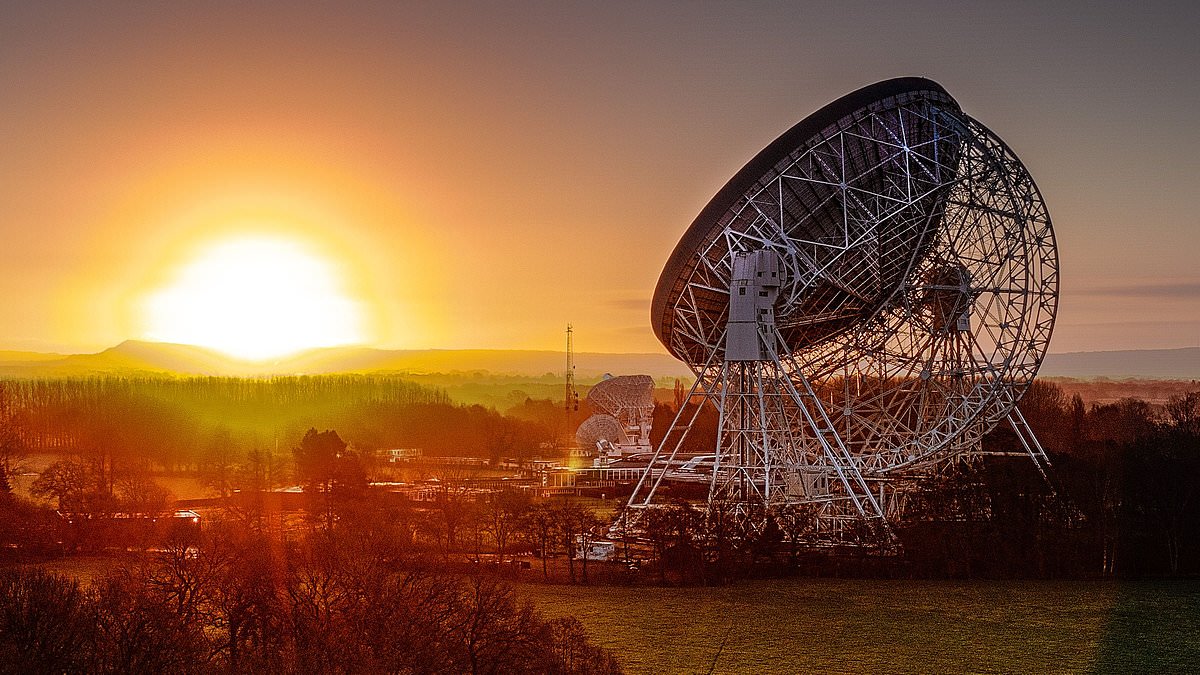
Get your news delivered straight to you by 7am - sign up to our new Morning Mail newsletter for FREESee more Daily Mail on Google - save us as a Preferred Source Published: 09:18 EDT, 27 July 2026 | Updated: 09:37 EDT, 27 July 2026 The UK's largest telescope could be forced to close due to spending cuts, it has been revealed.The UNESCO World Heritage-listed Jodrell Bank Observatory, home to the famous Lovell telescope, has lost its funding and is now peering down the barrel of insolvency.Scientists have cried out against the decision, which could see the observatory close after 81 years, calling it 'heartbreaking' and 'scientifically misguided'.Observations at the site, located near Macclesfield, Cheshire, will end on April 1, 2028, unless funding can be found to stop the closure.The UK Research and Innovation agency (UKRI), the funding body behind the observatory, said it had to prioritise investment on projects that deliver 'the greatest long term impact'. Closing the site jeopardises 28 jobs but could affect almost 3,000 scientists who use the observatory as part of their research.Founded in 1945, Jodrell Bank pioneered the study of galaxies through radio astronomy. The site was used during the Cold War to monitor Soviet missiles as nuclear tensions between Nato powers and the USSR reached their peak. The Lovell telescope at Jodrell Bank observatory in Macclesfield, Cheshire, is at risk of closing The observatory's £2.8million budget was cut for the site by the UK Research and Innovation agency Observations at the site could end on April 1, 2028, jeopardising 28 jobs and impacting around 3,000 scientistsNow the UKRI, which has an annual budget just shy of £10billion, said it had to cut the site's £2.8million budget due to rising research and running costs, the BBC reported.Professor Michele Dougherty, executive chair of the science and technology branch of UKRI said that funding cuts 'are never easy choices'. 'After listening to our community we have protected core discovery research,' she told the BBC.'However, the situation does require some tough, but necessary, decisions.'These are never easy choices, but we have made what we feel are the right decisions to bring... a sustainable financial position by 2029/30.'The announcement comes amid a wider 2.7 per cent cut over the next four years to astronomy, nuclear and particle physics research.There will also be a 20 per cent cut to the UK's participation in the Vera Rubin Telescope in Chile, which is helping make the first film of the universe – a project set up in the last year.UK funding used to help build the Extremely Large Telescope in Chile, which will search other Earth-like worlds for signs of life is yet another cut announced by the UKRI.Over the years, the Lovell telescope has received continuous upgrades, keeping it at the forefront of astronomical research.The third largest telescope in the world was further bolstered when it was connected to six other telescopes in England, as part of the e-Merlin network.Working in the network allowed the Lovell telescope to observe objects deep in space with a similar resolution to that of the Hubble space telescope.
Iconic UK space attraction and UNESCO World Heritage site could be forced to close due to cuts
Full Article
Original Source
Read the full article at Dailymail →KhanList aggregates and links to publicly available news content. We do not host full articles from third-party sources. Always verify important information with original sources.