
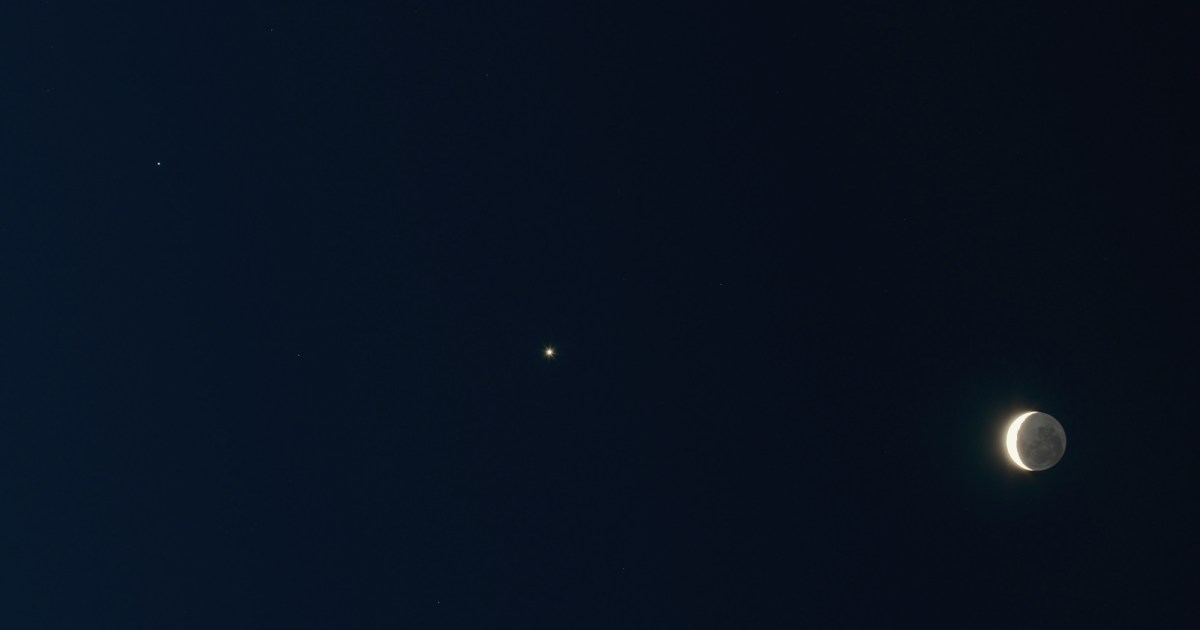
This meeting of Spica (upper left), Venus (middle), and the Moon occurred in September 2013. This week brings a similar sight. Credit: Ben (Flickr, CC BY-ND 4.0) Friday, November 6The waning Moon leaves us with perfect skies for deep-sky observing. Let’s kick off the week with a bright planetary nebula in Aquarius: NGC 7293, commonly known as the Helix Nebula. Despite its impressive magnitude of 7.3, the Helix presents a challenge: It is a broad 13’ across, which spreads its light over a relatively large part of sky, lowering its overall surface brightness. That said, you can still find the Helix in large binoculars or any small scope, tucked into southeastern Aquarius, roughly 7.7° southwest of magnitude 3.3 Skat (Delta [δ] Aquarii). If you turn south around 7 P.M. local time, find Skat to the upper right of bright Fomalhaut in Piscis Austrinus, then scan to its lower right, toward 5th-magnitude 66 Aqr. That star lies about halfway between Skat and the Helix Nebula. Once you’ve located the Helix, the more magnification you can turn on it, the better. Larger amateur scopes will start to show structure in the ring of glowing gas surrounding the central white dwarf, with the northern and southern edges glowing brighter than the eastern and western sides. That gas was once part of the central star, which puffed up and blew away its outer layers as it aged. Sunrise: 6:35 A.M. Sunset: 4:52 P.M. Moonrise: 3:56 A.M. Moonset: 3:16 P.M. Moon Phase: Waning crescent (5%) Saturday, November 7Venus is our (morning) star of the week, capturing attention above the eastern horizon before sunrise. This morning, the Moon passes 1.1° due south of Earth’s sister planet at 7 A.M. EST. You can easily catch the pair an hour before sunrise, some 6° high in the east and climbing as the sky begins to brighten. Magnitude –4.5 Venus blazes to the upper left of the delicate crescent Moon, whose western limb is just barely lit as the Sun sets across the lunar nearside. Look for earthshine on the already-shadowed portion of Luna’s face, as sunlight bouncing off Earth lights it up. Near Venus is another bright light: This is Spica, Virgo’s alpha star, shining at magnitude 1.0 and also lingering in the morning twilight. This morning it lies 1.3° northeast of Venus, with the planet and star roughly side by side above the horizon. Use this view as an anchor point: By the 10th, Venus will have moved to stand due west of this star and will be located to its upper right. Sunrise: 6:36 A.M. Sunset: 4:51 P.M. Moonrise: 5:01 A.M. Moonset: 3:40 P.M. Moon Phase: Waning crescent (1%) Io and Callisto are transiting Jupiter early on Nov. 8, with Io’s shadow visible on the cloud tops. Although Io’s transit begins after Callisto’s, the former will catch up with and overtake the latter by 3:30 a.m. EST. Credit: Astronomy: Roen Kelly Sunday, November 8Rising with the stars of western Leo shortly before midnight, bright Jupiter and its Galilean moons put on a show early this morning, better visible the farther east you’re located. Jupiter is just under 5° northwest (to the upper right) of Regulus as they rise in the east. Fainter Mars stands roughly 3° above Jupiter. You’ll want your telescope trained on the gas giant soon after rising to catch the show, which begins at 1:29 A.M. EST as a shadow appears on the planet’s eastern limb. This is Io’s shadow — but don’t be fooled by the positions of the moons you see in your scope. The moon closest to Jupiter on the east is Callisto, while the moon just east of that is Io, whose shadow we see. Ganymede lies farthest east, while Europa is currently hidden behind the planet in an occultation. The latter appears from behind the eastern limb about 1:54 A.M. EST, not long before Callisto reaches the planet and begins a transit at 2:07 A.M. EST. Keep an eye on Io and Europa: Io passes north of Europa at 2:23 A.M. EST, then heads into its own transit about 2:42 A.M. EST. Now the race is on, as Io approaches and then catches up with Callisto as the two moons transit, passing Callisto and moving west of it within half an hour. The two moons and Io’s shadow continue to transit until 3:45 A.M. EST, when Io’s shadow leaves the western limb, and Io takes about an hour and a quarter longer before egress. Callisto continues trundling along, finally finishing its transit about 5:51 A.M. CST, with the sky now starting to brighten with twilight in the Midwest. Sunrise: 6:37 A.M. Sunset: 4:50 P.M. Moonrise: 6:07 A.M. Moonset: 4:08 P.M. Moon Phase: New Comet Hartley-IRAS is crossing an extremely crowded portion of the sky, but its green glow should give it away in astrophotos. Credit: Astronomy: Roen Kelly Monday, November 9New Moon occurs at 2:02 A.M. EST. Dark skies make tonight the perfect opportunity to try spotting Comet 161P/Hartley-IRAS, still nearly 50° above the western horizon two hours after sunset. Glowing around 10th magnitude, the comet is currently located in far northern Aquila, near the Eagle’s border with Sagitta the Arrow. You can use Aquila’s bright luminary, Altair, to guide your way — the comet floats 7.7° north-northeast of this star. A closer but fainter guide is 4th-magnitude Alpha (α) Sagittae, just 2.3° north of the comet’s position tonight. Even a small scope will nab you the comet, but larger apertures will yield better views. Under high magnification, look at the comet’s southern side, which should be sharper as it plows into the solar wind. Not far from Hartley-IRAS’ position is the famous Coathanger asterism, located in Vulpecula the Fox. Cataloged as Collinder 399, you’ll find it roughly 5° northwest of the comet’s position, or about 4° northwest of Alpha Sge. Visible in binoculars or any telescope (in this case, lower magnification is better), you’ll immediately see why this star pattern bears its name. It looks exactly like its namesake, with a line of stars bisected by a small curve extending to the south. At the Coathanger’s eastern edge lies the open cluster NGC 6802. Sunrise: 6:38 A.M. Sunset: 4:49 P.M. Moonrise: 7:12 A.M. Moonset: 4:40 P.M. Moon Phase: Waxing crescent (1%) Tuesday, November 10The waxing crescent Moon passes 0.3° south of Antares at midnight EST, although the pair is not visible at that time. You can catch our satellite setting in the west around sunset, although it will likely disappear before Antares pops out of the twilight — that will likely happen only shortly before the star itself sets as well. Instead, challenge yourself with a different type of observation: picking up Saturn’s moon Iapetus, which tonight reaches greatest eastern elongation 9.4’ east of the ringed planet. The two-toned moon is tidally locked to its parent world, which means it rotates in time with its orbit. At eastern elongation, Iapetus’ darker hemisphere faces earthward, reducing the moon’s magnitude to nearly 12. This, combined with its distance from Saturn, makes it more of a challenge to find, but you can give it a try if you’ve got a larger scope. Try around 9 P.M. local time when Saturn is highest, some 50° above the southern horizon. It’s the brightest point of light in this region of the sky, hanging just below Pisces and to the far upper left of Fomalhaut, the brightest star in Piscis Austrinus (much closer to the horizon). Even if you can’t locate Iapetus or don’t have a large scope, Saturn is magnificent through a telescope. Its disk spans 19” and its rings are roughly 43” across, showing off their southern side. You should definitely spot its largest and brightest moon, mid-8th-magnitude Titan, just over 2’ west of the planet. Depending on your scope and when you look, you may also spot at least three other moons: 10th-magnitude Tethys, Dione, and Rhea, closer to the planet. Tethys lies to Saturn’s west, while Rhea and Dione are to the east. Sunrise: 6:39 A.M. Sunset: 4:48 P.M. Moonrise: 8:15 A.M. Moonset: 5:19 P.M. Moon Phase: Waxing crescent (4%) Venus and Spica stand close in the predawn sky all week; on November 11, Venus also comes to a halt, reversing course from westward to eastward motion. Mercury may just be visible above the horizon for a short time before sunrise as well. Credit: Stellarium Wednesday, November 11Venus reaches a stationary point among the stars of Virgo at 10 A.M. EST. This brings its retrograde (westward) motion to an end; after today, Venus will begin moving eastward or prograde through the sky, swinging north of Spica. You can easily catch the bright planet in the eastern sky before dawn. Venus’ brightness has increased over just the past few days, and it now blazes at magnitude –4.7. An hour before sunrise, you’ll easily spot it alongside Spica, standing just to the star’s upper right. Both are 10° high and rising as dawn approaches. Check out Venus through a telescope: its disk shows off a crescent phase just 10% lit, but stretches an impressive 53” in the sky. Also just becoming visible at this time is Mercury, barely 1.5° above the horizon and glowing at magnitude 1.2. See if you can locate it about 13° east (to the lower left) of Venus, although you’ll need a particularly flat horizon free of trees, buildings, and lights. Mercury, too, rises as twilight brightens, which may make the planet harder to see in the growing light. Try scanning for it with binoculars, although make sure to put them away well before sunrise from your location, which may differ from the time given below. Sunrise: 6:41 A.M. Sunset: 4:47 P.M. Moonrise: 9:15 A.M. Moonset: 6:05 P.M. Moon Phase: Waxing crescent (8%) Thursday, November 12The constellation Perseus is famous for its bright Double Cluster, but these two open clusters aren’t the only groups of young stars in the Hero worth viewing. Today, let’s shift our gaze to the western portion of this constellation, near its border with Andromeda, to check out M34, a mid-5th-magnitude open cluster containing about 100 stars. Sitting 5.2° west-northwest of 2nd-magnitude Algol (Beta [β] Persei), M34 spans about half a degree, roughly the size of the Full Moon. In physical space, astronomers believe the group spans about 14 light-years and sits 1,400 light-years away. It’s best seen under lower magnifications, such as in binoculars or small amateur scopes (4 inches or so). You’ll spot several dozen stars brighter than 12th magnitude, with its brightest suns spread throughout the cluster. Sunrise: 6:42 A.M. Sunset: 4:46 P.M. Moonrise: 10:08 A.M. Moonset: 6:57 P.M. Moon Phase: Waxing crescent (14%) Friday, November 13The Moon reaches apogee, the farthest point from Earth in its orbit, at 12:50 P.M. EST. At that time, our satellite will be 252,040 miles (405,619 kilometers) from Earth. Celebrate Friday the 13th with something spooky: a ghost in the constellation Andromeda. This evening, point your telescope toward 2nd-magnitude Mirach (Beta [β] Andromedae), already nearly 60° high in the east by 7 P.M. local time. One of the Princess’ brightest stars, Mirach is a cool, reddish M-type giant. It lies some 200 light-years away and shines nearly 2,000 times as brightly as our Sun. But Mirach is not quite our target — we’re looking for its so-called ghost, just 6.8’ northwest of the star. You’ll need a big scope to see it, but look carefully: Can you spot a faint smudge of light, about 4’ across, close to the star? This is the Ghost of Mirach, a far more distant elliptical galaxy glowing at 10th magnitude and cataloged as NGC 404. It lies some 8 million to 10 million light-years away, just beyond the gravitational bounds of our Local Group of galaxies. It’s called a ghost because it appears almost like a ghostly image of the bright star Mirach, which dominates the view. Sunrise: 6:43 A.M. Sunset: 4:45 P.M. Moonrise: 10:54 A.M. Moonset: 7:55 P.M. Moon Phase: Waxing crescent (21%) Alison Klesman is senior editor of Astronomy magazine. She holds a Ph.D. in astronomy and has studied a variety of topics, from minor planets to supermassive black holes.
The Sky This Week from November 6 to 13: Venus in the spotlight
Full Article
Original Source
Read the full article at Astronomy →KhanList aggregates and links to publicly available news content. We do not host full articles from third-party sources. Always verify important information with original sources.