
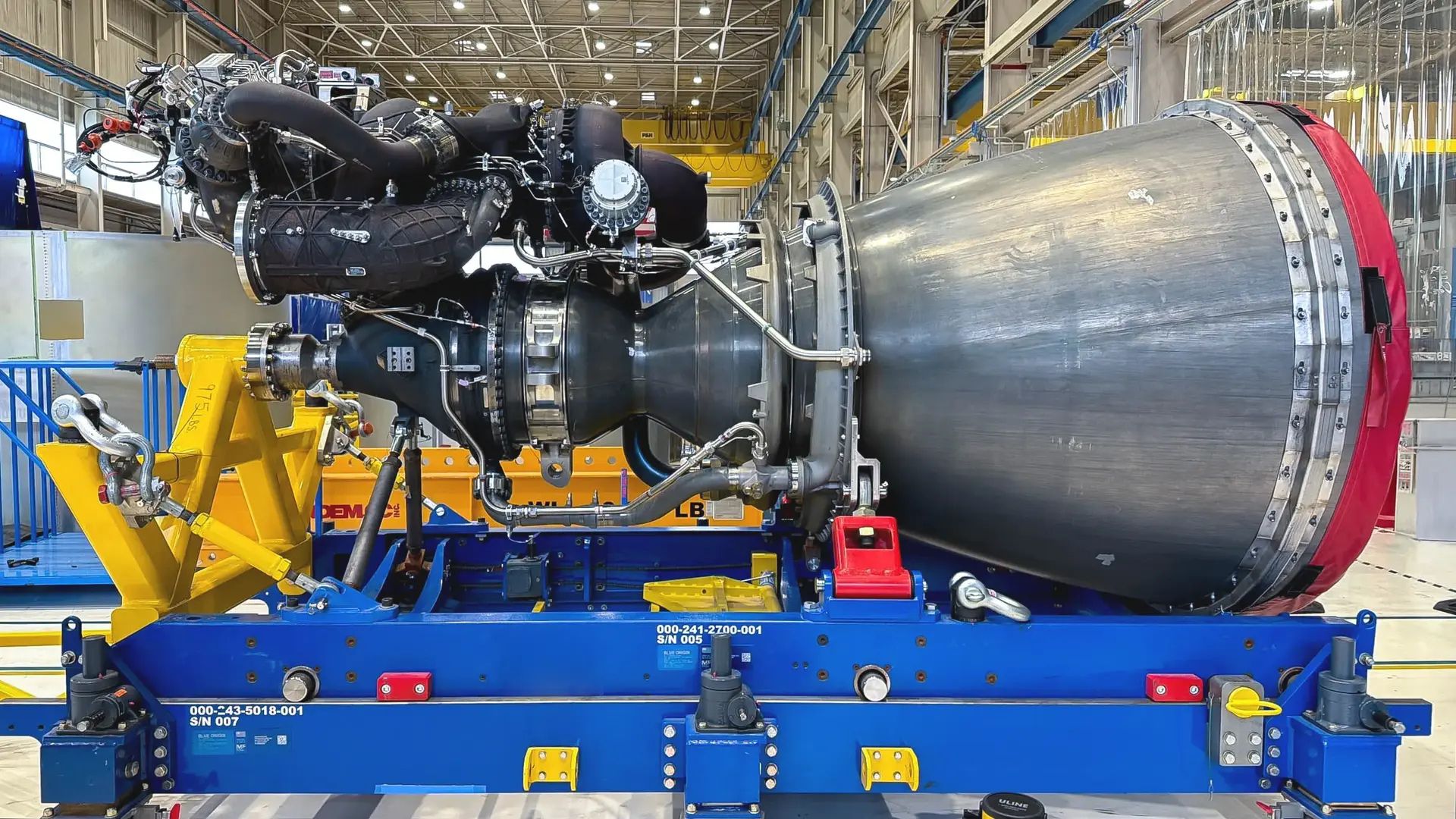
Blue Origin has developed a new rocket engine that delivers more thrust with significantly less hardware. Called Northstar, the liquid oxygen and liquefied natural gas-fueled booster engine produces 715,000 pounds-force of thrust. It also weighs 30% less than the company’s BE-4 engine, despite delivering greater power. The new engine marks Blue Origin’s second booster propulsion system. Its development also demonstrates how advanced manufacturing techniques can simplify rocket engine production. More than 65% of Northstar’s components use additive manufacturing, reducing the number of individual parts and assembly time. Northstar could strengthen Blue Origin’s propulsion portfolio as the company expands its launch capabilities. The announcement also included a major upgrade to its New Glenn rocket, which gains a new third stage for demanding orbital missions. Lighter and more powerful engine Northstar produces 715,000 pounds-force of thrust, compared with 640,000 pounds-force from the BE-4. That represents a substantial increase in output without adding unnecessary mass. Blue Origin says the new engine cuts overall mass by 30%. The engine also contains 50% fewer parts than its predecessor. Additive manufacturing accounts for more than 65% of its production. This approach allows engineers to consolidate components that traditionally require separate manufacturing and assembly processes. Production speed represents another significant improvement. Blue Origin says technicians can assemble Northstar in less than a day. The company has not disclosed its complete manufacturing process or the engine’s intended launch vehicle. Northstar retains several established elements of Blue Origin’s propulsion architecture. It burns liquefied natural gas and liquid oxygen through an oxygen-rich staged combustion cycle. A single-shaft turbopump handles propellant delivery. That combination connects the new engine with the company’s existing propulsion technology. However, its reduced component count and manufacturing requirements offer a different approach to producing large booster engines. Blue Origin accelerates development Northstar reached development testing just 11 months after receiving program approval. That timeline reflects a development process built around rapid design iterations and in-house manufacturing capabilities. The engine now joins the BE-4 in Blue Origin’s booster propulsion lineup. The company also develops engines for upper-stage and in-space applications, giving it several propulsion options across different mission profiles. The announcement did not specify Northstar’s first flight date or identify a launch vehicle for the engine. Those details will help clarify its eventual role in Blue Origin’s launch operations. New Glenn gains third stage Blue Origin also introduced GS3, a new third stage for its New Glenn rocket. The addition expands the vehicle’s ability to reach demanding orbital destinations without relying on additional spacecraft propulsion. GS3 supports direct insertion into geostationary orbit (GEO) and trans-lunar injection (TLI). Its performance varies with New Glenn’s configuration. The 9×4 vehicle can carry up to 14 metric tons to GEO and 20 metric tons to TLI. The 7×2 configuration supports up to 8 metric tons to GEO and 10 metric tons to TLI. These capabilities could serve commercial satellite operators and government customers. GS3 already has a contracted cislunar mission scheduled for 2028. The stage uses Blue Origin’s BE-7 engine, which delivers more than 460 seconds of vacuum-specific impulse on GS3 mission profiles. It also supports multiple burns and extended coast periods for complex orbital maneuvers. Blue Origin has completed an important structural test for the stage. Engineers pressurized its composite liquid hydrogen tank to 100% of maximum expected operating pressure for 2.5 hours. They subsequently reached 150% of that pressure for 10 minutes. Get the latest in engineering, tech, space & science - delivered daily to your inbox.Aamir is a seasoned tech journalist with experience at Exhibit Magazine, Republic World, and PR Newswire. With a deep love for all things tech and science, he has spent years decoding the latest innovations and exploring how they shape industries, lifestyles, and the future of humanity.
3D-printed Northstar booster engine packs 715,000 pounds of thrust, 30% lighter design
Full Article
Original Source
Read the full article at Interestingengineering →KhanList aggregates and links to publicly available news content. We do not host full articles from third-party sources. Always verify important information with original sources.