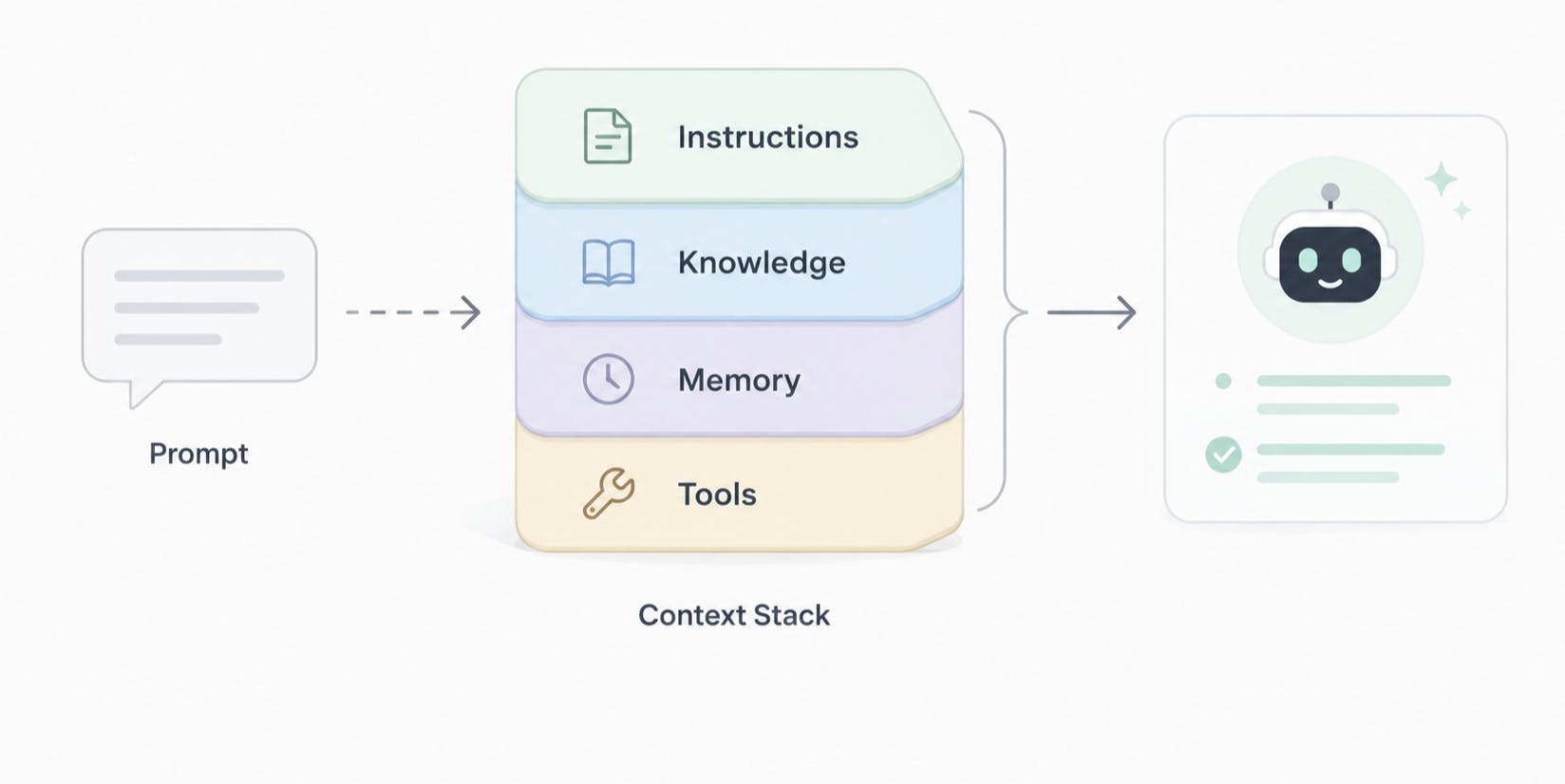
The magic was never in the wording of your question. It was in everything the AI could see when it answered.What "context" even meansWhen an AI answers you, it isn't reaching into some perfect well of truth. It's working with exactly what's in front of it at that moment — your question, plus whatever else has been placed in its view. That "whatever else" is the context. And it's doing more of the work than your prompt ever did.Think about asking a new coworker a question. If they just started today and know nothing about your company, even a perfectly worded question gets you a generic answer. Give that same coworker your docs, your past decisions, and access to the right systems, and suddenly they're brilliant — with the same question.The AI is the coworker. Prompt engineering was obsessing over how you phrase the question. Context engineering is making sure the coworker actually knows what they need to know before you ask.The model isn't guessing. It's answering the exact context you gave it — including the parts you forgot.The Context StackEverything you can put in front of an AI falls into four layers. Together they decide the answer far more than your wording does. I call it the Context Stack.LayerWhat it isWhat goes wrong without itInstructionsThe role, rules, and goal you setThe AI guesses what you meant and drifts off-taskKnowledgeThe facts, docs, and data it can seeIt makes things up to fill the gapMemoryWhat it remembers from earlierIt forgets what you said two messages agoToolsThe systems it's allowed to useIt answers from stale guesses instead of checkingAlmost every disappointing AI moment is one of these four layers being empty. The AI "lied"? It had no Knowledge, so it filled the hole. It "forgot" your name? No Memory. It gave a confidently outdated answer? No Tools to go look. It ignored your instructions? They were buried under everything else. Context engineering is just the practice of filling those four layers on purpose instead of hoping. It's less like writing a clever sentence and more like setting a desk before someone sits down to work.Why the wording stopped matteringHere's the part that surprises people. As models got smarter, they got better at understanding messy questions. You no longer need the magic words. A plain, slightly clumsy question works fine — if the context is right.But models did not get better at reading your mind about things they can't see. A newer, smarter model still can't tell you your company's refund policy if you never showed it the policy. It can't remember a decision from last week if nothing stored it. The smarter the model, the more the bottleneck moves away from how you ask and toward what you gave it to work with.That's why prompt tricks quietly stopped working and nobody announced it. The models simply outgrew the need for them. What they can't outgrow is missing information."Did my prompt skills just become worthless?"If you spent a year getting good at prompting, this can feel like the ground moved. It didn't — you just learned the small version of a bigger skill.Writing a clear instruction is still one of the four layers. You didn't waste that time; you learned to write the Instructions layer well. Context engineering doesn't throw that away. It surrounds it with the other three — knowledge, memory, tools — that you probably weren't thinking about.And the bigger skill is far more durable. Prompt tricks were tied to the quirks of a specific model and broke with the next release. Knowing how to assemble the right context is model-proof. It works on today's AI and it'll work on next year's, because "give it what it needs to answer" is never going out of style.A great prompt asks a good question. Great context makes sure the answer can even exist.That's the upgrade. You're not losing a skill. You're getting promoted from phrasing questions to designing what the AI knows — which is a much better job to have as the models keep getting smarter.How to start, todayYou don't need tools or a framework to practice this. Next time an AI gives you a weak answer, don't reword the question. Ask which layer was empty.Was it missing Instructions — did it not know the goal or the rules? Paste them in. Was it missing Knowledge — did it not have the doc, the data, the example? Give it. Was it missing Memory — did it lose the thread? Remind it. Was it missing Tools — did it need to look something up it couldn't reach? Get it access, or fetch it yourself and hand it over.Do that a few times and you'll stop blaming the AI for being dumb and start noticing it was working blind. That noticing is the skill.The takeawayPrompt engineering told you the magic was in the wording. It wasn't. The magic was always in what the AI could see when it answered — its instructions, its knowledge, its memory, and its tools.Fill those four layers on purpose and an ordinary model feels brilliant. Leave them empty and the smartest model on earth still guesses.Stop polishing the question. Start building the context. That's the skill that lasts. Cheers.
The Skill That Separates Weak AI Answers From Great Ones
Full Article
Original Source
Read the full article at Hackernoon →KhanList aggregates and links to publicly available news content. We do not host full articles from third-party sources. Always verify important information with original sources.