
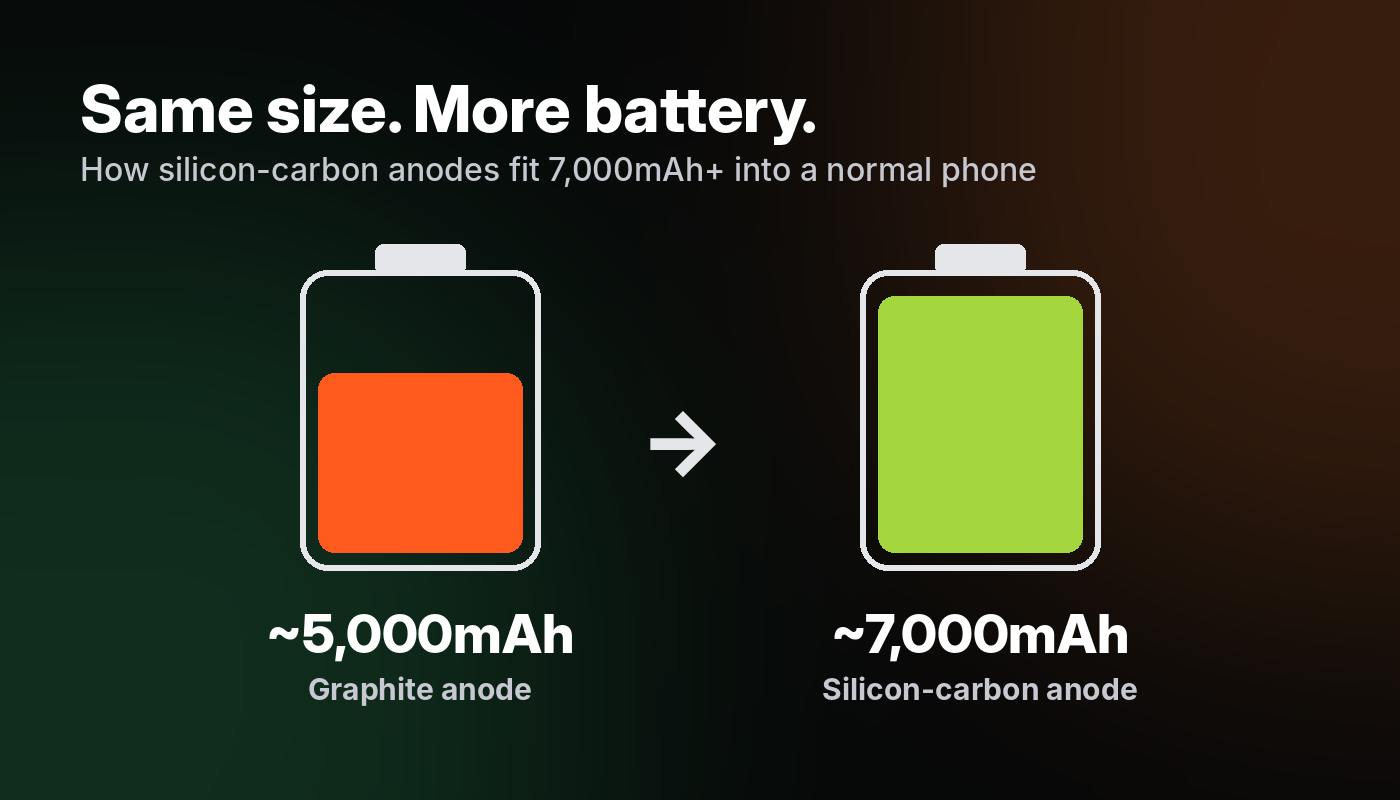
For almost five years, phone batteries were stuck. Flagships from Apple, Samsung, and Google hovered around 4,500 to 5,000mAh, and "two-day battery life" was something only chunky gaming phones could promise. Then, in about 18 months, everything changed. The OnePlus 15 ships with 7,300mAh. Tecno has put 8,000mAh into a phone that is 7.42mm thick. Honor sells a phone with a 10,000mAh battery that is 8.3mm thick. None of this came from making phones bigger. It came from changing one material inside the battery. Here is what silicon-carbon batteries are, why they work, what they cost you, and why the iPhone and Galaxy in your pocket probably still don't have one. What changed inside the battery Every lithium-ion battery has two electrodes. When you charge your phone, lithium ions move from the cathode into the anode and are stored there. When you use your phone, they move back, and that flow powers the device. For decades, the anode has been made of graphite. Graphite is cheap, stable, and predictable, but it has a hard limit: it can hold one lithium ion for every six carbon atoms. Once the industry had squeezed out almost all the efficiency it could from graphite, the only way to add capacity was to make the battery physically bigger. Silicon changes the maths. Per gram, silicon can in theory store 4 to 10 times as much lithium as graphite, according to LG Energy Solution. Even a small amount of silicon in the anode raises how much energy fits in the same space. That is what a "silicon-carbon" battery is: a normal lithium-ion battery whose anode mixes silicon into a carbon structure instead of using graphite alone. The cathode, the electrolyte, and the way you charge it stay basically the same. Why not just use pure silicon? Because silicon swells. When it absorbs lithium, it can expand to several times its original volume: by up to 300% when fully charged, according to Android Authority. A phone battery that grew like that would crack its own electrodes within a few charges, and it would push against the screen and the back of the phone. Manufacturers manage this in three main ways: Small amounts of silicon. LG Energy Solution says its first silicon anode for EV batteries, in 2019, used about 5% silicon. OnePlus says the "Silicon NanoStack" battery in the OnePlus 15 uses up to 15%. The rest is still carbon. Nano-sized particles. Very small silicon particles crack less when they expand than large ones. A carbon "cage". The silicon is embedded in a carbon matrix that gives it room to swell and spreads out the mechanical stress. The result is a battery that is denser than graphite but still behaves well enough to survive years of daily charging. How much difference does it make? Estimates vary: Android Authority puts the gain at roughly 10 to 20% more capacity in the same space, while How-To Geek cites 20 to 50%. In practice, that is roughly the difference between a 5,500mAh battery and a 7,000mAh battery without making the phone any thicker. Phone makers have spent that extra capacity in two ways: Bigger batteries in normal-size phones. This is the OnePlus 15 approach: a regular flagship body with a much larger battery inside. Thinner phones with normal batteries. Foldables benefit the most. A book-style foldable is two thin phones joined by a hinge, so every millimetre matters. Some brands have pushed the first approach to the extreme. Honor's 10,000mAh phone and Tecno's 7.42mm, 8,000mAh phone would have been impossible with graphite anodes a few years ago. The trade-offs nobody puts on the box Silicon-carbon batteries are a real improvement, but they are not free. They may wear faster. Even with all the engineering above, silicon still expands and contracts on every charge. Over hundreds of cycles, that stress adds up. A battery engineer interviewed on the Waveform podcast said these batteries tend to lose more capacity in their first two to three years than conventional cells, according to 9to5Google. Brands make strong claims of their own: OnePlus, for example, says the OnePlus 15 battery keeps 80% of its capacity after four years, based on its own simulated tests. Independent long-term data is still limited, because most of these phones are less than two years old. Some capacity may be held back. To slow wear, makers can limit how much of the battery is used. Nothing is a clear example: the Nothing Phone (3) has a silicon-carbon cell with a physical capacity of 5,500mAh, but outside India it is sold as a 5,150mAh phone, according to 9to5Google. They are harder to make at scale. Silicon anodes rely on complex nanotechnology processes that currently cost more than making graphite, according to How-To Geek. So, why doesn't my iPhone or Galaxy have one? This is the part that surprises most people. The biggest obstacle is not chemistry. It is shipping rules. International transport regulations treat lithium-ion batteries as dangerous goods. Under UN Special Provision 188, which air, sea and road regulators (including the US rules in 49 CFR) all follow, a cell of up to 20 watt-hours can ship under simplified rules. Above that, the device needs dangerous-goods handling, labelling and paperwork. At a typical 3.8 volts, 20Wh works out to roughly 5,300mAh. Look at Western flagships with that number in mind. The Galaxy S25 Ultra's 5,000mAh battery is about 19.4Wh, and the Pixel 9 Pro's 5,060mAh battery is about 19.7Wh, according to 9to5Google. They sit just under the line. There are two ways around the limit: Split the battery into two cells. The rule applies per cell, so two 3,000mAh cells can ship where one 6,000mAh cell cannot. Some Chinese brands already use dual-cell designs. It needs extra circuitry and costs more. Sell different batteries in different markets. Phones made and sold inside China face fewer of these international shipping hurdles. That is why the same model often has a bigger battery in China than in Europe or the US. Android Authority found the Xiaomi 15 Ultra ships with 6,000mAh in China but 5,410mAh globally, and the HONOR Magic 7 Pro with 5,850mAh in China but 5,270mAh in Europe. Apple, Samsung and Google ship hundreds of millions of phones, mostly through global supply chains. For them, a battery that changes their shipping status or needs a two-cell design is a big logistics and cost decision. Samsung also has a long memory: after the Galaxy Note 7 battery recall in 2016, it has tended to adopt new battery technology slowly and carefully. Samsung is rumored to be testing a dual-cell battery design, but so far the big brands have chosen proven graphite cells and longer software support over headline capacity. What this means if you are buying a phone A bigger number is still better, within reason. A 7,000mAh silicon-carbon phone will usually last noticeably longer per charge than a 5,000mAh graphite phone. Battery life still depends on the chip, screen, and software, so check reviews, not just the spec sheet. Look at the warranty and the cycle claim. If a brand says its battery keeps 80% capacity after a certain number of cycles, that is a useful promise. Check how long the battery warranty is in your country. Use the charging limit if your phone has one. Many phones let you stop charging at 80% or 85%. That reduces stress on any lithium battery, and it is especially sensible with silicon-rich anodes. Expect regional differences. If you see two very different battery sizes for the same phone, the difference is often shipping rules, not a different phone. Where this is heading Silicon-carbon is not the end point. Battery makers are steadily increasing the share of silicon in anodes, and brands are already testing 10,000mAh cells in normal-size phones. The open questions are the same ones that held the big brands back: how these batteries age over four or five years, how they handle heat during fast charging, and whether shipping rules will change. For now, the result is simple. If you want the longest battery life in a normal-size phone, the brands using silicon-carbon cells are ahead, and the gap is the biggest it has been in years.
The Silicon-Carbon Battery Breakthrough Behind 7,000mAh Smartphones
Full Article
Original Source
Read the full article at Hackernoon →KhanList aggregates and links to publicly available news content. We do not host full articles from third-party sources. Always verify important information with original sources.