
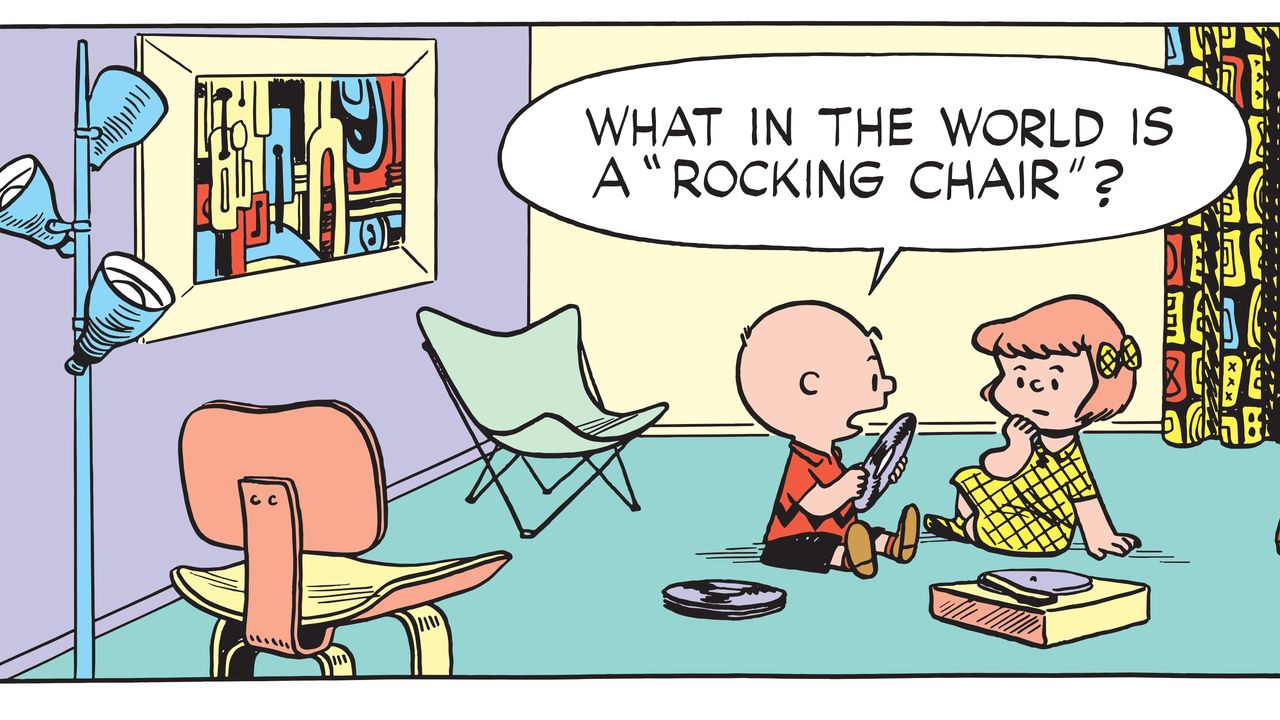
Peanuts has always had style. “Snoopy in Style,” a new pop-up exhibition opening this week in New York City’s Meatpacking district, spotlights the enduring influence of the comic strip on fashion and pop culture, showcasing archival material from the Charles M. Schulz Museum alongside Peanuts-inspired creations by Adidas, Bode, Sandy Liang, Tanner Fletcher, and Tory Burch.The Peanuts gang inhabited a neighborhood of gable-roofed ranch houses. © Peanuts Worldwide LLCLinus, Charlie Brown, and a midcentury-style executive desk © Peanuts Worldwide LLCBut fashion and pop culture are only part of the story: The strip’s backdrop tells its own, one that traces decades of American interiors and architecture, from the furniture that fills Charlie Brown’s living room to the neighborhood the Peanuts gang calls home. Peanuts creator Charles M. Schulz drew readers into his characters’ physical world with the smallest details—a window, a bed of plants, a paved path. "He could get away with using a visual shorthand," says Benjamin L. Clark, curator of the Charles M. Schulz Museum. "Your brain knows exactly what it is."A classic 1950s fireplace with a natural stone wall surround © Peanuts Worldwide LLCIf The Jetsons shouted midcentury modernism, Peanuts conveyed it subtly. "This minimalist approach allowed the focus to remain on character development, dialogue, and the central jokes," says Clark. Within these simple, unfussy settings, Charlie Brown let out his exasperated sighs, Snoopy dozed atop his doghouse, and Lucy made overtures to Beethoven-obsessed Schroeder.The bubble Schulz created for his characters echoed the neighborhood of the artist’s upbringing in St. Paul, Minnesota, and later on, his postwar tract home in Colorado Springs. The houses stayed consistently ranch-style with gabled roofs, allowing for only slight variation over the decades. In many ways, Peanuts could have been set in any neighborhood in any suburb across America, and that, say Peanuts scholars, was the point. To the average American in the 1950s and '60s, this typology was not only familiar, it matched their own reality, and, as Clark notes, “projected normalcy.” These backdrops provided a neutral canvas for Schulz's characters as they got in and out of trouble, squabbled, and dispensed advice, however dubious, from Lucy's psychiatry booth.A 1953 Peanuts strip depicted an Eames chair, a Butterfly chair, a Barwa chaise and an abstract painting. © Peanuts Worldwide LLCWhile the ranch-style house stayed fixed, the furniture inside didn’t, tracking interior design trends across the decades. When the strip debuted in the early 1950s, midcentury manufacturers Herman Miller and Knoll were dominant. In one widely republished strip from 1953, Schulz outfitted the living room with a trio of midcentury icons: the Eames LCW, the Butterfly chair, and the Barwa lounge chair. Elsewhere in the strip, a Noguchi-like, kidney-shaped coffee table anchors a room across from a hairpin-leg side table topped with a lamp with a playful, jigsaw-patterned shade.A reference to abstract sculpture in a 1953 strip © Peanuts Worldwide LLCIn other early Peanuts strips, Schulz depicted Saarinen-style Womb chairs, executive desks, and walls hung with abstract art. “It's interesting to see an Eames chair through the lens of Schulz and how he translated those forms into a really very human kind of thing—there's a warmth there,” says Matt Murphy, the exhibition designer for Snoopy in Style.A 1955 strip featuring a very of-the-era table lamp © Peanuts Worldwide LLCThe Peanuts living rooms, in particular, were more than a backdrop for the gang's plotlines; they kept pace with changing tastes. Bold, geometric-patterned curtains and upholstery from the 1950s gave way to Laura Ashley–style floral chintz in the 1980s, then to more eclectic, pattern-driven prints by the 1990s.In a 1989 strip, Charlie Brown and Sally's home featured a floral-print armchair © Peanuts Worldwide LLCOther spaces in the home, such as the kitchen, are more plainly depicted, but still reflected the popular styles of the times. In one strip from 1958, flat-front cupboards reflect the streamlined aesthetic of the decade.Linus in a classic midcentury kitchen in a 1958 strip © Peanuts Worldwide LLCIn a kitchen scene from 1982, Charlie Brown stands on a turned-leg stool over what appears to be a kitchen island, which became increasingly popular in the ’80s.A 1982 strip depicted a kitchen island, a feature newly popular in 1980s suburbia. © Peanuts Worldwide LLCA keen observer, Schulz recorded his surroundings, rather than imposing a point of view. His ability to portray curtains, lamps, chairs, and art stemmed from a habit of mentally “drawing” everything he saw in real life before putting it on paper, notes Clark. “He talked about how, if he saw interesting curtains anywhere he was, he was drawing in his mind the entire time,” he says. “He saw those curtains somewhere, and in his brain he's like, ‘Oh, those are interesting curtains, and I'm drawing them.’”Over the course of its five-decade run, Peanuts absorbed the American way of life and played it back in a package that made audiences laugh but also feel seen. As Snoopy himself once put it, “Learn from yesterday. Live for today. Look to tomorrow. Rest this afternoon.”Snoopy and Woodstock © Peanuts Worldwide LLC“Snoopy in Style” is on view September 2 through September 26, at 25 Little West 12th St, New York, NY.
The Secret Design History of Peanuts
Full Article
Original Source
Read the full article at Architecturaldigest →KhanList aggregates and links to publicly available news content. We do not host full articles from third-party sources. Always verify important information with original sources.