
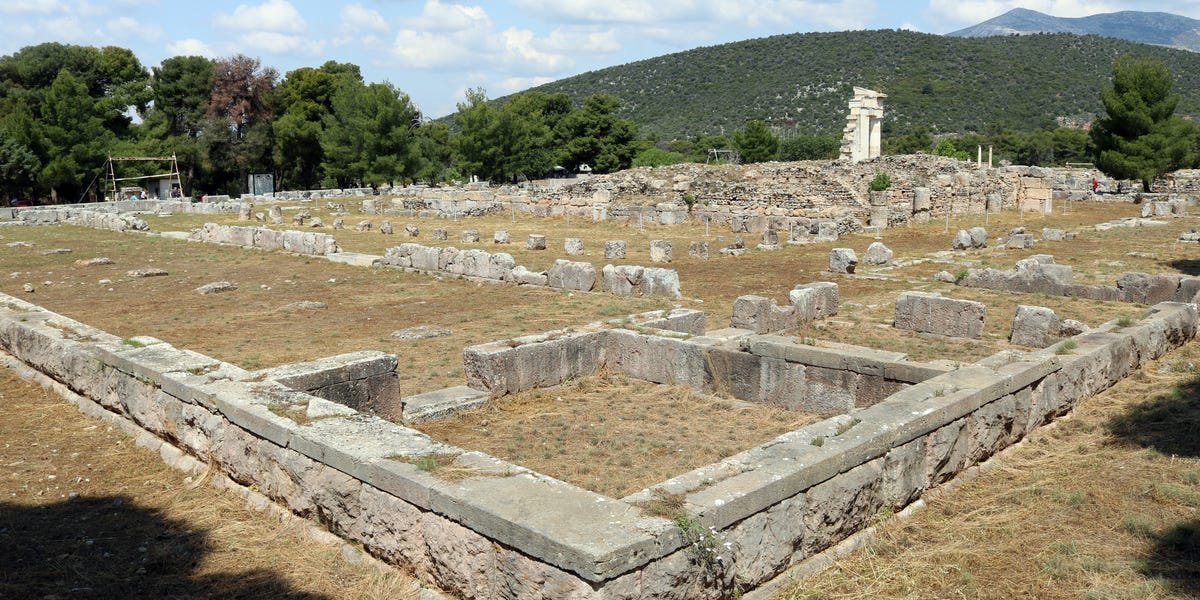
In the second century C.E., a traveler named Pausanias wrote about an open-air sacred precinct featuring statues of Asclepius—the Greek god of healing and the son of Apollo—and his wife, Epione, near the city center of Epidaurus. The only issue: Nobody knew the location. But now, a scholar at the University of Athens thinks there’s enough evidence to claim we’ve solved the 1,800-year-old mystery.Vassilis Lambrinoudakis of the Department of History and Archaeology of the National and Kapodistrian University of Athens pored over hundreds of years of research and concluded that a site in Epidaurus is the statue-filled spot Pausanias described.Excavations started in Epidaurus in the early 1900s, and since 1974, hundreds of student archaeologists have painstakingly excavated in and around the city. Lambrinoudakis collated the research, noting that not only has he likely found the mystery location, but that cult worship of Asclepius took place at the site for longer than we knew about.The oldest religious building in Epidaurus—dated to around 600 B.C.E.—features a structure with an underground chamber cut directly into the bedrock, likely part of early healing traditions. In Greek mythology, Asclepius took over his father Apollo’s role as a healer, and Epione was worshiped for her ability to help soothe pain. The ancient structure has a pebble-lined floor, walls coated in dark red plaster, and a circular basin built into the floor accessible by staircase. The bottoms of four amphorae are embedded in the bedrock floor. In the fourth century B.C.E., crews built a new circular building directly to the west, likely a “deliberate continuity of the same chthonic cult of Asclepius,” the university wrote in a translated statement.Nearby, the teams found a ground-level altar made of limestone blocks that they believe is older than both buildings. Lambrinoudakis said the combination of the finds shows the cult likely dates to the seventh century B.C.E.The structure served as a key gathering point in Epidaurus. Excavations revealed walls that created a processional route to and from the building, essentially an uncovered passageway for visitors. A large square in the center of the sanctuary features open space in front of the temple, a key functional element of the site.“It could accommodate the throngs of pilgrims who arrived at the site to take part in the sacrificial offering to Asclepius, which was accompanied by a festive procession,” the university wrote. To the east, an altar and platforms included seating for prominent families who watched the sacrificial rituals.Beneath Building K, excavators found an earlier structure from the early third century B.C.E. that sat on an unusually sturdy limestone foundation. The Roman building on top of it, which was rebuilt several times between the second and late fourth centuries C.E., has a central courtyard that probably had colonnades on at least three sides. The courtyard also has a gravel floor and a small basin made from reused marble pieces. In the building’s southwest corner, a large hall with a small basin or bath and a round room resembles spaces in other Epidaurus buildings that have been linked to the worship of Egyptian gods.In the northwest corner of Building K, on a lower level, sits an unusual, nearly intact crypt that opens to the north. Along its west side, reused column pieces from an unknown earlier building form a three-part niche, and gaps in the wall behind it let sunlight stream in at midday. “The overall character of ‘K’ suggests that it may have been the site of a mystical cult, particularly during the late Roman period,” the university said, adding they were unable to define who—or what—the cult worshipped.In the agora of ancient Epidaurus, just northwest of the city’s small theater, excavators had already uncovered a monumental fourth-century B.C.E. fountain complex. More recently, they found a large walled enclosure right next to it. Inside were small clay offerings that may once have hung from trees, a piece of a clay heating vessel, and a pottery fragment scratched with part of Asclepius’s name.At the center of the enclosure, a well fed an underground pointed-arch tunnel that carried water to the fountain. Because water was central to the worship of Asclepius, the university says the offerings, the well, and the fountain together identify the site as the long-lost town sanctuary Pausanias described. Excavators also found a larger-than-life marble statue of a woman in the enclosure. Lambrinoudakis thinks it may be the statue of Epione that Pausanias saw, but without an inscription, he can’t be sure.Tim Newcomb is a journalist based in the Pacific Northwest. He covers stadiums, sneakers, gear, infrastructure, and more for a variety of publications, including Popular Mechanics. His favorite interviews have included sit-downs with Roger Federer in Switzerland, Kobe Bryant in Los Angeles, and Tinker Hatfield in Portland.
The Sanctuary of a Healing God Was Lost for 1,800 Years. Archaeologists May Have Finally Found It.
Full Article
Original Source
Read the full article at Popularmechanics →KhanList aggregates and links to publicly available news content. We do not host full articles from third-party sources. Always verify important information with original sources.