
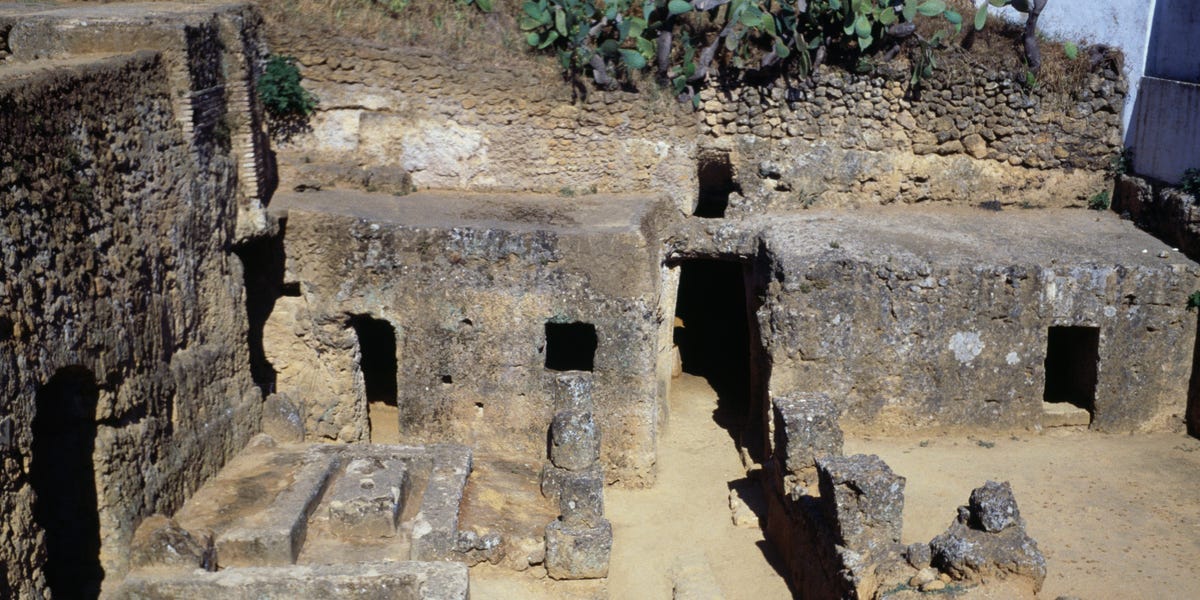
2 min readDigging under Calle Hilera, a busy street in Málaga, Spain, is bound to churn up remnants of the seaside city’s past. Officials just didn’t expect those remnants to be the literal remains of more than 1,000 people from the Roman era.During a project to extend the local metro line toward a future hospital site, crews exposed 984 burial complexes holding the remains of more than 1,000 people, according to the regional ministry of public works, as reported by Sur.The finds began piling up in the spring. When the discovery was first announced, the metro authority had uncovered 600 burials. Since then, the count has climbed past 1,000 individuals, and officials expect it to keep rising. So far, investigations have revealed a wide variety of burial types, but all of them date from the second to fourth centuries C.E., when the Romans were dominant along the Iberian Peninsula’s coastline.Although the crews found relatively few grave goods (mainly the expected pottery, coins, and a smattering of personal items), the necropolis, which stretches roughly 1,300 feet, has proven rich in other ways. Mario Muñoz-Atanet, the regional government’s public works delegate in Málaga, told Sur that the number of graves will likely grow as excavations continue.The burials include tile-lined tombs, table-style tombs, and a range of simple pits. In a few cases, newborns were buried inside amphorae. Many graves were also reused. “We are working on them one by one, tomb by tomb,” Muñoz-Atanet said. “One tomb of each type will be displayed in the future metro archaeology museum.”According to Muñoz-Atanet, plans for that museum are already underway, and finds from the metro excavations will form the centerpiece of its collection.The burial site also lies close to where the Nasrid Wall was discovered. That wall was built by the Nasrid dynasty, which ruled the last Islamic kingdom on the Iberian Peninsula from the 13th to the 15th centuries, long after the Roman-era burials. Experts believe that in the second century, the necropolis sat well outside the city but along a key coastal route leading out of the urban center. The site may even have been underwater in the centuries before it became a burial ground.The excavations have also turned up coins from many different places. According to Muñoz-Atanet, these coins help confirm Málaga’s history as a port that drew people from all over.That cosmopolitan past is no surprise. Málaga has passed through the hands of many rulers, and the modern city is built atop Phoenician, Roman, and Moorish settlements. Impressive historical finds are nothing new in the region. In 2005, for example, excavations at the Dolmen of Menga, a Neolithic monument in nearby Antequera that is now part of a UNESCO World Heritage Site, shed light on the site’s ritual uses. A recent study found that the monument was still in use as recently as 1,000 years ago, which may rewrite its history.If the past is any guide, Málaga’s next great discovery may be just one excavation away.Tim Newcomb is a journalist based in the Pacific Northwest. He covers stadiums, sneakers, gear, infrastructure, and more for a variety of publications, including Popular Mechanics. His favorite interviews have included sit-downs with Roger Federer in Switzerland, Kobe Bryant in Los Angeles, and Tinker Hatfield in Portland.
Subway Workers Dug Under a Busy Street and Found an Ancient City of the Dead
Full Article
Original Source
Read the full article at Popularmechanics →KhanList aggregates and links to publicly available news content. We do not host full articles from third-party sources. Always verify important information with original sources.