
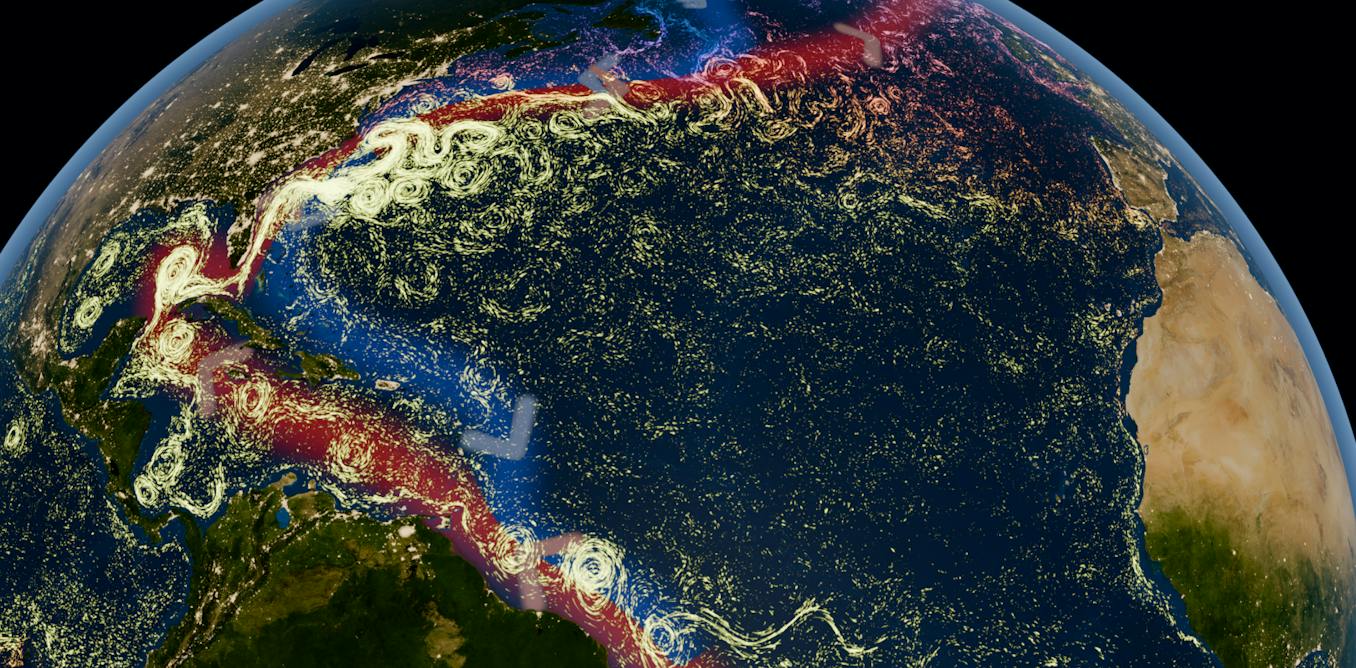
Icelandic government officials recently met to discuss a dramatic scenario: what if the current that circulates Atlantic waters weakened significantly, or collapsed altogether? The ocean currents are changing, with major implications for climate around the world. Yet our new research suggests most governments are not preparing for this possibility. Of 91 national adaptation plans submitted to the UN climate convention, only two even mention that key Atlantic current, and neither sets out concrete action in response to its possible collapse. The Atlantic Meridional Overturning Circulation, or Amoc, is part of the giant conveyor belt of ocean currents that moves warm surface water northward in the Atlantic and sends colder deep water back south. It plays a critical role in regulating the global climate by redistributing heat around the planet, influencing weather patterns and temperatures far beyond the Atlantic basin. As the climate warms, the Amoc is weakening, and could continue to do so throughout this century. While a full collapse, in which major ocean currents completely reorientate, is unlikely before 2100, a recent study projected a 50% weakening of the Amoc by the end of the century under an intermediate emissions scenario. A collapse would not be unique in geological history. Studies show that the Amoc has undergone dramatic changes before, including a near-complete shutdown around 17,500 years ago, after the coldest period in the last ice age. A slowdown or collapse would have major implications for temperature and rainfall around the world. In northern Europe, the loss of the heat Amoc transfers northwards from the tropics could lead to winter cold extremes of -20°C in London. Climate model experiments in which the Amoc is shut down show an average 29% weakening of the West African monsoons and 19% weakening of the Indian summer monsoon, increasing risks of food and water insecurity in regions that rely on monsoon rains. Other studies suggest an increased risk of severe drought in parts of Central America, West Africa and the Amazon region. Fisheries and sea level would also be affected. The Cliffs of Moher in Ireland, where the Atlantic meets Europe. Warm ocean currents keep north-west Europe relatively mild. tcacidima / shutterstock So how can countries prepare for changes in ocean circulation whose timing is highly uncertain? Our research identifies practical steps to incorporate Amoc-related risks into adaptation decision-making. Most investments assume only gradual change Of the 91 national adaptation plans reported to the UN climate convention so far, only two mention the Amoc. Brazil’s plan devotes a dedicated box to warning that its shutdown could push the Atlantic rain belt southwards, tipping the Amazon rainforest towards collapse. Ireland – which relies on the Amoc to sustain its mild climate – mentions that “reliance solely on adaptation may prove insufficient” in case of Amoc collapse, concluding that no national plan can prepare for such tipping points. Amoc is a particular challenge for adaptation. It represents a very high impact scenario whose likelihood is very difficult to quantify. And yet if the current were to collapse, some parts of the world could experience climate changes in the opposite direction to those they are preparing for, most notably colder winters in north-western Europe. This is important because many adaptation investments need to be robust to a wide range of potential changes to be effective. Consider a country planning to build a new reservoir to cope with more variable rainfall amounts under climate change. If instead the rainy season becomes shorter and there is less rain overall, the reservoir may seem like a bad investment. The effects of an Amoc slowdown would be felt across the world. Jongman & Hall (2026), Nature Sustainability Similarly, in countries that depend on monsoon rains, a weakening or collapse of the Amoc could mean even less rainfall than is projected under climate change. Along Atlantic coastlines, changes in sea level and ocean temperatures could affect how well coastal defences work. Changes in fish stocks could also threaten communities that depend on fishing. Many investments made now will remain in use for decades. Investments that perform well under moderate Amoc weakening but poorly if the current weakened much more could expose countries to major losses and damages, especially poorer countries with fewer resources to respond to surprises. Five ways to prepare for major Amoc weakening In our study, we outline five ways policymakers can start preparing now. 1. Identify the investments and countries most at risk. Countries that rely heavily on monsoon rainfall, fisheries, or have major investments along the Atlantic coast may be especially exposed, as are countries with limited ability to respond to surprises. 2. Stress-test key investments. This means using computer simulations with Amoc-collapse scenarios to check whether these investments would still achieve their intended purpose under very different conditions, such as changes in temperature, sea level or rainfall. 3. Favour flexible solutions. Choose investments that can be adapted or expanded as conditions change, such as infrastructure projects that are built in stages or are easily upgradeable, or wide diversity of water supply or coastal defence options. 4. Use Amoc monitoring to inform adaptation decisions. Sustained funding for ocean monitoring is needed to track changes in ocean circulation, but governments should also regularly reassess whether their adaptation investments remain effective as our knowledge of Atlantic currents evolves. 5. Reassess global climate projections. Explore the implications of major Amoc weakening or collapse for global climate projections, including estimates of future warming. The Amoc influences how much carbon the oceans absorb from the atmosphere, so changes in its circulation could affect both how countries adapt to climate changes and how much further warming they need to prepare for. These actions do not require predicting whether or when the Amoc will collapse, and should not take attention or resources away from responding to heatwaves, droughts, floods and other impacts of climate change that already happening. Efforts to rapidly cut greenhouse gas emissions remain crucial. What countries can do is start testing long-term investments against scenarios involving major Amoc weakening, helping to ensure that infrastructure, water supplies and other adaptations remain effective in all plausible futures.
The risk of Atlantic current collapse is missing from almost all national climate plans – new study
Full Article
Original Source
Read the full article at Theconversation →KhanList aggregates and links to publicly available news content. We do not host full articles from third-party sources. Always verify important information with original sources.