
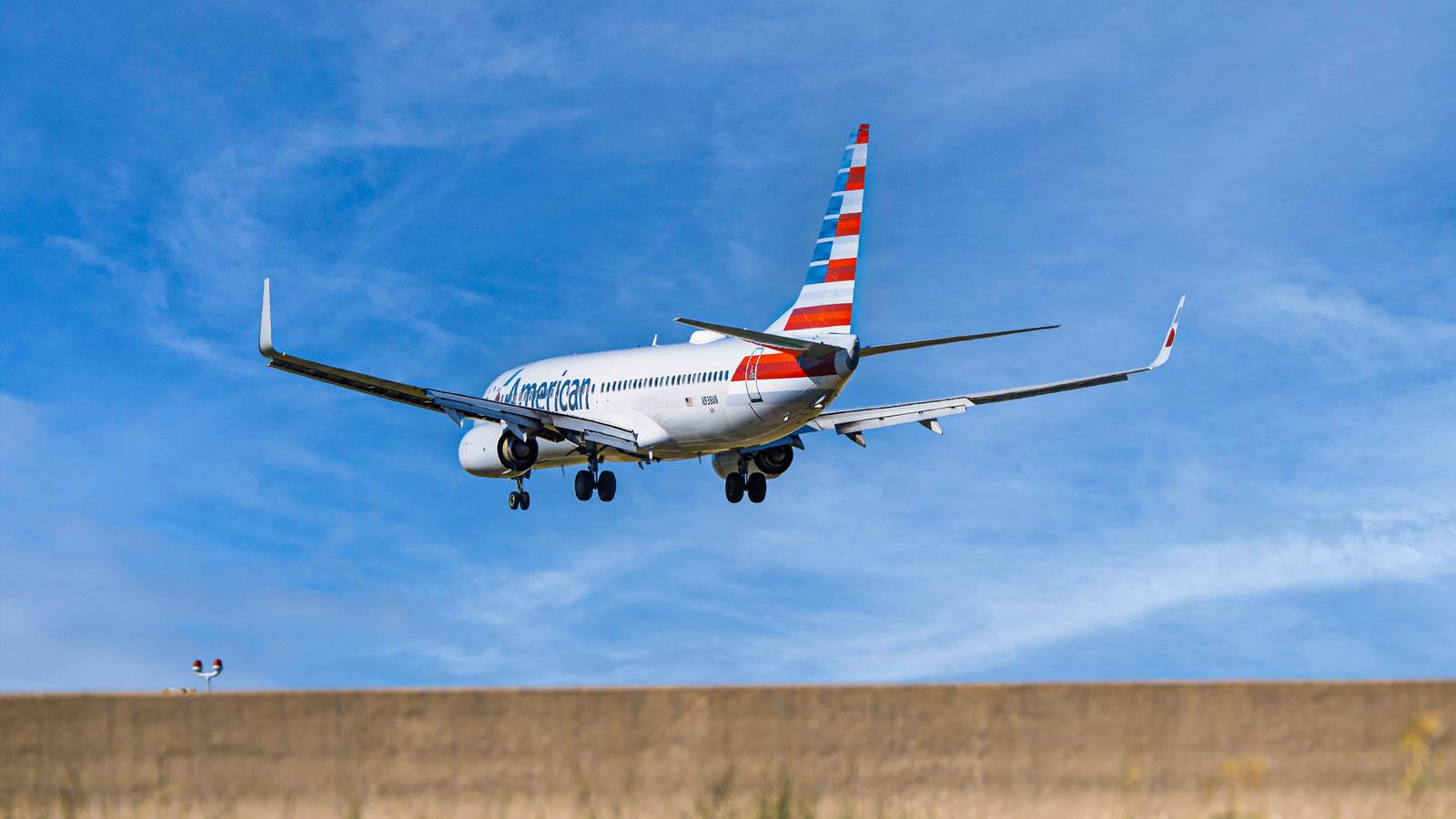
In 1958, Boeing debuted the 707, which was its first jet airliner, and the aircraft quickly became a huge success. Following the popularity of the large, long-range 707, the 727, a mid-size, mid-range aircraft, entered service in 1964. In 1968, the 737, which was an even smaller aircraft designed for short-haul routes, entered service. As all three were narrowbodies, they shared some common fuselage design elements, but were otherwise very different from one another given their different intended missions. One key difference between the three aircraft is their landing gear. The 707's main landing gear (MLG) design features four wheels, retracting in a gear bay covered by doors. The 727's MLG has two wheels, which are stowed in a covered gear bay in flight. The 737's MLG features two wheels, but uniquely, the sides of the tires are exposed in flight, as the 737 does not have large gear bay doors that fully cover the MLG. Interestingly, this isn't particularly unusual with narrowbody airliners. The Benefits Of Exposed MLG Bays Credit: kamilpetran I Shutterstock Boeing originally designed the 737 with exposed MLG back in the 1960s, and this design has persisted ever since because designing a new MLG for the 737 would be enormously complicated and expensive. In the 1960s, the 737 was expected to operate mainly to small, underdeveloped airfields, and this MLG design would simplify line maintenance at these outstations. Today, however, modern 737s are large mainline aircraft, and this is no longer a concern for most 737 operators. While the benefit of simplified maintenance at underdeveloped outstations is less of a prominent factor today, there are other benefits. Since the aircraft doesn't need a complex door mechanism, the MLG system is simpler, reducing costs. In addition, omitting an MLG gear bay door system reduces weight, lowering fuel burn. While this design is less aerodynamic, the 737 features rubber seals around the bottom of the wheel wells, smaller doors covering the gear struts, and hubcaps on the outer wheels. These design elements reduce the drag impact of the exposed gear bays, although they remain less aerodynamic and noisier than an MLG bay with doors. Still, the entire design is lighter and less complex than one with gear bay doors, which are strong benefits. On shorter flights, such as those that the 737 was originally intended to operate, the benefits of the exposed MLG can actually outweigh the drag penalty, which is why several other short-range aircraft have exposed gear bays. Boeing's Continuous Rejection Of MLG Bay Doors Credit: Mike Fuchslocher I Shutterstock There is rarely one 'single' answer in aircraft design, as each choice comes with benefits and drawbacks that need to be considered during development. Notably, the 737's initial competitor, the McDonnell Douglas DC-9, did feature gear bay doors, while the later Airbus A320 also features gear bay doors. However, while fully enclosed doors were considered the better option for the DC-9 and A320, this doesn't actually mean that the 737 would have benefited from them even in its modern, longer-range form today. The aircraft's general intended mission plays a role; on shorter flights, the drag impact of the exposed wheels has less of an impact than on longer services. Another part, however, has to do with the overall aerodynamic profile of the aircraft. Depending on where air is actually flowing around the 737's airframe and wings, there may have been less of an aerodynamic benefit to moving to covered gear bay doors, compared to doing the same for the DC-9 or A320. Of course, only Boeing knows the full benefit of the exposed gear bays on the 737. While the 737 Classic has more similarities with the original 737, the 737NG received an all-new wing and wingbox design. It would have been easier to integrate landing gear doors than in the past, but Boeing still opted to omit them. Not only would MLG doors add weight and increase maintenance costs, but they can end up increasing the size of the belly fairing depending on how the aircraft has been designed overall. This could result in more drag overall with the 737, offsetting any benefits. Other Aircraft With Exposed Gear Doors Credit: Michael Derrer Fuchs I Shutterstock In the short-haul world, covered gear bay doors are not nearly as uncommon as one might imagine. The Embraer ERJ and Bombardier CRJ lines also feature exposed gear bay doors, while being much newer designs than the 737. They are also small regional jets mainly used for short-haul flights Many small business jets are designed with exposed gear doors, although these do tend to operate shorter flights than even what a modern 737 operates. The same is also true for the ATR 42 and ATR 72. Rather interestingly, exposed wheel wells have actually been fairly popular with small aircraft in recent years. While the 727, DC-9, BAC One-Eleven, and A320 have MLG doors, the even newer Embraer E-Jet series does not, while the succeeding E2 does. Furthermore, the Airbus A220 has exposed landing gear. The A220 is the newest Western aircraft type in service today, and it has the range to operate routes as long as US transcontinental services, yet Bombardier (the original designer of the A220) omitted gear bay doors. Landing gear bay doors are usually more aerodynamic on their own than using exposed main landing gear, but they also add weight and complexity. The weight savings from using an exposed MLG design can be much more consequential for a smaller aircraft type, and, notably, modern 737s are among the largest commercial airliners to use an exposed design. Of course, this hardly means exposed landing gear is necessarily a competitive design choice for all aircraft types. The Benefits Of MLG Bay Doors Credit: SON-Media I Shutterstock The 737 is Boeing's only commercial jet airliner with exposed MLG bays. The later 757 has covered gear bays, while all of Airbus's aircraft feature gear bay doors. All of McDonnell Douglas's commercial jetliners feature gear bay doors as well. Depending on how the aircraft is designed, the aerodynamic benefits of the MLG doors may be greater than the weight savings. Various elements of the aircraft's design also factor into whether the plane would be better with exposed gear or bay doors. Larger aircraft, ranging from the 757 to widebodies like the 787, have at least four wheels per MLG bogey, and exposing all four wheels would prove impractical due to the size and complexity of the MLG bogeys. Airliners in production Current version First flight Boeing 737 737 MAX 1967 Boeing 767 767-300F 1981 ATR 42 ATR 42-600 1984 Airbus A320 A320neo 1987 ATR 72 ATR 72-600 1988 Airbus A330 A330neo 1992 Boeing 777 777F, 777X 1994 Embraer E-Jet E175, E2 2002 Boeing 787 Dreamliner 787-8, 787-9, 787-10 2009 Airbus A350 XWB A350-900, A350-1000, A350F 2013 Airbus A220 (Bombardier CSeries) A220-100, A220-300 2013 This is why essentially every airliner with four wheels or more per MLG bogey has gear doors. In addition, the aerodynamic benefits of MLG doors are more pronounced on longer routes, while larger, heavier planes feel less of an impact from the weight savings offered by exposed wheel wells. Perhaps the most interesting contrast is with the A320, which is the direct rival to modern 737 variants. The A320's gear bay doors are heavier but more aerodynamic. What's curious here is that the different variants of the A320 are sized very close to the 737, and these aircraft also have similar range, operating flights of very similar length. As a whole, they deliver very similar results for airlines and have very similar capabilities, but they take different approaches to get there. The Differences Between The A320 & 737 Credit: Markus Mainka I Shutterstock The A320 type is about 20 years younger than the original 737, and it therefore has an aerodynamic profile much newer than its Boeing rival. Notably, however, the modern A320 is still using largely the same wing as what Airbus originally designed in the late 1980s. The 737 received a new wing in the late 1990s, when Boeing developed the 737NG. This means that the 737 MAX, which has largely the same wing design as the 737NG, actually has a newer, larger wing than the A320neo. The A320 is more technologically advanced than the 737, while one long-standing advantage of the 737 against the A320 has been its lower weight, helping fuel burn. The 737-800 in particular actually seats slightly more passengers than the competing A320-200, while also having slightly more range. As such, it's slightly outsold the A320-200, while the A319-100 slightly outsold the 737-700. The A321-200 significantly outsold the competing 737-900 and 737-900ER as it's significantly larger and more economical. With the latest 737 MAX and A320neo families, the 737 MAX has actually gained slightly more weight compared to the A320neo due to the new engines. The 737 MAX tends to burn less fuel during climb, while the A320neo family is reportedly more efficient during cruise, making it better for long-range routes. The 737 MAX 8 has remained extremely popular, but the A321neo has become a runaway success due to its range and economics, which Boeing has only recently been able to compete effectively against with the slightly lighter-weight 737 MAX 10.
The Real Reason Why Boeing Never Believed In Gear Doors For Its Best-Selling Jet
Full Article
Original Source
Read the full article at Simpleflying →KhanList aggregates and links to publicly available news content. We do not host full articles from third-party sources. Always verify important information with original sources.