
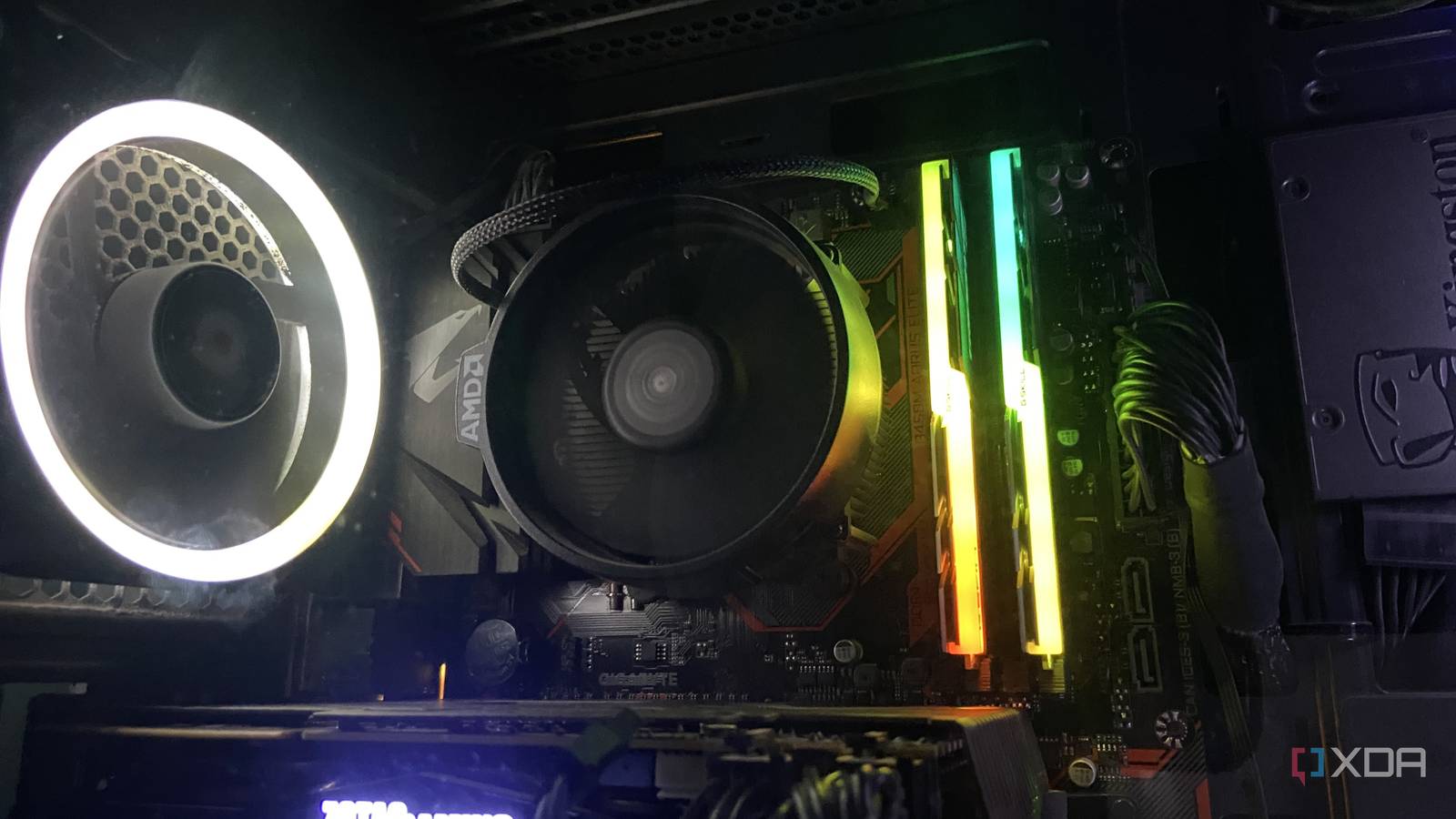
Published Aug 26, 2026, 7:01 AM EDT Abhinav pivoted from a career in banking to pursue his first love in writing. Even while working full-time, he continued contributing as an editor-at-large, a role he has held for more than 7 years. A lifelong tech enthusiast who has built three gaming and productivity powerhouse PCs since 2018, his passion for technology keeps him closely following the semiconductor industry, from NVIDIA and AMD to ARM. His MSc dissertation explored how artificial intelligence will reshape the future of work, reflecting his curiosity about the wider social impact of emerging technologies. The memory economy has not been kind to PC builders over the past year. Those hit hardest by the DRAM crisis include the users who have been eyeing a platform jump from DDR4 to DDR5 systems, and of course, the ones who were looking to assemble a build from scratch. Which is why, for my next build, I've given up on the price trackers altogether, refreshing and waiting for the prices to drop. The industry is making that easier to justify too, with older processors returning and DDR4 platforms seeing renewed production, giving builders more options that aren't dictated by inflated pricing or whatever happens to be available on the secondary market. Here's why I'm eyeing a DDR4 build the next time I'm ready to assemble a rig. For gaming, the platform matters much less than the GPU DDR4 platforms are not the bottleneck everyone assumes When it comes to use-cases, gaming is probably the easiest to justify a "last-gen" platform. Even with a flagship GPU, moving from PCIe 4.0 to PCIe 5.0 barely impacts gaming performance, and that's a fact that has been established by gaming benchmarks time and again. Last year in February, GamersNexus compared the current flagship, the GeForce RTX 5090 on PCIe 5.0, PCIe 4.0, and even PCIe 3.0 on the same PCIe x16 slot. The benchmarks found that the maximum variance emerged in a comparison between PCIe gen 5 vs gen 3, and even then, amounted to a minuscule 1–4%, in a near-hyperbolic example. That makes PCIe 4.0 support on an AM4 motherboard a lot less concerning than it is usually perceived. PCIe 4.0 is fully supported on numerous DDR4 platforms, and what makes the situation even better is the fact that motherboards are the only components that are at least somewhat shielded from the memory crisis. As a matter of fact, prices of several SKUs have actually gone down since the beginning of the DRAM crisis, which makes it easier to snag a bargain on high-end models. AM4 still delivers the PCIe bandwidth that I need for everything Is a socket truly dead-end if chipmakers keep re-releasing CPUs for it? Credit: Andrey Matveev via Unsplash With all the other aspects considered, a reasonable buyer will still ask if the CPU becomes much of a bottleneck in this situation, because, after all, AM4 is almost a decade old, and often touted as a "dead-end" socket. The point that I would argue is that it matters a lot less in user experience, primarily because the ceiling set by socket AM4 is already high enough to support most modern workloads. The AMD Ryzen 7 5800X3D, which Team Red decided to re-launch this summer as a tenth-anniversary chip is a highly capable chip many years after its release. At a retail price of $349, it's a powerful upgrade for anyone who is already on an AM4 platform. There's a reason why it makes for a reasonable buy. One might argue that the chip is roughly 16–26% behind the succeeding Ryzen 7 7800X3D in single-threaded workloads and 21% behind in multi-threaded tasks while rivaling the price of the latter, and they would be right. However, running a 7800X3D requires an AM5 platform and, by extension, DDR5 memory, which pushes the price of the build into the stratosphere. As per RAM price tracking data by Tom's Hardware, a 32GB DDR5-6000 kit will set one back by a whopping $402, which is more than double the cost of a dual-channel 32GB DDR4-3200 kit, currently retailing at $179. The cost savings can easily allow one to allocate more money towards a GPU, and if sniped timely, can result in an entire tier jump. It's not a road without compromises But it's still better than the alternative the hardware economy has on offer All of this analysis stems from a rather simple question, which is, "what really constitutes a smart build?" The answer to that question is inevitably going to vary from one user to the other, but for me, it generally means getting a level of performance that's commensurate with the pricing of the hardware. Now, there is no denying that AM4 itself should be outdated and out of consideration for consumers in the latter half of 2026, and yet, it seems as though not only is it a viable alternative, but also a better choice for builders who believe in the same building philosophy as I do. For the specific workload that matters to me, such as running small, quantized local models at Q4_K_M and AAA gaming, the GPU defines nearly all the aspects of that performance, and so, it makes more sense to save on the platform and invest in a GPU. My inference workflow will be bottlenecked by VRAM rather than being CPU-bound, and in terms of gaming, the successor to the 5800X3D, which is the 7800X3D, offers only 15% more performance on 1% lows at my target resolution with the same GPU, which is 1440p. PCIe Gen 4 NVMe SSDs make sense over PCIe Gen 3, but chasing PCIe Gen 5 is a practice in chasing diminishing returns. A second look through all of these aspects revealed how little the platform itself matters for all the things I want from a PC, and that's undoubtedly the most compelling reason to not break the bank chasing the alternatives. AMD Ryzen 7 5800X3D Modern problems require last-gen solutions The worst possible solution to the memory crisis certainly is throwing more money at the problem. If the newest platform is pricing individuals out, it makes sense to look at the viable last-gen alternatives, just as the consumer market has been doing for many decades now. Of course, taking a further look at your actual workload makes the decision a lot easier than it seems, as it certainly did for me.
The RAM crisis brought DDR4 back from the dead, and my next build might be last-gen on purpose
Full Article
Original Source
Read the full article at Xda-developers →KhanList aggregates and links to publicly available news content. We do not host full articles from third-party sources. Always verify important information with original sources.