
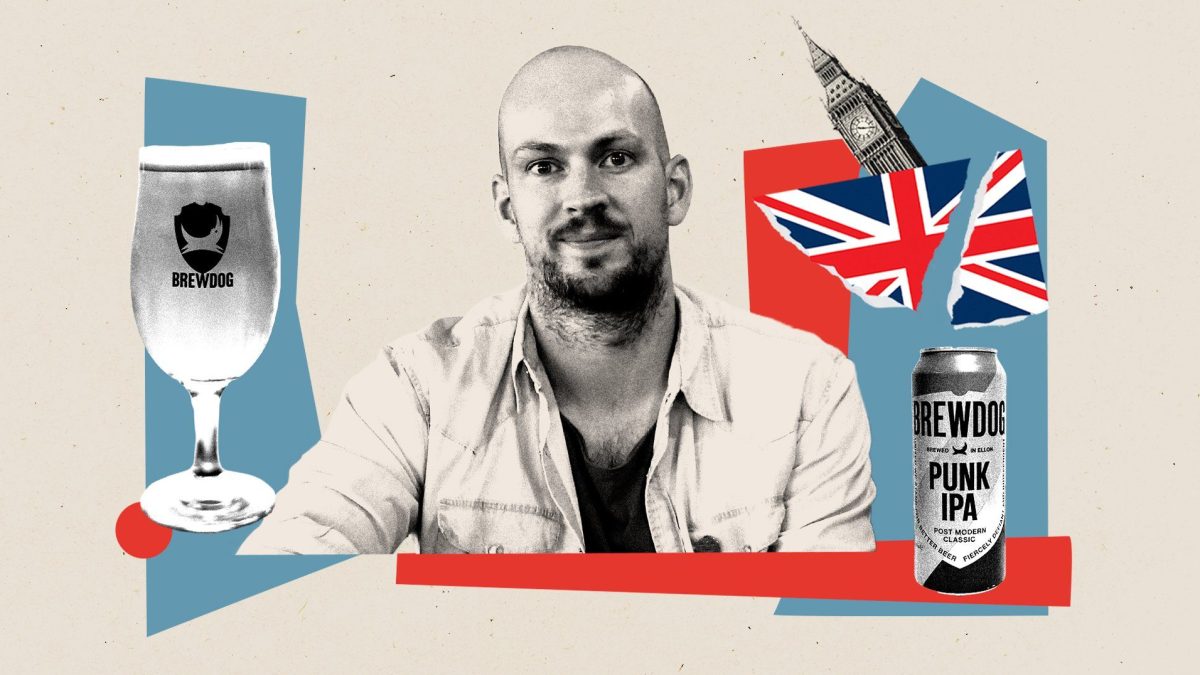
Who broke Britain? Welcome to The i Paper’s opinion series in which experts and writers debate the issues that concern them about modern Britain. • Martin Lewis: the money-saving expert… who accidentally cost Britons billions• The American woman who ripped the heart out of Cadbury• The romcom king who made Britain fall in love with its own decline Among Britain’s beer drinkers and makers I have spoken to, one name has become synonymous with bad blood, bad practices and bad legacy. That name is James Watt, co-founder of BrewDog. BrewDog was established in 2007 by a pair of childhood friends from Fraserburgh in north-east Scotland, James Watt and Martin Dickie. They brewed their first beers with improvised kit in Dickie’s mother’s garage. From there, they built a beer brand that sought to stand against the overly corporate, bland, big money beer companies that filled the taps of Britain’s pubs. Their company image was anarchic and anti-establishment – a middle finger to boring brews. They built their own bars, too, popularising the industrial, exposed-brick look that spawned a thousand imitators and that I would argue were markedly less inviting places to drink than regular pubs were, but that drew crowds in the 2010s for seeming new and therefore cool. Cooler-seeming still was that in 2009, with their company on the rise, Watt and his co-founder launched “Equity for Punks”, whereby fans of their beer could invest in the company in return for shares, and discounts on their products. The message was: we make this beer for you, the people, and why shouldn’t you be the ones who own it as we grow, instead of private equity fat cats? The marketing stunts for Brewdog, even back in the early days before the shine came off the company’s promises of being different, were grating. In 2011, the company drove a tank along Camden high street as a war cry against dull mainstream lagers. In the same year, they brewed a beer at the bottom of the ocean. This kind of thing has carried on throughout the company’s history: in 2020, they launched a “Barnard Castle” beer, named after the destination of Dominic Cummings’s notorious lockdown trip. They once brewed the world’s strongest beer and put it in a taxidermy squirrel. There has always been a flavour of “I’m mad, me!” to Watt’s moves. He called himself the “captain” of the company, for God’s sake. All of which might have been forgivable were it not for what else was going on with the company. Despite all the punk rhetoric, BrewDog sold a fifth of the company to a US private equity fund in 2017. In that same year, I had a boyfriend who worked behind the bar at a BrewDog, and I spent a lot of time there witnessing the ill-will that the staff harboured towards the business, over low wages but also the cringiness of the merchandise they were encouraged to sell, things like T-shirts printed with the word punk, to the point that even the managers were encouraging us to drink as many under-the-table pints as we could as one in the eye for Watt. But there later turned out to be much more serious complaints against BrewDog as a company. For all his talk of community, Watt’s employment practices left a lot to be desired. In 2021, a large group of former BrewDog employees wrote an open letter about Watt’s “cult of personality” and the company’s “toxic attitudes”, on top of which BBC One produced an investigation in 2022 into alleged inappropriate behaviour from Watt himself towards female staff members. BrewDog denied all allegations through a lawyer’s statement in the documentary, but then complained to Ofcom about the programme after it was aired, a complaint which Ofcom did not uphold. In 2024, BrewDog abandoned a previous promise to pay new hires a Real Living Wage. Watt postured as a rebel and turned out to be just another species of corporate vampire. On LinkedIn, he posts complaints about how much tax he has to pay as a now very rich person, and in March this year he was forced to apologise to over 200,000 “equity punks” who, despite investing £75m in the business, were left with nothing when BrewDog went into administration and its main UK assets were sold to a US cannabis and drinks company called Tilray Brands. The deal also cost 484 BrewDog staff their jobs. Though they once had an implied valuation of £2bn, this deal was the best the company could apparently secure after getting into heavy debt and expanding too rapidly in a rocky hospitality landscape. The feeling is that the punkiness was all talk in the first place. After the sale, the handling of which the trade union Unite has described as a “national disgrace”, Watt issued an apology on LinkedIn to the equity punks, describing in terms that still manage to be self-aggrandising the “huge gambles and many mistakes” he made, which has done little to soften the blow of losing their cash. There is, I would argue, very little anti-establishment bite in Watt’s recent social media presence, making bland Reels with his ex-Made in Chelsea wife Georgia Toffolo about his new business venture, a company which rewards regular people for posting about brands. “All self-respecting captains go down with their ships,” Watt wrote in his finance memoir Business for Punks in 2015, but when push came to shove, he had already cashed out in 2017, saving himself and letting his crew sink. He stepped down as CEO in 2024, though launched a bid to buy it back in July. The tide is turning back on the BrewDog-ification of pubs. London’s most popular new pubs, as Jimmy McIntosh noted for The New Statesman last year, are not decked out with industrial tables and exposed brickwork, but mimic the look of the old school boozer. Take The Devonshire, the impractically busy pub-du-jour in Piccadilly. But Watt’s mismanagement of BrewDog will continue to be felt in British society. Adopting the language of insurgency in service of profit has since become widespread elsewhere in British business. I remember once seeing a fleet of advertisements some years ago inviting people to “join the rental rebellion”, which turned out to just be an advert for some new-builds in Wembley Park. The big disappointment of Watt is that he did spot a gap in the market that was begging to be filled. Mass market beers were often uninspiring, and consumers did want craft beer, made at a smaller scale, that tasted good. There’s nothing wrong with BrewDog’s beer: I’m not even a huge beer drinker and I like a Punk IPA. BrewDog’s intervention into the beer market has brought other beers that are more exciting than a Heineken into British supermarkets. And the company was a homegrown success, in a country that is often too quick to rain on the parade of our own entrepreneurs. But Watt made Britain that little bit worse by squandering the opportunity of establishing a different kind of company model. One that seemed, initially, genuinely invested in its customers, in its product, and in its staff over and above profit. He positioned himself as a person to emulate and to admire, and then turned out to be more concerned with image, particularly his own, than substance, and making money for himself.
The beer ‘punk’ who became a British hate figure
Full Article
Original Source
Read the full article at Inews →KhanList aggregates and links to publicly available news content. We do not host full articles from third-party sources. Always verify important information with original sources.