
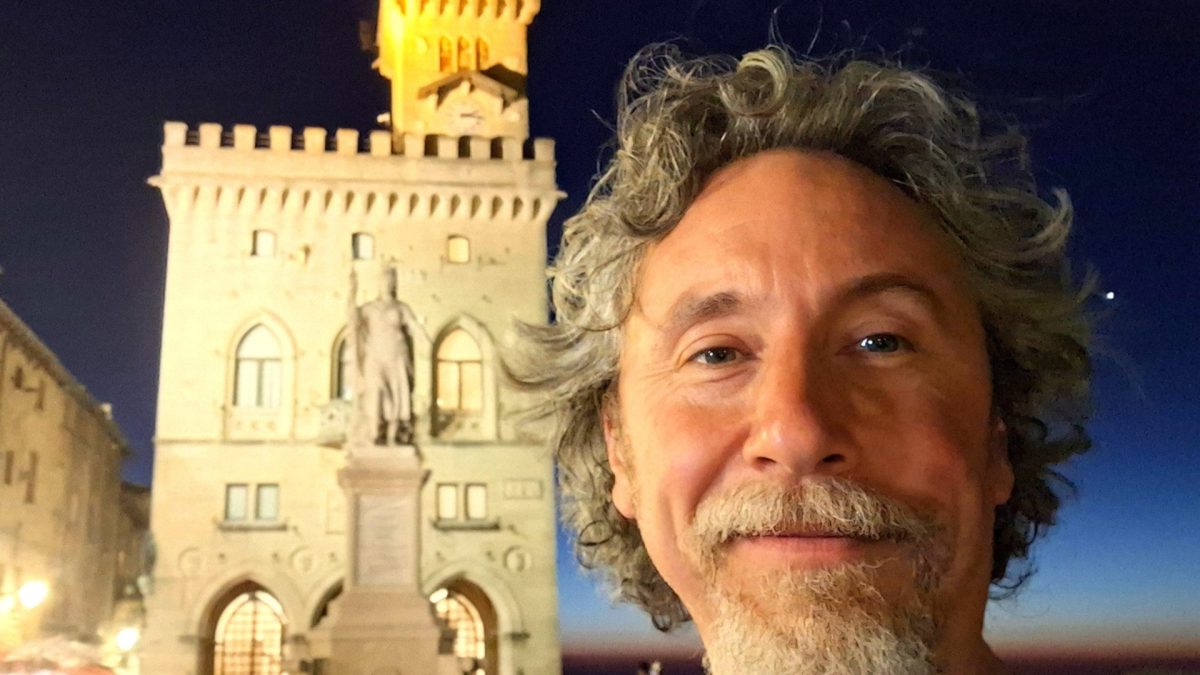
The cable car rose gently above Borgo Maggiore, towards the crenelated peak of Monte Titano, and I was grateful for the ride back to my starting point. I had just descended 200 metres along the Costa dell’Arnella trail and through the Porta San Francesco, the original entrance to the city, and my legs were already registering their opinion. Gliding upward, I could see all the way to the Adriatic, across the vast swath of Italian landscape wedged between here and the sea. That’s the thing about San Marino – it’s entirely surrounded by Italy, a country more than 1,500 years its junior. It has stood here for centuries, yet has never been part of the nation that eventually formed around it. All but encircled by Italy’s Emilia-Romagna region, with a small section bordering Le Marche and Tuscany less than 50km away, the world’s oldest republic feels different from neighbouring areas. San Marino is quieter, less performed, more purposeful than an Italian hill town dressed up for tourism. The cable car over Borgo Maggiore (Photo: FotoGablitz/Getty Images/iStock Editorial/lugmayer.com) Its origin story has the quality of legend. Founded in 301 AD by a Dalmatian stonemason named Marinus, who fled persecution for his Christian beliefs and found refuge on Monte Titano after curing a local landowner of paralysis, it has since watched empires, wars and republics rise and fall. The Roman Empire crumbled around it. The Italian Peninsula’s warring city states tore each other apart before unification in 1861. It watched two world wars. Through everything, the principle of hospitality and sanctuary held. My guide Sara (bright purple hair, infectious pride) took this personally. “It is who we are,” she told me. “We have always invited people in and given them refuge.” She led me to a plaque commemorating San Marino’s sheltering of Jewish people during the Second World War – remarkable given the vulnerability of such a small nation. More recently, Ukrainian families have made their homes here, and two Palestinian children have arrived. “It’s not much,” Sara said, “but you have to remember we are a country of 33,000 people.” Now covering 61sq km (in Europe, only Monaco and Vatican City are smaller), San Marino comprises nine castelli, or municipalities, of which Borgo Maggiore is one. The City of San Marino sits perched at 749 metres on a ridge of Monte Titano. Connecting the castelli are a serpentine road and a cable car. San Marino’s medieval streets are peaceful after dark (Photo: Serge Yatunin/Getty Images/iStock Editorial) Three medieval fortress towers – Guaita, Cesta and the rarely visited Montale – stand sentinel over the City of San Marino, above a triple layer of ancient walls. Walking the cobbled streets beneath the towers felt like moving through a place that had simply decided to keep going, whatever the rest of the continent chose to do. Buildings made of Titano’s limestone slowly become more honeyed in colour as the sun dips in the sky. The layout of the streets has changed very little in a thousand years. Just over two million visitors came to San Marino in 2025, and it can get quite busy in the daytime, but the secret is to stay the night. Once the day trippers stream back down to Italy, the city exhales. The streets quieten and the restaurants fill. I visited Cesare, which has stood on the same spot since 1956, where head chef Granziano Canareza seated me beside an open fire, casually tossed on a log and poked the embers beneath the grill. Steak tartare with parmesan mousse gave way to passatelli (pasta made of breadcrumbs, parmesan and egg) with asparagus and bacon, then smoky chargrilled lamb chops. The room filled quickly with families, friends and lingering tourists. Guaita Tower overlooks San Marino and the Italian landscape beyond (Photo: Edgar Moskopp/Getty Images/Moment RF) The next morning, I walked the Passo delle Streghe (Witches’ Path), a cliff-edge walkway of worn cobbles and open trail connecting Guaita and Cesta towers. The climb is relentless, the kind that demands you stop not just to catch your breath but to turn and register what you’re looking at. Up here the wind howls along the ridge; local legend has it that the sound is that of screaming witches soaring overhead. On a clear morning it’s easy to dismiss. On a dark night, perhaps less so. From the top of Guaita the view was extraordinary, all of Emilia-Romagna spread below, Rimini’s ancient Roman streets reduced to miniature against the crystalline blue of the Adriatic, the plains stretching north towards Bologna, the Apennines rising to the south and west. Across the ridge, the Cesta, the second tower, appeared through the morning haze like something from a different world, perched impossibly on its own peak. On my final evening I ate at La Terrazza. The food – braised radicchio, cappellacci, sweet bread with peaches and vanilla cream – was exceptional, but the show belonged entirely to the sunset. The distant hills gradually lost definition as the light changed, yellows and deep oranges spreading slowly along the horizon, softening through rose and purple until the last of the daylight dissolved and the valley disappeared into darkness. Podere Lesignano has been in Matteo’s family for generations and now offers experiences including cooking classes (Photo: Matthew Dennis) The following morning I headed down into the countryside to meet Matteo, a young Sammarinese – person from San Marino – running Podere Lesignano, a farm-to-table project. His family have worked this land for generations, keeping pigs, goats and sheep, cultivating olives, vines and corn. He poured me a sangiovese and three types of grappa. It was 10.30am. “I studied in Modena,” he said, smiling, “but I had to come home. I had the choice between a small flat or this.” Just over his shoulder, above the treeline, the three towers watched over it all in the morning sunshine. Just as they have for centuries. How to get there British Airways flies from Heathrow to Rimini from £150 return including checked luggage. Ryanair and easyJet also fly from the UK. From the airport take a 40-minute taxi to San Marino for about €40, or bus no.9 to Rimini Central Station then the Bonelli Bus, totalling about €7. Where to stay Hotel Titano has doubles from £84, including breakfast. More information The writer stayed at Hilton Garden Inn London Heathrow Terminals 2 and 3. Doubles start at £262.65, booked via Holiday Extras, which also offers access to the No 1 Lounge in Terminal 3 for £50.
The quieter alternative to Tuscany with a cable car, old town and great food
Full Article
Original Source
Read the full article at Inews →KhanList aggregates and links to publicly available news content. We do not host full articles from third-party sources. Always verify important information with original sources.