
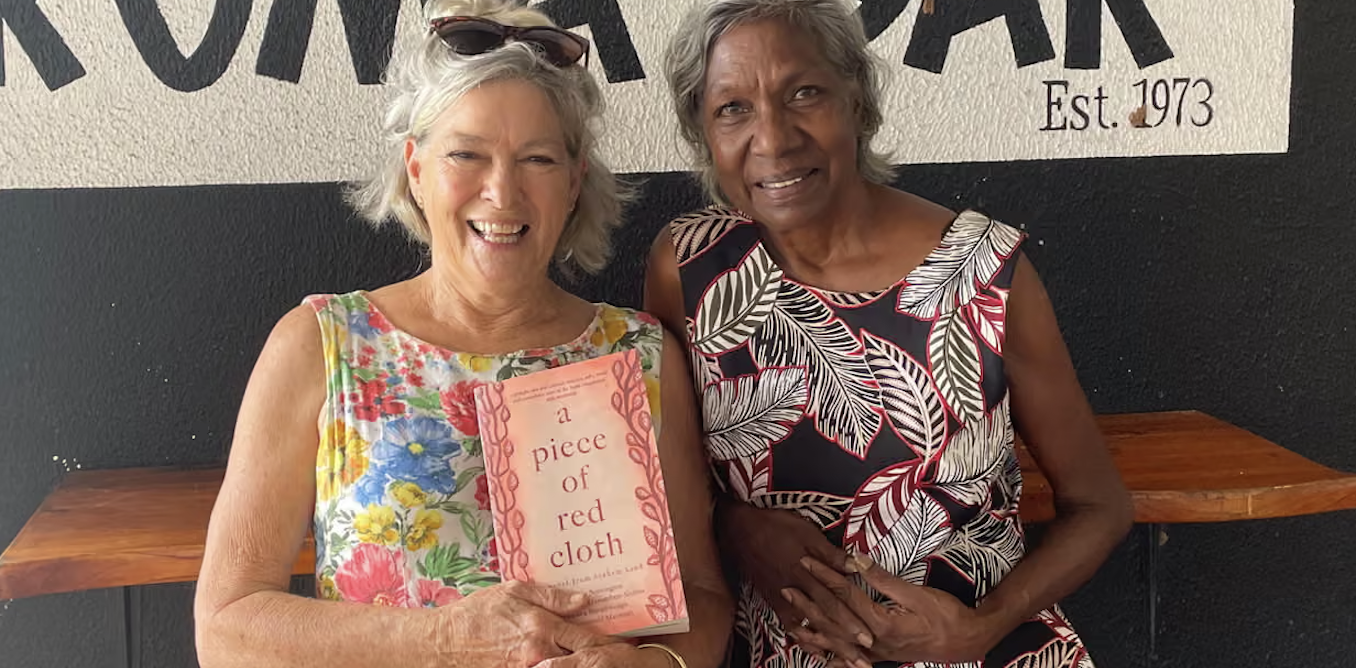
This year’s winners of the Prime Minister’s Literary Awards query the instability of Australian identity. And the winners of the fiction and nonfiction prizes both point to the cruel legacy of European invasion and colonialism. A brave and moving historical Yolŋu novel, A Piece of Red Cloth, has won the fiction prize. It was collectively authored by Yolŋu knowledge holders Merrkiyawuy Ganambar-Stubbs, Djawa Burarrwanga and Djawundil Maymuru, and novelist Leonie Norrington. A pioneering collaboration between Aboriginal and non-Aboriginal writers that honours Yolŋu ancestors through the eyes of their descendants, it represents a healing opportunity for Australian culture. As Norrington says, “Aboriginal people, since the first invaders came, have been trying to say, ‘Look, we have a really wonderful way of understanding the world, and you can learn from it.’” Described by the judges as “a profound work of remembrance, fusing oral history, novelistic technique and deep cultural knowledge”, this innovative book also received this year’s Australian Book Industry Award for Social Impact Book of the Year. It has been shortlisted for multiple prizes. The nonfiction prize winner, Walkley Award-winning journalist Kate Wild’s The Red House, is a gripping exposé of race and power within contemporary Australia – explored through the tragic killing of Kumanjayi Walker in 2019, and the subsequent murder trial of Constable Zachary Rolfe. It’s also no stranger to literary prizes, having won this year’s Age Non-fiction Book of the Year. Walkley Award-winning journalist Kate Wild won the nonfiction prize for her gripping exposé on the killing of Kumanjayi Walker and subsequent murder trial. Nicholas Coghlan Play, emotion and imagination Turkish–Australian Ender Başkan’s playful and expansive Two Hundred Million Musketeers has won the poetry prize. Rohan Howitt’s consideration of Australia’s claims to the Antarctic, The Southern Frontier, was awarded the Australian history prize. Both prizes for younger readers went to verse novels. Drift by Pip Harry, which follows two 14-year-olds as they navigate fitting in and deal with anxiety (and bees), won for young adult literature. And Song of a Thousand Seas by Zana Fraillon, which looks at friendship and different brains through the eyes of an octopus, won for children’s literature. These are stories about kin, culture and belonging, migration, settlement and territorial rights. They pick at the loose threads of psychological and physical definitions of what it means to be Australian. Their fresh perspectives explore and interrogate ideas of home and nationhood, ownership and entitlement – with imagination, rigour and heartfelt emotion. The awards, delivered by Creative Australia, boast the biggest prize pool in the country. The winners of each category receive A$80,000, with A$5,000 each for shortlisted writers. ‘True history’ as fiction A Piece of Red Cloth, set in the 1600s, tells the story of Batjani, a Yolŋu elder trying to protect her beloved granddaughter, Garritji, from Makassan trepang fishermen on the coast of Arnhem Land. The story opens up a complex and unfamiliar chapter of pre-colonial Australian history. For hundreds of years, trading between Yolŋu and seafarers from the port of Makassar, now eastern Indonesia, took place without issue. But when European merchants claimed the region as the Dutch East Indies, a new chapter of brutality was introduced. The Makassan traders adopted the cruel tactics of their colonisers, and began plying Yolŋu men with opium and alcohol. In exchange, they claimed the young women and children, and took them for sex-trafficking, until the the elder Yolŋu women rose up in protest. The novel reimagines these facts as Batjani does her best to protect Garritji, who is approaching womanhood, from the fishermen. “It’s a true history,” says Ganambarr-Stubbs, whose own grandmother was snatched in a similar scenario. “Wider Australia should learn more about the history – all the histories – because that’s how all of us came to be here now.” Nonfiction: ongoing race inequity The Red House highlights the ongoing inequities of race in Australia. In her investigation of the legacy of Australia’s colonial past, journalist Kate Wild seeks ways to break the cycle of dehumanisation and state violence that continues to plague this country. With precision and care, she recounts the confrontation between Walker and Rolfe in an isolated desert community, and tracks the aftermath of Rolfe’s high-profile, emotionally charged court case. Her report reveals the depth of Australia’s damaged and unresolved relationship with its First Nations peoples. An outsider, she nevertheless finds ways to integrate Warlpiri and Luritj perspectives with care and respect, laying down a challenge to those involved in the work of communicating First Nations stories. Her book was praised by the judges as a work “of great listening” that “embeds the reader in a supratemporal zone beyond Western ideas of time, history and narrative in order to trace repeating patterns of violence, rhetoric, pain and anger”. It represents a nuanced, compassionate contribution to a critical ongoing national conversation about race, culture, history and entitlement. A story of transgenerational trauma, difficult questions and unfinished business, Wild’s work takes on issues that many Australians still prefer to avoid or deny. It presses for an end to a situation that appears to have no resolution. Poetry: fatherhood in an uncertain world With his debut poetry collection, Two Hundred Million Musketeers, Ender Başkan captures the intensity of parenting young children within an increasingly uncertain world. Fatherhood impacts his work, friendships and creative practice in inner-city Melbourne. It alters his awareness of social and political concerns, and shifts his attention from the past and the present into the future. Dealing in connection and bustling with life, Başkan’s poems reflect on his childhood, his grandparents’ exile from Türkiye (where Başkan returns, with his young family), and on being Turkish. He explores his responsibilities to child-rearing and housekeeping, the need to earn a living and to care for older generations. Başkan has been critically hailed as a writer whose “main point is that poetry can and should be fun”. He won the 2021 Overland Judith Wright Poetry Prize, and the 2025 Anne Elder Award. His work continues the legacy of migrant poets that included his close friend and mentor, the late Ania Walwicz. According to the judges, Başkan offers “an invitation to explore what might be possible if a line were to stretch between one person and another”.
The Prime Minister’s Literary Award winners include a collective Yolŋu novel – and a murder trial
Full Article
Original Source
Read the full article at Theconversation →KhanList aggregates and links to publicly available news content. We do not host full articles from third-party sources. Always verify important information with original sources.