
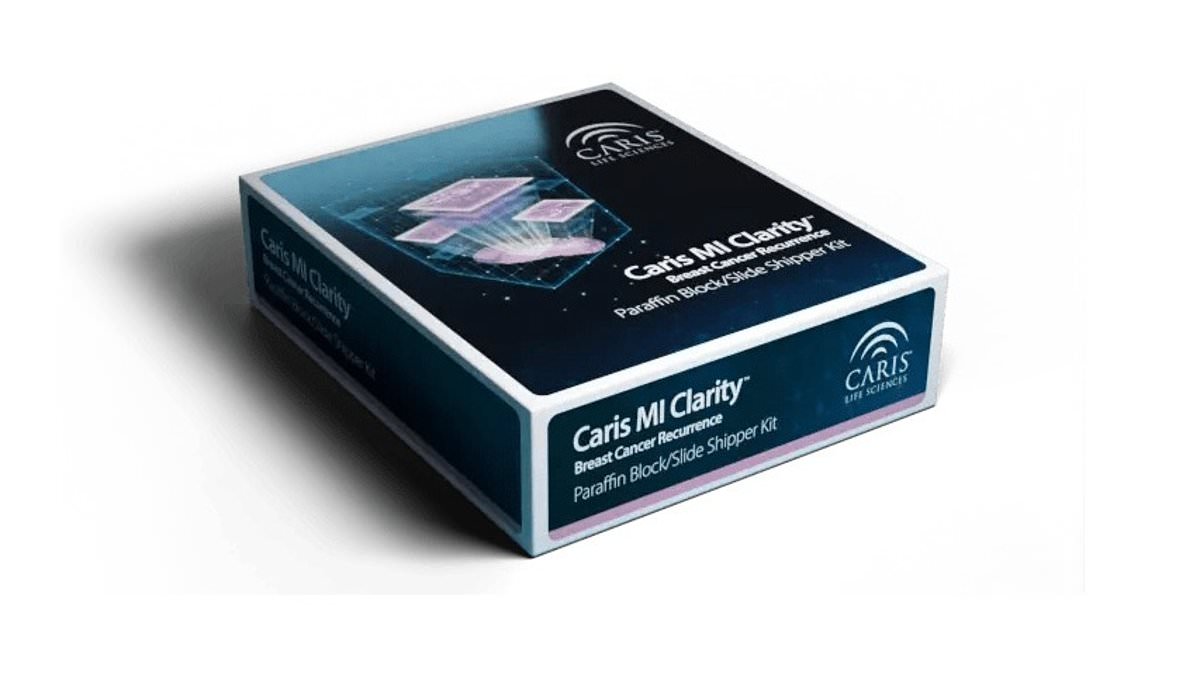
A pioneering new test that can accurately predict the risk of breast cancer returning after treatment is being launched in Britain.During trials, it was able to identify women whose cancer went on to return as long as 15 years after their original diagnosis.Called Caris MI Clarity, the test could help doctors identify patients who need closer monitoring or additional treatment, potentially saving lives.It costs £769, delivers results in as little as three days and could benefit up to 20,000 British women every year, according to its developers.The test will be available to NHS oncologists and major private healthcare providers this month, although patients will have to pay for it themselves or through private health insurance.Charities told the Daily Mail that, if successful, the tool could play an important role in the 'vital' prevention of cancer recurrence.Caris MI Clarity is designed for postmenopausal women diagnosed with an early-stage form of breast cancer known as hormone receptor-positive, HER2-negative breast cancer, which has not spread to nearby lymph nodes.This type of cancer can be successfully treated, but some women remain at risk of the disease returning many years later – even after more than a decade without any sign of cancer. A pioneering new test that can accurately predict the risk of breast cancer returning after treatment is being launched in Britain.When it does return, it can spread to other parts of the body, including the bones, liver and lungs. This is known as distant recurrence and is responsible for the vast majority of breast cancer deaths.More than 11,000 people die from breast cancer in Britain every year.Until now, doctors have faced difficulties identifying which patients are most likely to suffer a recurrence, particularly many years after treatment.Existing tests examine the activity of genes within a tumour to help estimate the risk, but results can take weeks. Caris MI Clarity will be available to NHS oncologists and major private healthcare providers this monthCaris MI Clarity takes a different approach, its makers claim.Using artificial intelligence, it examines digital images of a patient's tumour, taken at the time of their original diagnosis, alongside other medical information about the patient.It then looks for patterns associated with cancers that have subsequently returned.From this analysis, it produces two separate risk scores.The first estimates the likelihood of cancer returning within five years of diagnosis. The second assesses the risk of recurrence between five and 15 years.Doctors can use these results to help determine whether patients need additional treatment or closer monitoring in the years ahead.The technology was developed using information gathered from thousands of women who took part in two major international breast cancer studies.Researchers examined what happened to these patients over time, comparing the characteristics of tumours that subsequently returned with those that did not.This enabled them to develop a system designed to recognise warning signs linked to cancer recurrence. 'Breast cancer coming back many years after someone's initial diagnosis is one of the biggest challenges we need to address,' Dr Kotryna Temcinaite, senior research and impact communications lead at the charity Breast Cancer Now, told the Mail.'It's vital that we better understand who is more likely to experience their breast cancer coming back, either in the first few years after diagnosis or much further down the line, so they can be given the most effective treatment.' The charity said it looks forward to seeing how the test performs in practice.'It's a top research priority for us to build our understanding of why some breast cancers come back and what we can do to stop them returning, so that people don't have to live in an all-consuming fear of recurrence, and everyone diagnosed with breast cancer lives and lives well,' Dr Temcinaite added.The test has already been launched in the US and is now being brought to Britain by Cambridge-based diagnostics company EDX Medical, founded by scientist and entrepreneur Professor Sir Chris Evans.'Bringing this truly pioneering test to the UK offers breast cancer patients and their doctors the opportunity to gain invaluable insight into the risk, both short and long term, of disease recurring,' Prof Sir Evans said.'This test is a very significant step forward in terms of risk assessment and treatment planning for those patients.'Around 60,000 women are diagnosed with breast cancer in Britain each year.Hormone receptor-positive, HER2-negative breast cancer accounts for roughly three quarters of cases, although not all these patients would be eligible for the new test.Taking into account age and other eligibility criteria, developers estimate that up to 20,000 women a year could benefit.However, despite being made available to NHS oncologists, Caris MI Clarity will not initially be funded by the health service.The Mail understands there are currently no immediate plans to offer it free to NHS patients.George Sledge, chief medical officer at Caris Life Sciences, which is working with EDX Medical to bring the technology to Britain, said: 'Breast cancer clinicians have long been forced to make some of the most consequential treatment decisions with an incomplete picture of how recurrence risk changes over time.'
The £769 test that could predict whether breast cancer will return up to 15 years after treatment, helping doctors identify women most at risk before it's too late
Full Article
Original Source
Read the full article at Dailymail →KhanList aggregates and links to publicly available news content. We do not host full articles from third-party sources. Always verify important information with original sources.