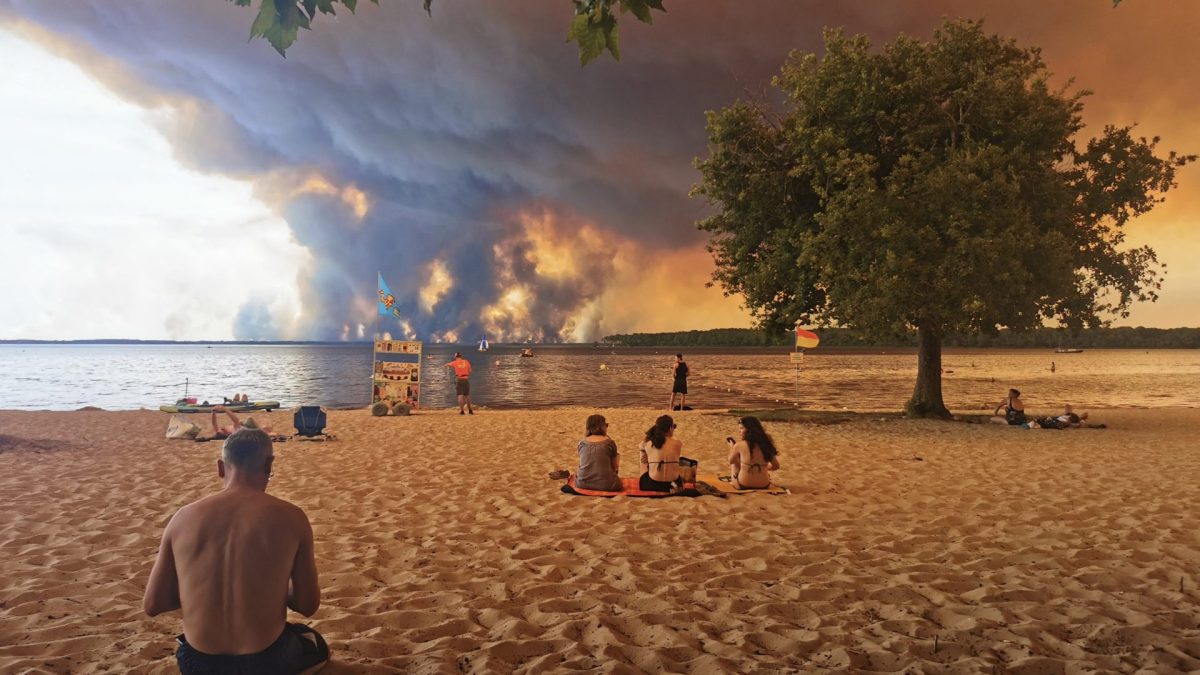
More than 140,000 people have been forced to flee homes and holiday accommodation in south-west France as wildfires rip through the region. Authorities have evacuated the entire Cap Ferret peninsula, one of the area’s most popular tourist destinations, with some forced to flee the flames by boat to avoid becoming trapped. In central Spain, huge forest fires about 30 miles from Madrid led to 60,000 people evacuating their homes. French Interior Minister Laurent Nuñez told broadcaster Tf1 the blaze which tore through the Gironde region was “self-sustaining” and on Friday evening changed direction to bear down on Bordeaux. “We have never seen a convective fire of this magnitude,” he said. “We are going to reorganise our response so we can fight it from the ground and prevent it from advancing toward Bordeaux.” French police officers on motorcycles give directions to drivers stuck in traffic during the evacuation (Photo: Gari Garaialde/Getty Images) Beach goers sit on the beach of Moutchic in Lacanau as clouds of smoke rise into the sky from a wildfire. (Photo by Maximilien LAMY / AFP via Getty Images) Lège-Cap Ferret mayor Philippe de Gonneville said conditions in the lead-up to the fire were “unheard of”, with the region having seen above-average temperatures and no rain “for the last month and a half”. “Neither we nor the firefighters have seen anything like it,” he added. Around 50 firefighters have been injured attempting the fight the blaze, which has torn through more than 46,000 acres and destroyed at least 80 homes. Elsewhere, another wildfire near Biscarrosse, in the Landes region, slightly further south, forced further evacuations, including at a nursing home. In total, more than 140,000 locals and tourists have been forced to flee from both regions, with that figure expected to climb higher over the weekend. A firefighter waters burning tires and barrels while battling a wildfire in Cebreros area, near Avila, 80 kms west of Madrid (Photo@Cesar Manso/ AFP via Getty Images) Hotter and drier conditions have become increasingly common as climate change takes its toll on Europe. According to the European Union’s Copernicus Climate Change Service, the continent is the fastest warming on the planet, making the risk of major fires much greater over time. France is not the only European nation struggling to contain rampant blazes. In Spain, fires close to Madrid were “beyond the capacity of firefighters to contain” according to the regional government’s emergency management chief. “”It’s not possible to attack the fire in that area, so defensive measures are being taken,” Carlos Novillo said. Spanish officials declared a state of emergency as people were forced to evacuate their homes due to wildfires across the country (Photo: Pablo Blazquez Dominguez/Getty Images) Firefighters gather as smoke rises from wildfires in Lege-Cap-Ferret in the Gironde department, amongst worsening drought conditions following a heatwave and water shortages across much of France, July 24, 2026. REUTERS/Stephane Mahe As many as 60,000 people have been evacuated from areas around the Spanish capital, with Prime Minister Pedro Sánchez due to visit the affected regions on Saturday. Francisco Martín, the central government representative for the region of Madrid, said that another 20,000 people had been ordered to shelter at home. Regional President Isabel Díaz-Ayuso called it the worst fire in Madrid’s history. Martín said more evacuations could be coming and that the priority now was to protect the town of San Lorenzo, the home of the Escorial, King Philip II’s 16th-century royal palace and monastery. A national state of emergency has been declared and authorities fear worse could be yet to come as heatwave conditions push temperatures north of 39°C. Spain has set new record temperatures and seen far more frequent and deadly fires over the past several summers, although this year has been particularly severe. The country’s Minister for Ecological Transition, Sara Aagesen, revealed fires had already burnt more than five times the amount of land in the first six months of the year than in 2025. Firefighters battle a wildfire in the Cebreros area, near Avila, 80km west of Madrid (Photo: Cesar MANSO / AFP via Getty Images) Changes in land use, with a shift away from agriculture in some regions, are both increasing the chance of major fires developing and aiding the speed at which they spread. The inferno raging near the Spanish capital was fuelled after two major fires merged into one single blaze. Meanwhile, in Ávila province, near Madrid, flames spread around 12 miles in less than half an hour. “It was horrific,” El Tiemblo – which is within Ávila – mayor Arturo Varas González told local outlet laSexta. Some local authorities also lack the resources and funding to take preventative measures, such as back burning, on the scale needed to mitigate the risk of blazes.
The pictures that show why France ordered 140,000 people to flee wildfires
Full Article
Original Source
Read the full article at Inews →KhanList aggregates and links to publicly available news content. We do not host full articles from third-party sources. Always verify important information with original sources.