
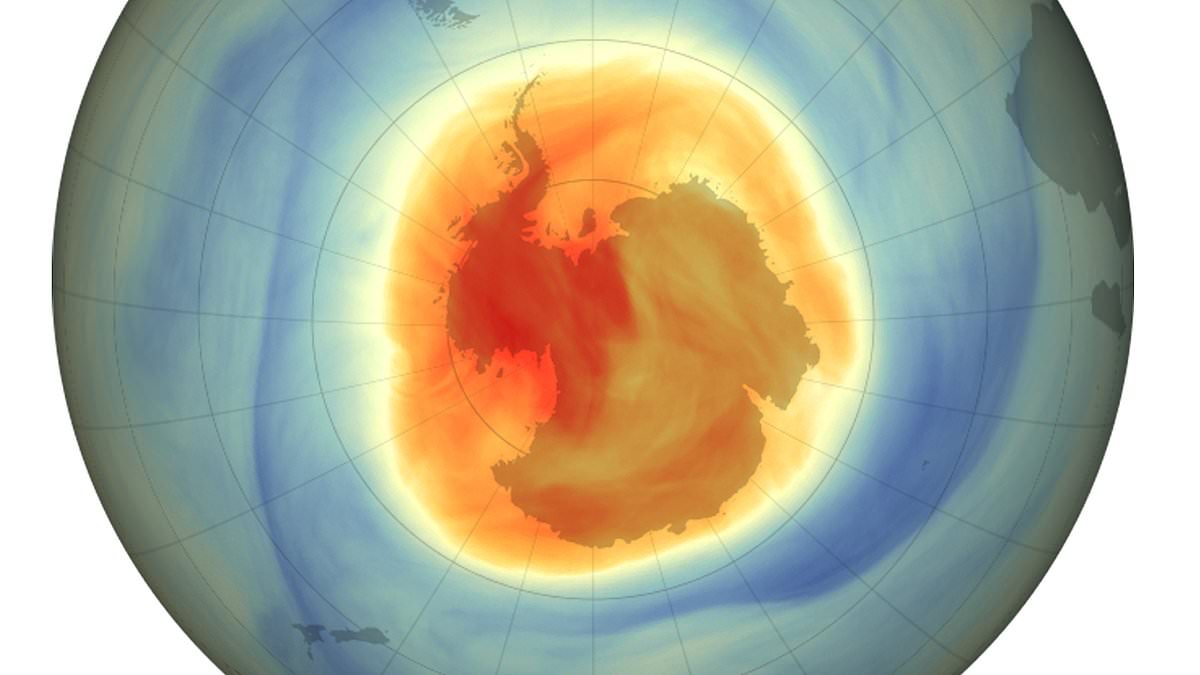
The ozone hole is at its largest in a decade, thanks to 'atypical weather conditions' over Antarctica, NOAA and NASA scientists have revealed. At its peak, between September 7 and October 13, the hole stretched to 9.6 million square miles (25 million square kilometres). To put that into perspective, that is more than twice the area of the United States. Scientists say the hole – which is the seventh largest in 48 years of recording – is being fuelled by the powerful polar vortex. 'The annual ozone hole has been forming later in the season in recent years, which tells us the ozone layer is healing,' explained Paul Newman, a senior scientist at the University of Maryland and leader of NASA's ozone research team. 'But an unusually powerful polar vortex has extended ozone depletion in the Antarctic this season, allowing the hole to grow to proportions we haven't seen in a decade.' The ozone hole is at its largest in a decade, thanks to 'atypical weather conditions' over Antarctica, NOAA and NASA scientists have revealedNOAA and NASA's measurements show that the hole reached its greatest extent on September 18. On that day, it stretched out a staggering 10.5 million square miles (27.1 million square kilometres). That's about three times as big as the United States – and around 90 per cent as large as the largest ozone hole ever observed, which was recorded on September 9, 2000.Dr Newman explained: 'The 2026 ozone hole is large but could have been 1 to 2 million square miles (3.5 million square kilometers) larger if ozone–depleting substances were as prevalent in the atmosphere today as they were at their year 2000 peak.'Dr Newman is referencing chlorofluorocarbons (CFCs) and other ozone-depleting compounds that were once widely used in consumer goods such as refrigerators, air conditioners, and building insulation. While these chemicals still linger in the atmosphere today, scientists estimate they'll be gone by the 2070s, at which point the ozone hole will fully recover.Ozone in the stratosphere acts as Earth's sunscreen, helping to shield us from harmful solar radiation. However, when human–made compounds containing chlorine and bromine are released into the air, ozone can deplete. NOAA and NASA's measurements - taken using weather balloons (pictured) - show that the hole reached its greatest extent on September 18Air currents carry these gases up into the stratosphere, where they're broken down by UV radiation. As the freed chlorine and bromine atoms interact with cloud particles, they cause ozone to be destroyed. While the ozone hole opens up every autumn, scientists say the current polar vortex is to blame for this year's unprecedented size. 'The polar vortex was unusually large this year in part because planetary–scale weather systems that typically well up from the lower atmosphere and break up the vortex were especially weak in August and September,' said Amy Butler, a research scientist at the NOAA Chemical Sciences Laboratory. 'That weak wave action kept the strongest polar vortex winds further from the South Pole by several degrees of latitude, creating a larger area for conditions ideal for ozone depletion to occur.'The news comes shortly after scientists warned that the polar vortex could bring early snow to Britain. Forecasts predict a dramatic weakening of the polar vortex, with some even indicating the winds could reverse direction by mid–November.If this happens, the jet stream will be allowed to wander from its usual position, increasing the risk of cold air moving southwards out of the Arctic.It could also cause a 'blocked weather pattern' that encourages high pressure to become established over the UK, bringing cold, dry air.Speaking to the Daily Mail, Dr Regan Mudhar, a weather scientist from the Université de Lausanne, said we 'certainly can't rule out' the possibility of snowfall.The Ozone layer sits in the stratosphere 25 miles above the Earth's surface and acts like a natural sunscreenOzone is a molecule comprised of three oxygen atoms that occurs naturally in small amounts. In the stratosphere, roughly seven to 25 miles above Earth's surface, the ozone layer acts like sunscreen, shielding the planet from potentially harmful ultraviolet radiation that can cause skin cancer and cataracts, suppress immune systems and also damage plants. It is produced in tropical latitudes and distributed around the globe. Closer to the ground, ozone can also be created by photochemical reactions between the sun and pollution from vehicle emissions and other sources, forming harmful smog.Although warmer-than-average stratospheric weather conditions have reduced ozone depletion during the past two years, the current ozone hole area is still large compared to the 1980s, when the depletion of the ozone layer above Antarctica was first detected. In the stratosphere, roughly seven to 25 miles above Earth's surface, the ozone layer acts like sunscreen, shielding the planet from potentially harmful ultraviolet radiationThis is because levels of ozone-depleting substances like chlorine and bromine remain high enough to produce significant ozone loss. In the 1970s, it was recognised that chemicals called CFCs, used for example in refrigeration and aerosols, were destroying ozone in the stratosphere. In 1987, the Montreal Protocol was agreed, which led to the phase-out of CFCs and, recently, the first signs of recovery of the Antarctic ozone layer. The upper stratosphere at lower latitudes is also showing clear signs of recovery, proving the Montreal Protocol is working well.But the new study, published in Atmospheric Chemistry and Physics, found it is likely not recovering at latitudes between 60°N and 60°S (London is at 51°N).The cause is not certain but the researchers believe it is possible climate change is altering the pattern of atmospheric circulation - causing more ozone to be carried away from the tropics.They say another possibility is that very short-lived substances (VSLSs), which contain chlorine and bromine, could be destroying ozone in the lower stratosphere.VSLSs include chemicals used as solvents, paint strippers, and as degreasing agents.One is even used in the production of an ozone-friendly replacement for CFCs.
The ozone hole is at its largest in a DECADE: Opening over Antarctica reaches 9.6 million square miles - more than twice the area of the United States, NASA warns
Full Article
Original Source
Read the full article at Dailymail →KhanList aggregates and links to publicly available news content. We do not host full articles from third-party sources. Always verify important information with original sources.