
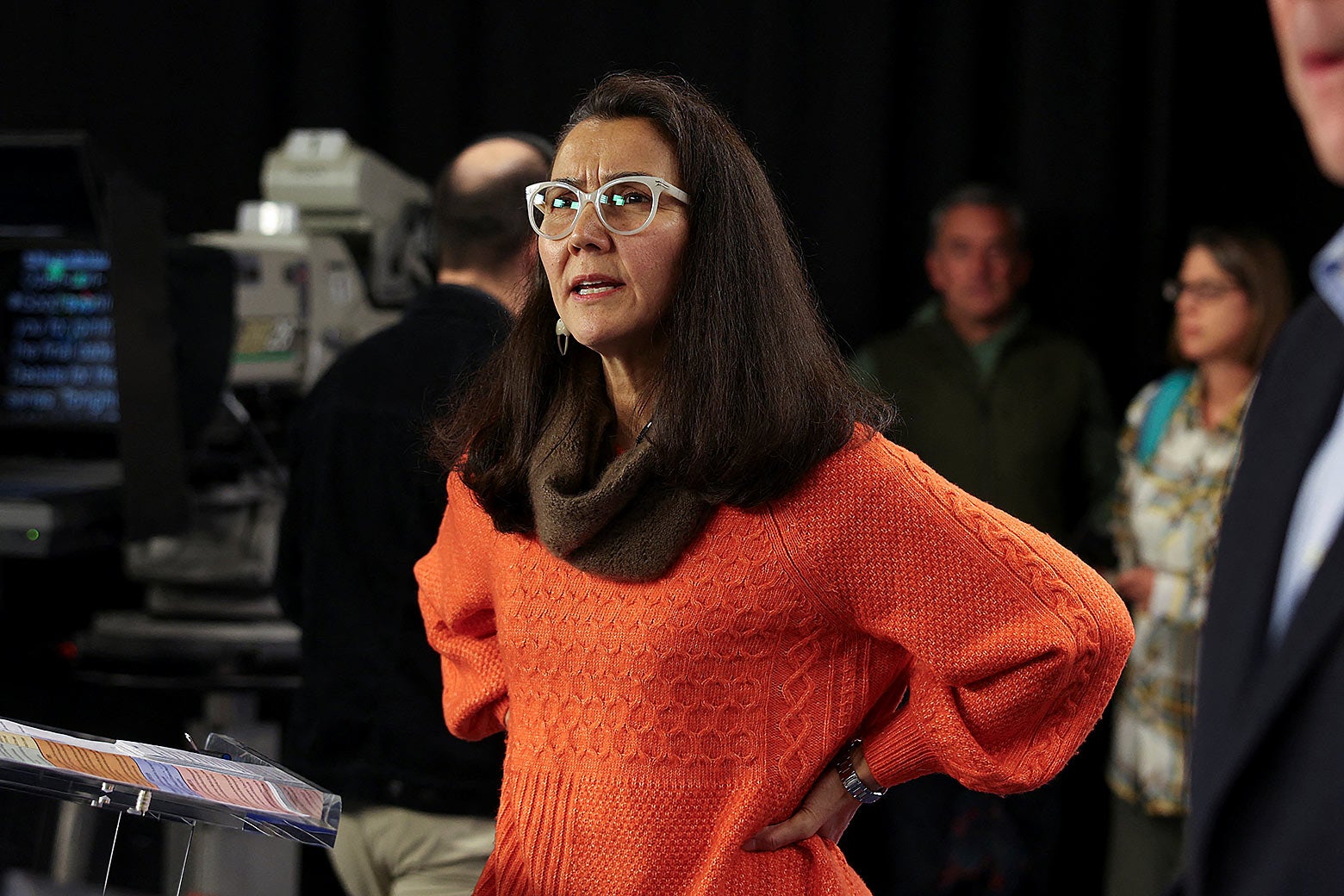
Jurisprudence By Enter your email to receive alerts for this author. Sign in or create an account to better manage your email preferences. Unsubscribe from email alerts Are you sure you want to unsubscribe from email alerts for Dahlia Lithwick? Oct 31, 20269:00 AM Mary Peltola. Kerry Tasker/Reuters Sign up for Executive Dysfunction, a weekly newsletter that highlights one under-the-radar story about how Trump is changing the law—or how the law is pushing back—and keeps you posted on the latest from Slate’s Jurisprudence team. Election mayhem season is upon us and it’s best to be prepared. In just the past week, Trump officials have sued to potentially block the certification of a Senate race in Alaska. They’ve threatened local California election officials with jail time. They have certainly implied that the outcome in a Senate race in Minnesota can’t be trusted unless the Republican wins. On this week’s Amicus podcast, Mother Jones’ national voting rights correspondent, Ari Berman, joined Dahlia to explain what we already know in terms of the attempts to throw sand in the gears of voting, and how all that is informing him about what to look out for this coming week. Their conversation, edited and condensed for clarity, follows. Dahlia Lithwick: When this Alaska lawsuit first hit, it did not pass the laugh test, right? Ari Berman: I mean, it was straight out of the Four Seasons Total Landscaping form of election law, in terms of how ridiculous it was. When I first started covering voting rights, the efforts by Republicans were to make it harder to vote before the election. Then what Trump did in 2020 was, he tried to throw out results after the election. Now, they’re trying to throw out results before the election. When we say that’s unprecedented, it really is. I can’t recall a single lawsuit like this that basically says, “If the candidate we like loses, you can’t certify it.” That’s basically what it said. I mean, it talked about some legal principles, but it was basically just a political document that said, “There’s two Dan Sullivans, and voters are evidently too stupid to figure out which one is which, even though one is on the ballot clearly identified as incumbent senator.” So they’re now asking a federal court to set aside the election if the Dan Sullivan they like doesn’t win, which I think has no chance of actually succeeding. But of course, this lawsuit’s not aimed at succeeding. It’s aimed at laying the groundwork to challenge the election after the fact. So now we really do have to talk about the skullduggery on the Democrat side, because we got a New York Times story this week about that other Dan Sullivan and how this all came to be. I want to give my cautions, because there is some context to be had. One, this ballot-stacking game is hardly new in American politics. And maybe more importantly, while it’s kind of gross, it’s certainly legal, and as you said, the ballot clearly names the incumbent. Nevertheless, skullduggery is skullduggery. Do you want to tell us what happened this week and whether and why it matters? The New York Times published a big piece. I would argue it was a slightly overheated and overhyped piece, in terms of how they presented it. The Times basically reported that the campaign, or operatives affiliated with the campaign, of Mary Peltola essentially recruited the other Dan Sullivan into the race to siphon votes away from Dan Sullivan, the incumbent senator of Alaska. To me, that seems like a political problem, not a legal problem. I don’t see how a court would change how they view this, because the Alaska Supreme Court already dealt with this issue. That’s the most important thing to know about this whole Alaska situation. This was already dealt with under state law by the Alaska Supreme Court. Officials in Alaska already tried to remove the other Dan Sullivan from the ballot, and the Alaska Supreme Court overruled them. So I can’t see how anything will change. Trump is basically saying on Truth Social that Peltola should not be able to run, not just that the other Dan Sullivan shouldn’t be able to run, but Peltola herself shouldn’t be able to run. The thing is, as you know, Dahlia, you can’t disqualify candidates via Truth Social. There’s a process here, and this process has already played out. To me, this feels like a political problem for Republicans in Alaska, and not a legal problem, even though the governor is saying they’re going to investigate, I don’t know what’s going to come of that. I do find it a little ironic that the Republican Party—which encouraged the hacking of a presidential candidate’s email, stole a Supreme Court seat, gerrymandered mid-decade, has done all sorts of things from Roger Stone to Lee Atwater to what Trump has done in terms of weaponizing the entire federal government, trying to overturn the 2020 election—is now saying this is election interference. They’re not exactly coming from, like, the high moral ground here. Right. It is that asymmetry that’s always a fork in our eye. When we go low, we freak out, and when they go low, we are just like, “Oh, well, that’s what they do.” So the asymmetry never fails to trip us up. And now the president has not just called for the Democratic nominee to be disqualified, but also criminally prosecuted, because he never wastes an opportunity to waste our time. Apparently in his view, this is a crime by the nominee. It just goes back to “lock her up.” It goes back to how he’s using his Justice Department as basically the revenge part of his government. They’re going after James Comey. They’re going after whoever he doesn’t like. Cassidy Hutchinson, even though they failed to actually indict her. I think it’s a lot of threats. I’m not concerned about that. What I am concerned about is this affecting election certification in Alaska. I think that’s the thing we should pay attention to. Because of ranked choice voting in Alaska, they don’t even tabulate the results of ranked choice voting until 14 days after the election, meaning it’s going to take a while to count the votes in Alaska. There’s going to be a ton of disinformation during that time, particularly if the Alaska Senate race is the seat that determines control of the U.S. Senate, which is entirely possible given how close it is. I think you’re going to see a lot of pressure not to certify the election brought to bear on Republican officials in Alaska. That’s where they’re going to rerun the 2020 playbook. Even though courts have very clearly said election certification is ministerial, not optional. That is one of the really big things we now know from 2020. You can’t just not certify an election because you don’t like who won the election. That said, they’re going to lean very heavily to not certify the election, and that’s why I would be more concerned, for example, about a situation like Alaska than California. Because in California, they have no power whatsoever to force the state to do anything. In Alaska, they could at least lean on the governor and the lieutenant governor to try not to certify. Then it would go to court; it might very well go back to the Supreme Court. I would imagine the election would end up being certified, but there is some uncertainty here in terms of how the process could break down, and obviously, the litigation by the Justice Department and then, more to the point, all the things the president has done to increase the chance that they’ll try to challenge the results of that election Just because they haven’t succeeded, and they’re deplorably bad at it, does that mean we shouldn’t worry, or doesn’t it matter how bad you are at it. If you want to unsettle election results, even doing it badly can have catastrophic results? It would be incredibly naive not to worry, but I think it’s worth noting that they incited an insurrection, but they didn’t succeed in overturning the election, which was their ultimate goal. And it’s a lot harder to overturn a midterm than a presidential election because there are so many different elections. It’s so decentralized. We’re not talking about five or six swing states here. We’re talking about House and Senate and governor’s races all across the country. Now, could it come down to one Senate race in a place like Alaska where they can try to manufacture some kind of dispute? Absolutely it could. But in terms of some of the hypotheticals—like not seating Democrats in the House, I mean, that would be very, very difficult to do. Just procedurally, it’s hard to do. It’s also hard to imagine it being within one or two seats. Nobody knows, but Democrats could win 25–35 seats in the House. It’s unlikely they’re going to win by one seat, based on how the polling is looking. And not just the polling, but look at where Trump is campaigning, where they’re spending money, all of those things. So the closer the election is, the better chance they have of contesting it. But I think the good news is, after 2020, there’s a lot we know about the system, and as I said earlier, certification is mandatory, not optional. The Justice Department can’t block certification of the election. They would have to convince someone not to do so. I think it’s very unlikely they will be able to convince a court not to do so, because there’s so much settled law from 2020 and after that you have to certify the election results. Absent a legitimate dispute about the election, a Bush v. Gore or a Franken versus Norm Coleman type scenario, we’re talking about a few hundred votes that are reasonably disputed. Absent that, the fact that you don’t like a candidate’s name, for example, that’s not going to lead to a lack of certification. In terms of leaning on local officials, that’s where I would be most concerned. Where do the vulnerabilities lie? There are new Trump-aligned people in power at the county level, and at the state level. Election deniers have taken over some of these positions. So that’s where I would be concerned that someone at the local or county level would try to block certification, and then it would have to go back to the courts, and the courts would ultimately say, “You have to certify the election.” I’m pretty confident of that. But again, that’s where the chaos and the uncertainty comes into the process. So the Alaska thing to me was a signal that they’re not going to be legally successful in overturning the election, but they’re going to try. There was a question before of whether they would even try. I guessed they would, but we hadn’t seen the evidence of that until now. Harmeet Dhillon was on 60 Minutes saying they’d only challenge it in crazy circumstances, and then they filed two lawsuits in the same week that are basically designed to block certification. So we now know they’re going for it, which shouldn’t be surprising. But going for it is different than winning. To me, this is more of a Hail Mary than it is like they’re on the goal line about to kick the game-winning field goal. So many people have done work behind the scenes now to prepare. A lot of people were caught off guard in 2020. They didn’t really think Trump was going to go through with it. They saw the hair dye falling down Rudy Giuliani’s face, and they just laughed it off and never thought it would get to an insurrection. Now people take this seriously, and the amount of work that’s been done behind the scenes and the amount of work that’s been done to Trump-proof the system and protect election officials makes me think they’re going to try some of this stuff, but it’s going to be very hard for them to actually pull it off, particularly in a midterm environment. Are people really going to storm the Capitol over a House race in Kentucky or a Senate race in Alaska? I mean, I guess it’s conceivable, but I just have a hard time seeing it happen. I think at the end of the day, rather than going all the way to Jan. 3, Trump is probably going to be really pissed off, blame a lot of different people, and go golfing. Donald Trump Jurisprudence Senate Alaska Capitol Riot 2026 Midterms
The One Real Danger of Donald Trump’s Mary Peltola Threats
Full Article
Original Source
Read the full article at Slate →KhanList aggregates and links to publicly available news content. We do not host full articles from third-party sources. Always verify important information with original sources.