
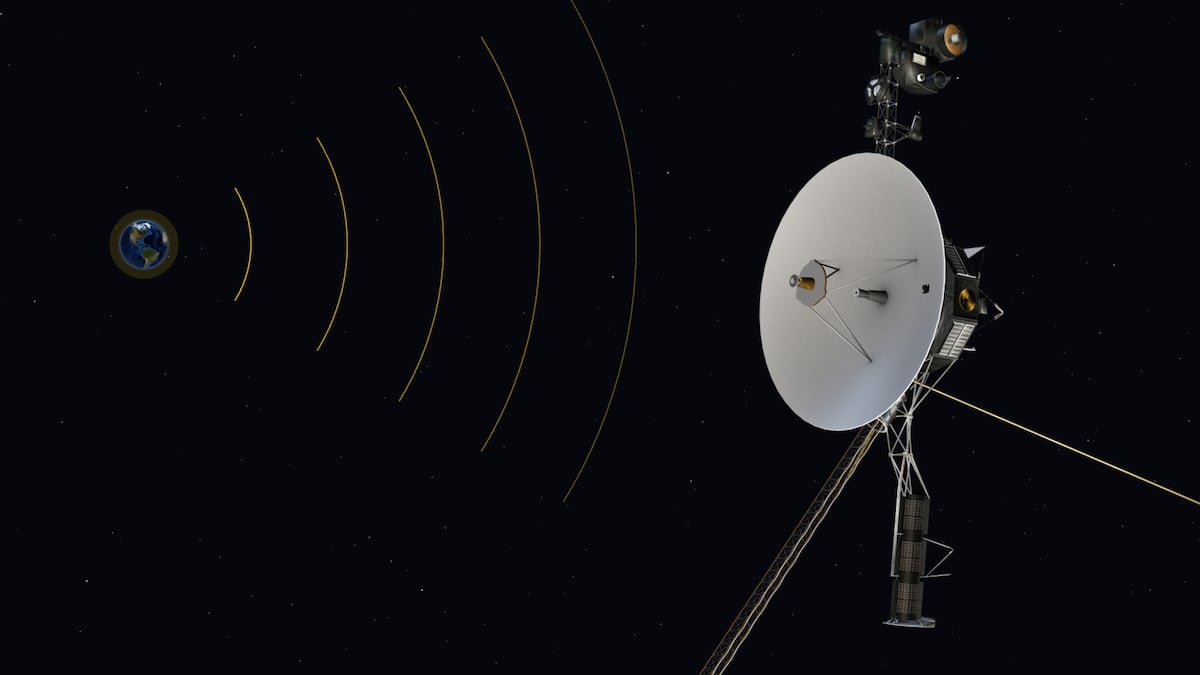
The Voyager 1 probe is about to achieve its most unlikely feat. Its creators at NASA dreamed of sending it to visit the two giant planets, Jupiter and Saturn, taking advantage of a rare planetary alignment in the summer of 1977 that occurs about once every two centuries. They knew it would then be hurled out of the solar system and would wander forever through space. And, faced with the very remote possibility that an alien civilization might find it, they put a self-portrait of humanity on board.“The launching of this bottle into the cosmic ocean says something very hopeful about life on this planet,” Carl Sagan said weeks before the launch. The era’s most popular astronomer led the design of that message, encoded on a golden disc, which added the project’s most idealistic flourish. What was not foreseen then was that, 49 years later, the most distant human-made spacecraft would still be powered on and sending data from a region of interstellar space never before explored. The U.S. space agency has chosen a very special moment to celebrate that unexpected milestone: November 18, when it surpasses the distance of one light-day from Earth. Calculations indicate it will do so at 11:16:07 a.m., CET, when the U.S. East Coast — six hours behind at 05:16:07 — is beginning to wake up.Linda Spilker, the current chief scientist of the Voyager program, was working at NASA’s Jet Propulsion Laboratory (JPL) when the spacecraft lifted off on September 5, 1977. “I never imagined the mission would last this long,” Spilker said in a recent interview; she compares this exceptional longevity to that of another spacecraft she worked on, Cassini (1997–2017), which studied Saturn’s moons and rings. The twin probes Voyager 1 and Voyager 2, by contrast, were equipped with much more rudimentary technology and very basic computer components. Their six onboard computers add up to a total of 68 KB of memory — an amount today handled by coffee makers and other simple household appliances.Talking to Voyager 1 today is a feat that requires considerable patience, because of the distance and the probe’s computing limitations. Astrophysicist and science communicator Javier Armentia explains that the difficulty lies not only in waiting a day for each message to arrive: given the limited transmission speed to the spacecraft — 16 bits per second, which is about half an emoji — “the information is necessarily sparse.” He compares it to asking a young person used to modern messaging to go back to the old SMS. In this chat with the cosmos you have to measure your words and then wait two days to receive a response to a command sent from Earth. What the probe sends — although it does so over a faster channel, 160 bits/s — conveys, Armentia says, a terse “I’m still alive, I’m still here,” accompanied by measurements that reveal the environment it is passing through.The odyssey of the first human-made spacecraft that will surpass the one light-day distance — just over 16 billion miles (about 26 billion kilometers) — began with another exercise in ingenuity, led by a figure far less famous than Carl Sagan. In 1965, doctoral student Gary Flandro was assigned at JPL to calculate possible trajectories for spacecraft to the outer planets. Flandro identified a unique opportunity: in the late 1970s, Jupiter, Saturn, Uranus, and Neptune would occupy positions that would allow a single spacecraft to visit all four planets. That alignment repeats roughly every 175 years. In addition to enabling rapid travel to those worlds, each close approach would change the craft’s trajectory and boost it toward the next destination, taking advantage of the gravity of those massive, moving planets.That possibility gave rise to the ambitious Grand Tour project, a voyage through the outer worlds of the solar system. But, as Armentia recalls, that dream also had to overcome budget cuts comparable to those Donald Trump is now trying to impose on NASA. In the early 1970s, President Richard Nixon decided to end the Apollo lunar program. The Grand Tour, with four ambitious probes, was also canceled. But its proponents did not give up. They proposed a less costly mission based on the design of the Mariner probes, which had already explored Venus and Mars. From that reworking came the Voyager probes. Their survival story had begun even before leaving Earth.The best photos from ‘Voyager 1’THE PALE BLUE DOT. This is the great legacy of “Voyager 1.” A photograph of Earth taken on February 14, 1990, by the spacecraft from a distance of six billion kilometers from the Sun. This version was recreated in 2020 by NASA to mark the 30th anniversary of the iconic image.NASA/JPL-CaltechTHE BEGINNING OF THE JOURNEY. Voyager 1 was launched into space on September 5, 1977. Just two weeks later, it was already sending back historic photos. This one, taken on September 18, showed Earth and the Moon together in a single image for the first time. Both were in their waxing phases, viewed from space at a distance of nearly 12 million kilometers. Thus began the odyssey of this probe, which was on its way to Jupiter, where in 1979 it would discover things never before seen on the solar system’s largest planet.NASA/JPLJUPITER AND ITS MOON IO. Voyager 1's first stop was Jupiter. The probe took this photo of the gas giant on February 1, 1979, from a distance of 32.7 million kilometers. Scientific analysis showed that the different colors in the clouds around the Great Red Spot indicate that the clouds are swirling around that area at different altitudes.NASA/JPLTHE GREAT RED SPOT. Voyager 1 continued to approach Jupiter. On February 25, 1979, when the spacecraft was just 9.2 million kilometers away, it captured this spectacular view of the Great Red Spot. The colorful pattern of undulating clouds to its left is a region of wave motion of extraordinary complexity and variability.NASA/JPLJUPITER'S RINGS. Although they cannot be seen from Earth, Jupiter also has rings, which are extremely thin and faint. On March 4, 1979, Voyager 1 obtained the first evidence of their existence through a backlit and heavily overexposed photograph, which has much greater scientific value than illustrative value. Voyager 2 flew by later and was able to repeat the image, yielding this spectacular result.NASA/JPLVOLCANIC ERUPTION ON IO. One of Jupiter's four large moons, Io is the most volcanically active body in the solar system. Hours after its closest approach to the Moon, Voyager 1 took this photo on March 4, 1979, from less than half a million kilometers away from Io. The photo shows a volcanic eruption that caused a massive explosion and ejected material to an altitude of more than 150 kilometers.NASA/JPLTHE CRATERS OF GANYMEDE. It might look like the Moon, but it isn't. This photo is of Ganymede, Jupiter's largest moon and the largest moon in the entire solar system. With a diameter of 5,270 kilometers, it is even larger than Mercury, the smallest planet in our solar neighborhood. The image was taken on March 5, 1979, from a distance of 272,000 kilometers from the enormous moon. Many impact craters are visible, reminiscent of those seen up close by the astronauts on the Artemis 2 mission.NASA/JPLSATURN AND ITS MOONS TETHYS, ENCELADUS, AND MIMAS. A year and a half after flying by Jupiter, Voyager 1 was already close enough to Saturn (18 million kilometers away) to capture it with its rings in all their splendor on October 30, 1980. This photo is actually a mosaic of images, which also show three of its 293 moons (it is the planet known to have the most moons): Tethys (far left), Enceladus (near left), and Mimas (to the right of the rings).NASA/JPLTHE MIST OF TITAN. On November 12, 1980, Voyager 1 made an extraordinarily close flyby of Titan, another moon of Saturn. At a distance of just 22,000 kilometers, it was able to capture images of the layers of mist that cover it. The image has been color-enhanced to reveal various details of this unique mist.NASA/JPLFAMILY PHOTO OF THE SOLAR SYSTEM. On February 14, 1990, the same day that Voyager 1 took its iconic image of Earth as a pale blue dot, it also photographed five other planets: Venus, Jupiter, Saturn, Uranus, and Neptune. NASA refers to it as “the first family portrait of the solar system.” After its flyby of Titan in November 1980, Saturn’s gravity had propelled the spacecraft above the plane of the planets. This allowed it to take these farewell images — from the perspective shown in this animation — shortly before its cameras were shut down for good.NASA/JPLUnlike its twin, which completed the full space tour, Voyager 1 only visited Jupiter and Saturn. Its trajectory, designed to pass close to Titan, then carried it out of the plane in which the planets orbit and prevented it from continuing on to Uranus and Neptune. Despite that, the images captured by its cameras revolutionized knowledge of our celestial neighborhood and changed lives on Earth.In the late 1980s, when he was still a teenager with an interest in astronomy, Pablo Santos Sanz wrote to JPL requesting photographs from the mission. One or two months later he received a package at his home in Valladolid with photographic prints that he still cherishes. He especially remembers Jupiter’s rings lit from behind: “It’s the same effect that makes dust suspended in a ray of sunlight visible inside a room,” he explains. Those images, together with Carl Sagan’s TV series Cosmos, helped spur his vocation. He is now the scientific director of the Sierra Nevada Observatory (Granada) at the Institute of Astrophysics of Andalusia (IAA‑CSIC).That set of images did not include Voyager 1’s most famous photograph, the “Pale Blue Dot.” It was one of its final pictures, a great farewell selfie for all humanity. Sagan proposed the idea in 1981 and fought for it until, in 1990, the spacecraft completed its photo shoot by turning its camera toward Earth, now so distant that it occupies only a single pixel in the image. For Santos Sanz, the image invites a humble view of our species’ own adventure. He also believes that the milestone the spacecraft is now marking has two scales. One light-day is an extraordinary distance for a machine built by human beings, but barely a first step into interstellar space. As the astrophysicist explains, we have gone farther than ever before yet we remain close by: “We are, as Sagan said, on the shore of the cosmic ocean.”Celebrations in SpainIn Armilla, also in the province of Granada, these space probes continue to make their mark 49 years after their launch. The credit goes to José Salvador Moral and Antonio Molina, members of the town’s astronomy club, who have built a full-scale replica of a Voyager probe. The model, which faithfully reproduces every component of the spacecraft, is currently on display at the Conde Duque Cultural Center in Madrid. On November 18, the science and music festival “A Light-Year Away” will take place there, centered around the model. It will be one of many celebrations of this milestone taking place around the world, organized by science museums, planetariums, and astronomy associations. The Castellón Planetarium is screening special sessions this November on the Voyager mission, which has also been highlighted in the free activities of Science Week, being held by the science museums in A Coruña through this Sunday.Moral recalls the day the idea arose: “It was the weekend before the [Covid] lockdown. We began sketching a small model on a bar napkin and I was stunned. Antonio said to me, ‘You’re not thinking what I’m thinking, are you?’” The months of confinement during the pandemic gave them the chance to take “the crazy idea of reproducing a 1:1 Voyager” seriously. They finished it five years later, during which time they studied every component of the spacecraft and found objects in their homes, on the street, in trash bins and in workshops that were exactly the same shape and size. “By reusing those things we built 80% of the model; we only had to manufacture a few parts,” says this amateur astronomer. He hopes his project, which will continue to tour museums in Spain, will help “young people become more aware of what humans are capable of when we concentrate on building rather than destroying, which is unfortunately what many people — and especially politicians — are focusing on.”Sign up for our weekly newsletter to get more English-language news coverage from EL PAÍS USA Edition
The odyssey of ‘Voyager 1’: A chat with the cosmos one light-day from Earth
Full Article
Original Source
Read the full article at English →KhanList aggregates and links to publicly available news content. We do not host full articles from third-party sources. Always verify important information with original sources.