
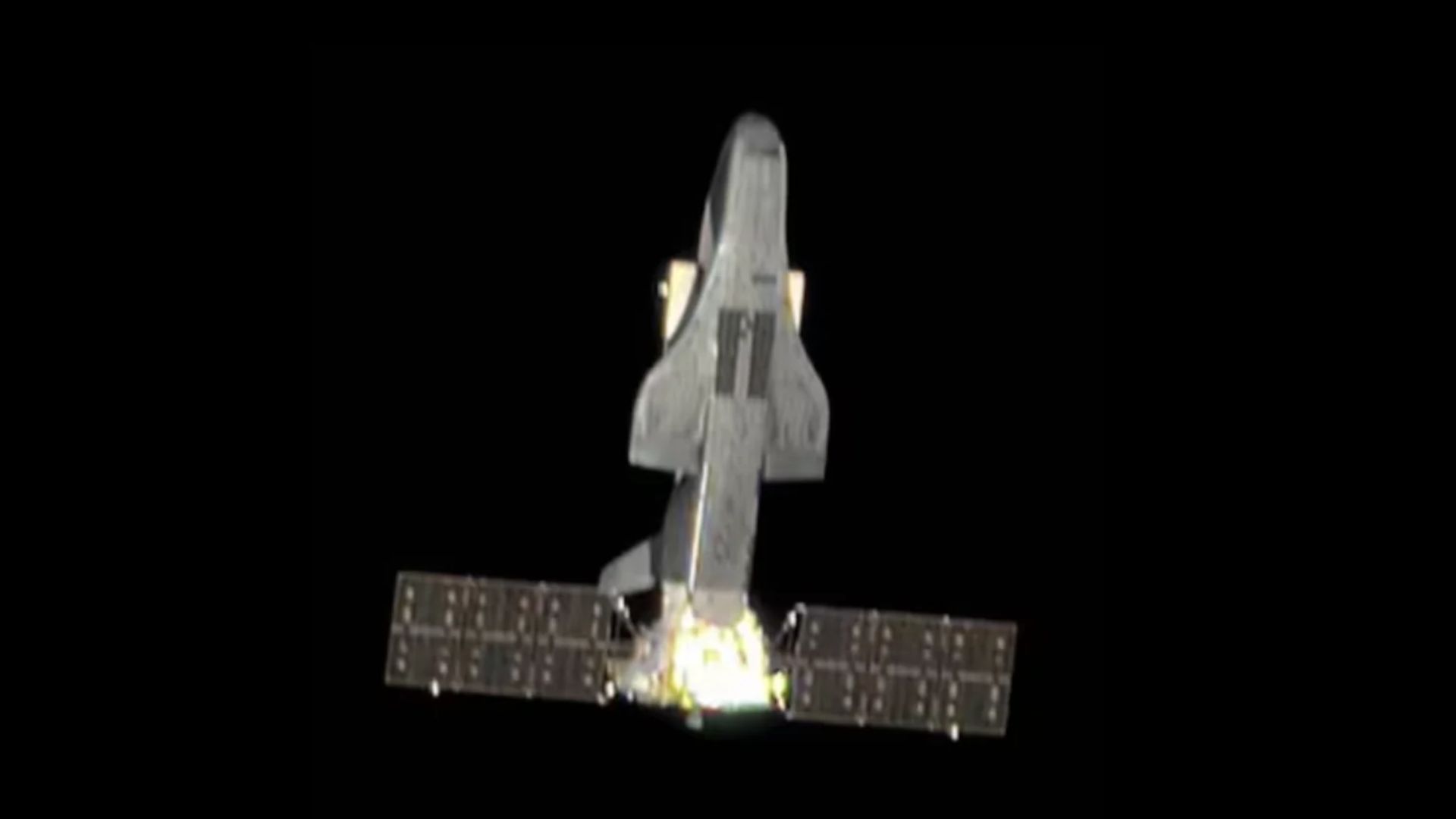
A photograph released by the US Defense Intelligence Agency (DIA) on October 26 shows a delta-wing spacecraft in orbit with its cargo bay doors open. The vehicle is widely believed to be China’s experimental Shenlong spaceplane, though neither the agency nor Beijing has confirmed its identity. A commercial imaging satellite took the photograph on May 28, 2024, from less than 56 miles (90 kilometers) away. The image offers a rare view of a vehicle that China has said little about publicly, even as it continues to test reusable spacecraft. Four days after the photo’s release, Chinese researchers published a study that used computer simulations to test whether a fleet of 40 reusable spaceplanes could shorten the wait to begin a descent toward any point on Earth. What the orbital photo shows The photograph appeared in the DIA’s Challenges to Security in Space report. It was taken by WorldView-3, an imaging satellite operated by Maxar Technologies, now Vantor. Along with the open bay doors, the image shows equipment mounted at the rear of the spacecraft. The vehicle resembles the Boeing X-37B, an uncrewed spaceplane operated by the US military. The X-37B can spend extended periods in orbit and land on a runway after reentry. China has disclosed very few details about its own vehicle’s design, what it carries, or the work it performs in orbit. The reusable spacecraft tests China has flown four missions involving its experimental reusable spacecraft since 2020, with the most recent launch taking place in February. Beijing has described the program as an effort to make access to space more convenient and affordable. According to the DIA, the spacecraft appeared to maneuver alongside a companion satellite during its second mission, which ran from 2022 to 2023. During its third mission, from 2023 to 2024, the vehicle released and interacted with another object in orbit. Operating close to another spacecraft could help with satellite inspection or servicing. Releasing objects in orbit could also support satellite deployment. The DIA attributed those observations to earlier missions, while the newly released image gives a direct view of the vehicle’s open payload bay. Researchers model a fleet of spaceplanes The separate study, led by Du Chongrui at Northwestern Polytechnical University in Xi’an, appeared online on October 30 in Acta Aeronautica et Astronautica Sinica. The researchers used computer simulations to examine how a fleet of reusable orbital vehicles could reduce the wait for a suitable opportunity to return to Earth. For a spacecraft headed to a specific destination, the timing of its departure from orbit matters. It needs to be in a position from which it can leave orbit and reach its destination during atmospheric flight. The researchers highlighted rapid transport and emergency disaster response as potential uses for the concept. Orbital vehicles of this kind could also have military applications. The team used a reference vehicle model for the simulations. Its findings describe when a vehicle in the proposed fleet could begin its return, while the time it would take to reach the ground is a separate question. The study did not use Shenlong’s actual specifications. Get the latest in engineering, tech, space & science - delivered daily to your inbox.Atharva is a full-time content writer with a post-graduate degree in media & amp; entertainment and a graduate degree in electronics & telecommunications. He has written in the sports and technology domains respectively. In his leisure time, Atharva loves learning about digital marketing and watching soccer matches. His main goal behind joining Interesting Engineering is to learn more about how the recent technological advancements are helping human beings on both societal and individual levels in their daily lives.
Rare photo shows China’s suspected Shenlong spaceplane with open cargo bay
Full Article
Original Source
Read the full article at Interestingengineering →KhanList aggregates and links to publicly available news content. We do not host full articles from third-party sources. Always verify important information with original sources.