
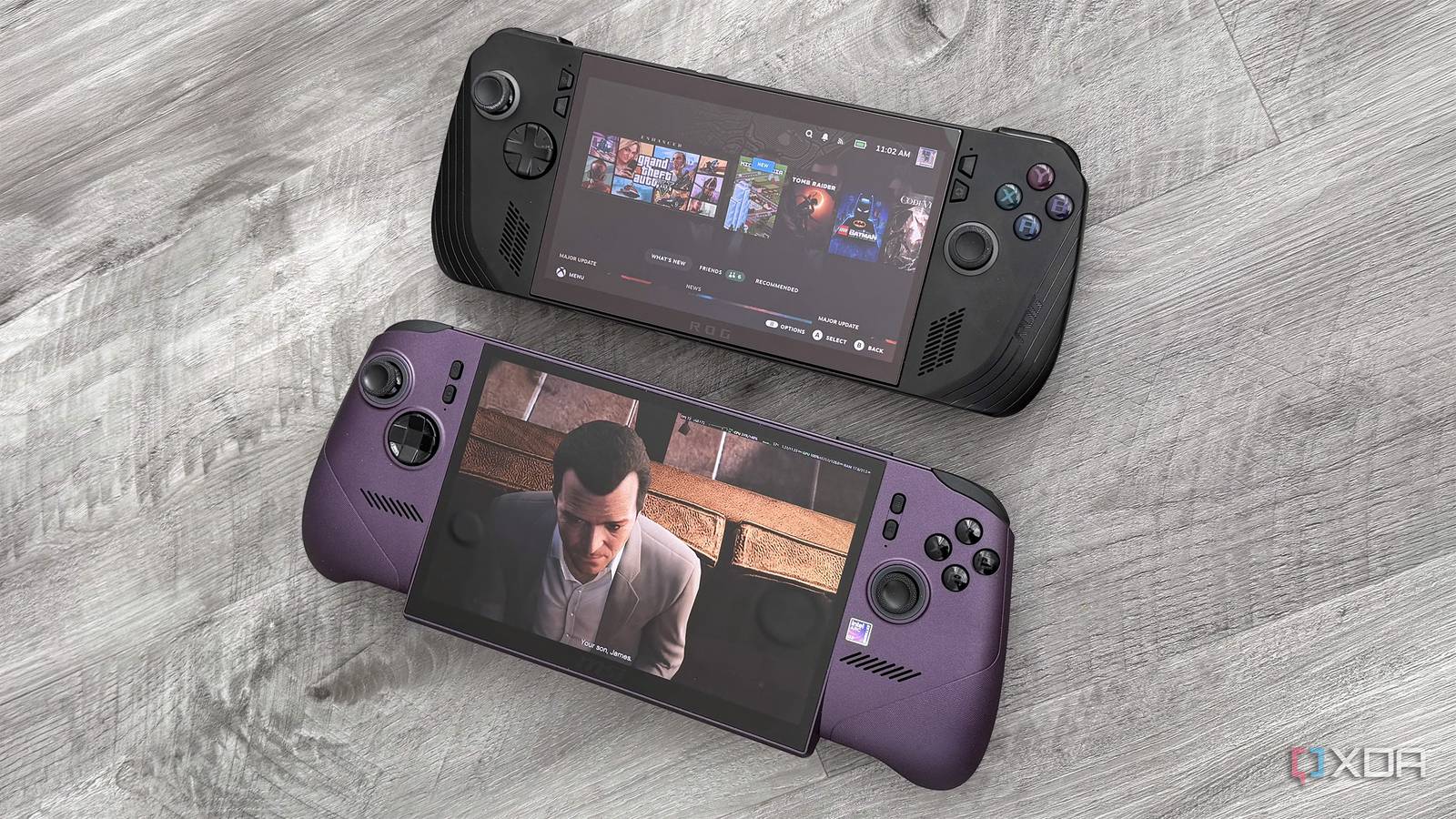
Published Jul 23, 2026, 4:30 PM EDT Maker, meme-r, and unabashed geek, Joe has been writing about technology since starting his career in 2018 at KnowTechie. He's covered everything from Apple to apps and crowdfunding and loves getting to the bottom of complicated topics. In that time, he's also written for SlashGear and numerous corporate clients before finding his home at XDA in the spring of 2023. He was the kid who took apart every toy to see how it worked, even if it didn't exactly go back together afterward. That's given him a solid background for explaining how complex systems work together, and he promises he's gotten better at the putting things back together stage since then. I've spent an unreasonable number of hours tuning my Asus ROG Ally X. It daily-drives CachyOS instead of Windows, because squeezing extra frames out of the same silicon is one of my favorite things. So when Intel showed up with the Arc G3 Extreme, its first chip actually designed for handhelds instead of adapted from a laptop part, I wanted it to be good. AMD has run this market unopposed since the Steam Deck, and monopolies make lazy hardware. The MSI Claw 8 EX AI+ is that chip's debut, and I've been comparing it to my ROG Ally X and to our earlier benchmarks of that device. The short version is that Intel did it. The Arc G3 Extreme beats the Z1 Extreme in the ROG Ally X and the Z2 Extreme in the ROG Xbox Ally X almost everywhere it matters, often by an embarrassing margin, while sipping less power. It should have been the easiest recommendation I made all year, but when MSI put a $1,800 price tag on it, things fell apart. Intel built a handheld chip by sacrificing the CPU, and it worked Two P-cores sounds like a typo but that's the whole strategy The Arc G3 Extreme is a strange piece of silicon on paper. Intel cut the design down to two Performance cores, backed with eight E-cores and four low-power E-cores, and poured the reclaimed power budget into a 12-core Xe3 GPU. The same B390 iGPU that was used in the flagship X9 388H. For a laptop or desktop chip, that trade would be baffling. For a handheld, it is perfect because every watt the CPU uses is one the GPU can't use. The synthetic numbers tell the story cleanly. In 3DMark Time Spy, the Claw 8 EX AI+ scores 4,564 to the ROG Xbox Ally X's 4,033, a 13% lead, with my Z1 Extreme-based ROG Ally X trailing at 3,463. PCMark 10 lands at 8,148 against 7,167, a 14% gap. Geekbench 6 is closer, with 2,786 against 2,771 single-core (a dead heat) and 13,686 against 12,540 multicore. What I find fascinating is that AMD's individual cores are still stronger, with the Z2 Extreme still winning in Cinebench 2024, 112 to 103. Intel didn't out-muscle the Z2 Extreme; it out-budgeted it, shifting the balance with a slower CPU but faster GPU. Games on handhelds are GPU-limited anyway, so this is the right call, unless you want to use that handheld for things other than gaming. Because in the benchmarks, handheld gaming is what matters most, it's a rout. Our review testing put Shadow of the Tomb Raider at 71 fps on the Claw against 43 fps on the ROG Xbox Ally X, a 65% lead. Cyberpunk 2077 with RT Low went 44fps to 25fps, which is the difference between "playable with ray tracing" and "why did you turn that on." Forza Horizon 5 was the closest race at 61fps to 57fps. One near-tie and two blowouts, in real games, on the same class of hardware My own runs back that up. Cyberpunk 2077, using its built-in Steam Deck preset held 51.88fps, comfortably past the point where Night City stops feeling like a slideshow, and Grand Theft Auto V on high settings bounced between 76fps and 100fps depending on how much of Los Santos I was setting on fire. Neither of those is a stress test, but that's the point: in this tier of settings, the Claw doesn't strain. It shrugs. The whole chip is a bet on performance per watt My scheduler patches never stood a chance Raw frames are the easy win. What makes the Arc G3 Extreme clever is how it spends its power to get them. The two P-cores aren't a cost-cutting measure; Intel built a power-sharing layer that parks them at low wattage, handing the E-cores housekeeping and the GPU everything else. The whole design assumes what handheld gamers knew already, that the GPU is the star and the CPU just needs to be there most of the time. The philosophy also flows into the software. Endurance Gaming lets you pin the driver to 30fps, 40fps, or 60fps targets and reduce SoC power to maintain them. Handhelds have needed this, but there's one gotcha. You can use that, or XeSS frame generation, as they're mutually exclusive. Stretched battery life or generated frames is a hard choice, but I'll take longer playing time on any day of the week and twice on Sundays. My tuned ROG Ally X stretches the bounds of what the Z2 Extreme can do, but software tuning only goes so far. It won't beat silicon generations, and I'll probably be putting CachyOS on the MSI Claw before long because Windows 11 is holding it back. The only place the Arc G3 Extreme will struggle is with CPU-heavy emulation and simulation titles, but overall, this is a home run out of the park for Intel in its first purpose-built attempt against AMD's handheld crown. Then you see the price and the whole argument collapses The math isn't mathing The MSI Claw 8 EX AI+ costs $1,800. The ROG Xbox Ally X, the device it beats, costs $999. My ROG Ally X has an MSRP of $900, which means I could buy two of them for the price of one Claw and have $0 left over for games, which is fitting, because after spending $1,800 on a handheld, I wouldn't be able to afford any. The value math is brutal. Against the ROG Xbox Ally X, you're paying an 80% price premium for a 13% Time Spy lead and game gains ranging from 7% to 76% (at least in our tests). Even taking the most generous number, the price rises faster than the gains. Sure, that's never going to be a disqualifier for a halo product, and the Claw is once again the best handheld you can buy right now. But "best" doesn't always mean "worth it," and I drew that line around $1,000. Before you think I'm dragging MSI here, I'm not. Memory and storage prices have climbed across the entire PC market, and the Claw comes with 32GB of LPDDR5x-8533 memory and a 1TB SSD. First-gen silicon is never cheap. Intel has a non-Extreme Arc G3 coming, which drops the CPU frequency a touch and uses a B370 iGPU instead, which should be less of a shock to the wallet. That said, knowing why the price is high doesn't make it lower. At $1,800, this handheld isn't competing with other handhelds anymore; it's competing against gaming laptops or serious desktop PC upgrades, or a console with three years of new games. That's the comparison any normal buyer is going to make, and the Claw loses it to almost everything. Intel won the benchmarks, but my wallet still votes AMD Here's where I land after all the charts, benchmarks, and hours on hours of testing. The Arc G3 Extreme is the most exciting thing to happen to handheld silicon since the Steam Deck arrived on the scene. The MSI Claw 8 EX AI+ proves it beyond argument, with ample data to back it up. Every number shows Intel built the better chip this time around, and now AMD has to respond. I'd like Nvidia to get into the handheld game, but they seem to want to push the high-power silicon instead. As a product you'd hand over $1,800 for, my brain rebels at the idea. My cheaper, aging ROG Ally X cost half as much, and still plays everything I want to throw on it, thanks to CachyOS, and the Xbox Ally X remains the sane buy at this tier for anyone that doesn't already have a PC gaming handheld. This is two years in a row that MSI has put an Intel chip into a handheld and produced both the most powerful and most expensive device on the market from the mainstream brands. Gaming handhelds are getting too expensive across the board, and the Claw is the poster child. If Intel can get this silicon into a $900 device, then it's game on. Until then, it's a victory lap for engineers and a shrug for everybody else. MSI Claw 8 EX AI+ CG3EM Dimensions 296 x 130 x 25-48 mm Weight 785 g Chipset Intel Arc G3 Extreme RAM 32GB LPDDR5x Storage 1TB M.2 Gen4 NVMe SSD Wireless Connectivity Wi-Fi 7 and Bluetooth 6 Asus ROG Ally X Dimensions 11.02 x 4.37 x 1.45 inches (280mm x 111mm x 36.9mm) Weight 1.49 pounds (678 grams) Chipset AMD Ryzen Z1 Extreme Processor (8 cores/16 threads, up to 5.10 GHz boost) RAM 24GB LPDDR5 7500 MHz Storage 1 TB M.2 2280 NVMe PCIe G4x4 SSD Wireless Connectivity Wi-Fi 6E & Bluetooth 5.2 ROG Xbox Ally X Dimensions 290.8x121.5x50.7mm Weight 715g Chipset AMD Ryzen AI Z2 Extreme Processor 8c/16T Zen 5 up to 5 GHz boost – RDNA 3.5 16CU up to 2.9Ghz boost - up to 50 TOPS NPU RAM 24GB LPDDR5X-8000 Storage 1TB M.2 2280 SSD for easier upgrade Wireless Connectivity Wi-Fi 6E (2 x 2) + Bluetooth 5.4
The MSI Claw 8 EX AI+ has the power to beat the ROG Ally X, but the price makes it hard to care
Full Article
Original Source
Read the full article at Xda-developers →KhanList aggregates and links to publicly available news content. We do not host full articles from third-party sources. Always verify important information with original sources.