
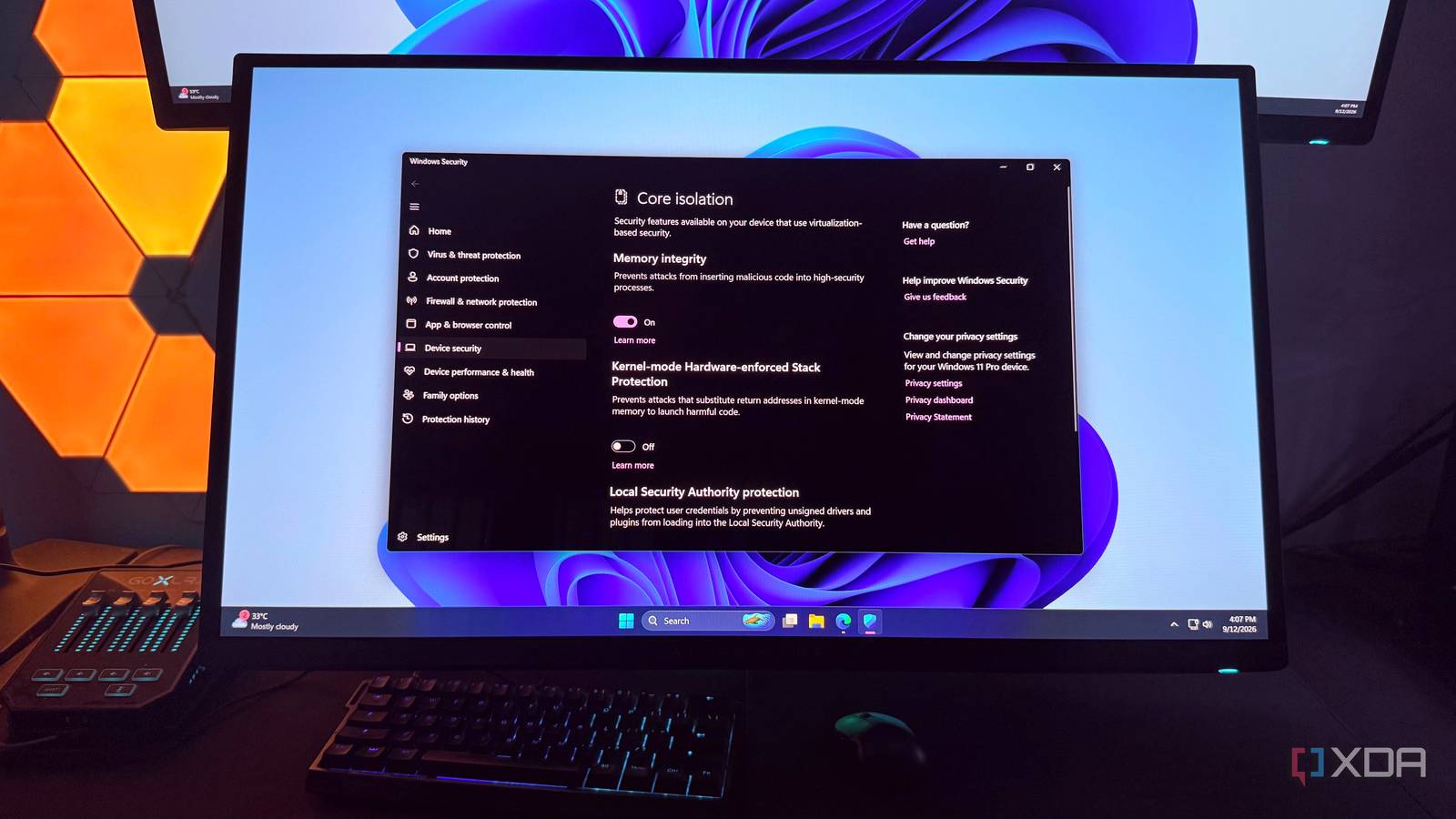
Published Sep 13, 2026, 7:00 PM EDT Hamlin has been in the tech field for over nine years. Since 2017, his work has appeared on MakeUseOf, Android Police, OSXDaily, Beebom, and more. He served as the Senior Editor at Valnet's MakeUseOf for over two years before joining XDA. He uses a high-end gaming rig for desktop use and a MacBook for traveling, but dislikes some of the quirks of macOS. You're more likely to catch him at the gym or on a flight than anywhere else. Microsoft is about to make one of Windows 11's core security features a lot harder to ignore. The next Patch Tuesday update, rolling out on October 13, 2026, will automatically enable memory integrity on more eligible Windows PCs. If you've poked around Windows Security before, this may not sound like news. After all, memory integrity has been around for years, and Microsoft already enables it by default on clean Windows 11 installations if your PC meets its requirements. The difference this time, however, is who Microsoft is expanding that default protection to. For instance, if you upgraded from Windows 10 to Windows 11 at some point, there's a chance memory integrity is still disabled even if your hardware supports it. That's what Microsoft is addressing with this rollout. While that's good news from a security standpoint, enabling memory integrity can prevent incompatible drivers from loading, which means some of your older hardware that relies on those drivers may not work. Memory integrity clashes with some older drivers Windows won't let them load if they don't meet its security requirements The easiest way to understand why this happens is to look at what memory integrity actually does. Memory integrity uses virtualization-based security to run Windows' code integrity checks in an isolated environment that the kernel itself can't directly interfere with. Before Windows lets kernel-mode code run, It checks it there first. And that matters because drivers operate at the kernel level and have far more access to your PC than a normal app does. So if malware manages to exploit a vulnerable driver, it could potentially use those privileges to compromise parts of Windows that'd otherwise be off-limits. Enabling memory integrity makes that much harder by imposing stricter requirements. The problem is that some perfectly legitimate drivers don't meet those requirements either, and older drivers are more likely to run into compatibility issues because they may have been written without memory integrity in mind. If Windows deems one of those drivers incompatible, it can prevent it from loading altogether. Blocking a driver can take your hardware down with it It doesn't matter if the device itself works perfectly fine Credit: This is the part I'd pay attention to before the October rollout. If Windows blocks a driver, whatever depends on that driver may stop working properly. For instance, if you have a Logitech webcam that relies on a legacy driver, you may not be able to use it if Windows blocks that driver. Other USB peripherals like audio interfaces can also run into the same problem if they depend on drivers that aren't compatible with memory integrity. Even popular software tools can be affected. A good example is Intel XTU, which I've used to undervolt my laptop in the past, since it relies on kernel-level drivers for CPU tuning. Microsoft even warns that incompatible drivers can cause boot failure or BSODs in rare cases. Updating the driver may be all it takes to fix the problem, but if the manufacturer abandoned the hardware years ago, that's unlikely to be an option for you. The good news is Microsoft isn't forcing it But that doesn't mean you won't encounter incompatible drivers later It's not like Microsoft is going to flip the toggle on all Windows PCs starting October 13. First of all, this is a gradual rollout, so not every eligible PC will get it at the same time. And even if your PC meets the hardware requirements and you have virtualization enabled in the BIOS, Windows checks for incompatible drivers before enabling it. Microsoft also says existing user choices will remain unaffected. So if you've already disabled memory integrity yourself, this rollout won't automatically turn it back on. That's why it's a good idea to open Windows Security and go to Device security -> Core isolation details to see if memory integrity is already enabled. If it's not, try enabling it, and Windows will let you know if an incompatible driver is getting in the way. But having compatible drivers now doesn't mean you won't run into problems later. You could connect an older peripheral down the line that relies on an incompatible driver, and that's when Windows may hit you with the "A driver can't load on this device" message. If you can't find an updated driver, you can always disable memory integrity again, but I'd only do that as a last resort. Most PCs should be fine, but now is a good time to check yours You still have plenty of time to review your memory integrity settings before Microsoft rolls out this change in mid-October. I wouldn't disable it preemptively just to stop Windows from auto-enabling it because the last thing you want is an attacker taking advantage of a vulnerable driver to get kernel-level access to your PC. Since Windows checks for incompatible drivers before flipping the toggle, you're unlikely to even notice that something has changed. But just keep this in mind the next time you connect an older peripheral.
Microsoft is putting your Windows drivers on trial this October, and some of your devices may no longer work
Full Article
Original Source
Read the full article at Xda-developers →KhanList aggregates and links to publicly available news content. We do not host full articles from third-party sources. Always verify important information with original sources.