
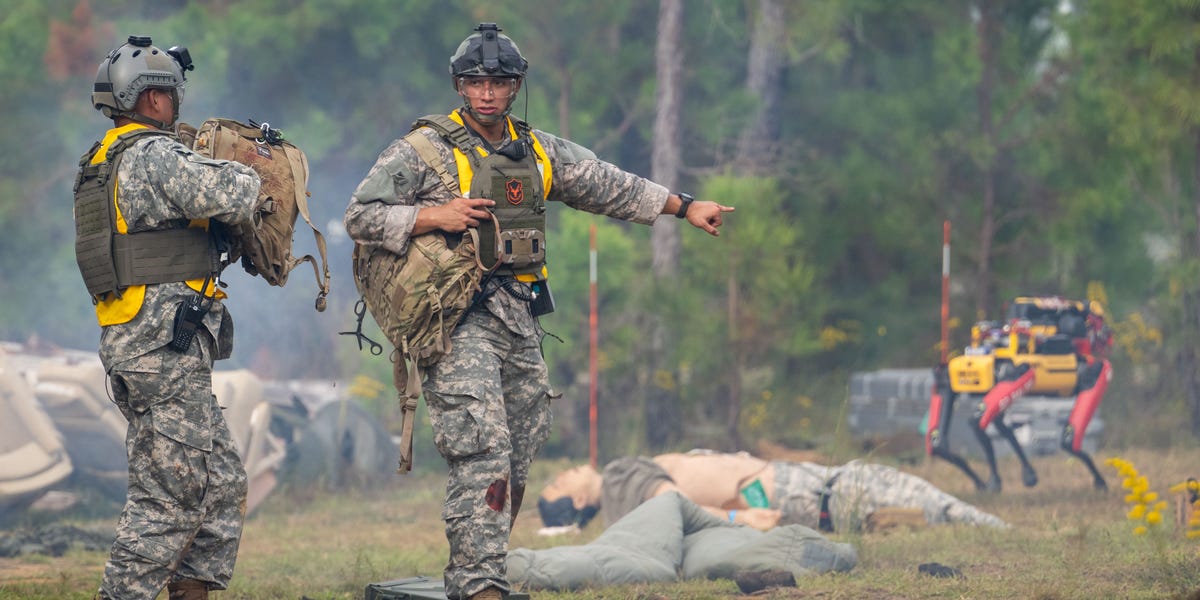
The military tested robots to help medics find wounded troops and decide who needs help first Paul Flacks/DARPA Medics working alongside a ground robot prepare to treat simulated casualties during a DARPA Triage Challenge event in September 2025. The competition concluded earlier this month. Earlier this month, drones and ground robots searched simulated disaster zones in a competition testing whether machines could help military medics quickly find casualties and identify which needed lifesaving care first. It was all part of the Defense Advanced Research Projects Agency's "Triage Challenge," an event meant to test companies and universities on whether their tech could be a viable solution for medics on future battlefields filled with enemy drones and AI.DARPA is the Pentagon's research arm tasked with finding potential answers to tough military problems, like how missiles can strike their targets when GPS disappears and how to stop adversaries from wrecking havoc on economic markets.At the Disaster City facility in College Station, Texas, a facility built to replicate disasters to test emergency response teams, medics and robots faced scenarios like responding to tornado destruction and a nighttime attack on a military outpost.Ground robots and drones had 15 minutes to find actors and mannequins representing wounded troops and civilians. In another test, they were given the casualties' locations and had five minutes to assess how urgently they needed help. A medic and an unmanned ground vehicle search for casualties as an planned explosion detonates in the background, part of the DARPA Triage Challenge on Nov. 13th, in College Station, Texas. Paul Flacks/DARPA The machines also had to identify injuries, check whether casualties responded, and decide who needed to be evacuated first — all without touching patients.Jeremy Pamplin, the event's program manager and a retired Army physician, told Business Insider in September that rapid triage focused on severe bleeding and breathing problems, identifying someone a medic needed to reach immediately."Teams have to get out there, recognize these problems really fast and say, 'yep, that's somebody you got to go see right now," he said. Robots and drones could help medics find "needles in the haystack," he said of simulated patients, "to try to save the most lives they possibly can."Military officials have previously warned that the US military is unlikely to control the air in future conflicts, potentially leading to major casualty evacuation challenges the US military has not experienced in decades. That prospect has prompted medical units to begin training to treat frontline casualties for days, or even weeks, before they might receive advanced care. Drones scouted ahead of medics and ground robots, sending casualty information to the medics' phones. A separate element of the event tested whether algorithms could predict what treatment patients would need hours later.In a major war, medics may have to focus scarce resources on casualties they can save, an ethical dilemma most medical providers in the US military have little experience confronting.Pamplin hopes technology can help medics make such decisions with better information. Robots could locate and assess casualties while predictive algorithms help medics anticipate what treatment each patient needs and how long they can wait.That type of mechanical help might aid medics not just by saving more lives, he said, but also by "relieving the burden of doubt from our young medics and war fighters as they're trying to manage those situations." Read next Business Insider tells the innovative stories you want to know Business Insider tells the innovative stories you want to know Business Insider tells the innovative stories you want to know Business Insider tells the innovative stories you want to know Kelsey Baker is a military affairs reporter with Business Insider. She joined in 2025 and covers military personnel issues and how the military is overhauling how it prepares for future conflicts.Prior to joining BI, she worked at The Washington Post as a Military Veterans in Journalism Fellow covering human interest stories and international news and at The Chronicle of the Horse magazine covering horse sports. She holds a graduate degree in Journalism from Northwestern University, a degree in Diplomacy from Norwich University, and an undergraduate degree in History from the University of Denver. She previously served in the Marine Corps as a logistics officer, and later in the reserve.Contact her via email at kbaker@businessinsider.com, or via Signal at KelseyBaker75.75. Use a personal email address, a nonwork WiFi network, and a nonwork device; here's our guide to sharing information securely.
The military tested robots to help medics find wounded troops and decide who needs help first
Full Article
Original Source
Read the full article at Businessinsider →KhanList aggregates and links to publicly available news content. We do not host full articles from third-party sources. Always verify important information with original sources.