
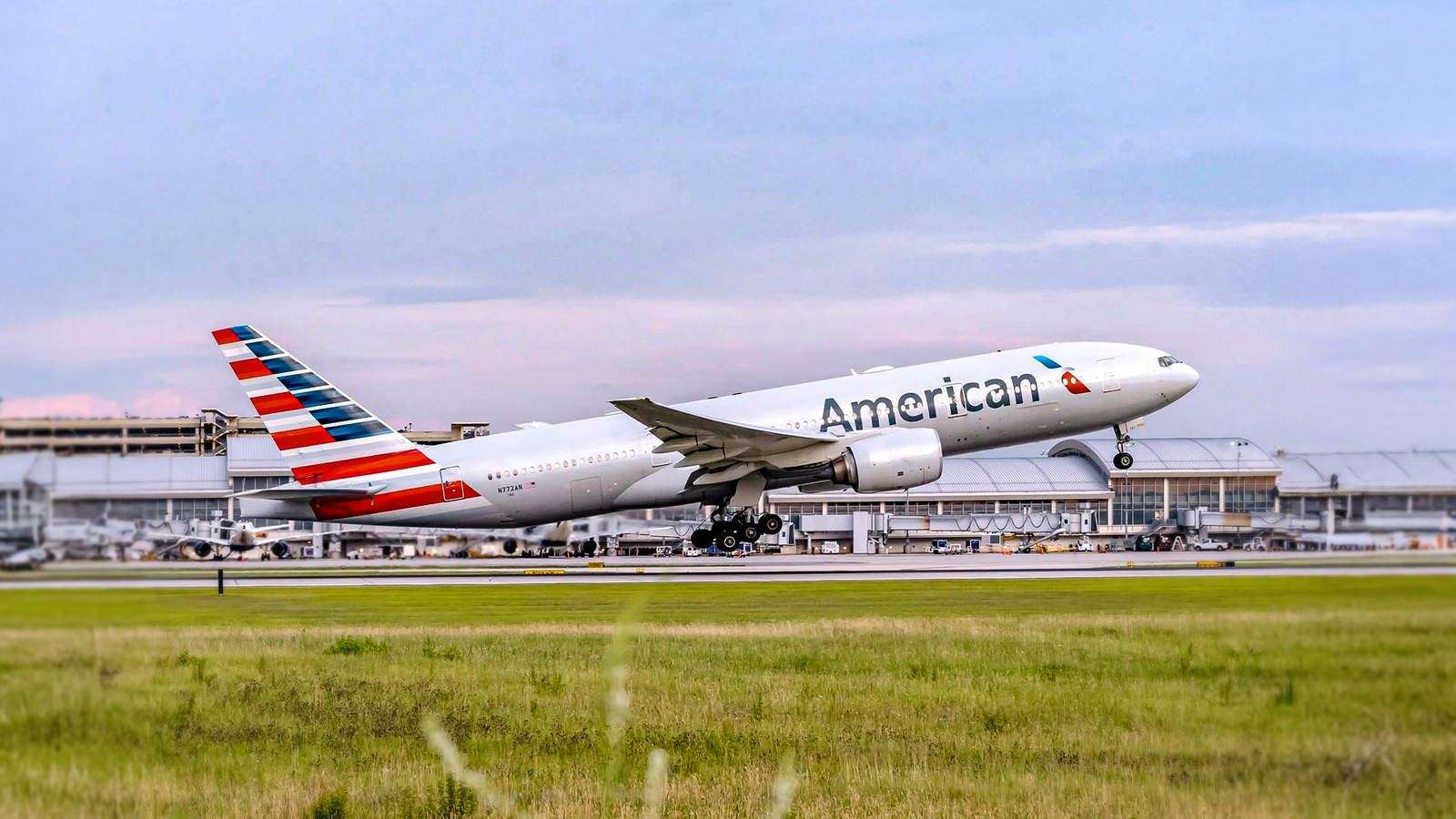
Despite American Airlines' second-largest hub just 130 miles (209 km) away at Charlotte Douglas International Airport (CLT), it operates daily, year-round transatlantic service on a 273-seat Boeing 777-200ER from Raleigh–Durham International Airport (RDU) to London Heathrow (LHR). RDU deviates from the conventional hub-and-spoke network conventions by diverting over 140,000 overseas passengers yearly. The route boasts a strong 75-80% load factor, versus roughly 70% of Charlotte's traffic, which is made up of connecting flyers. One of the reasons it's surprising for a dedicated widebody jet to be stationed at an outstation is the absence of existing maintenance reserves or spare airframes. That creates a quantifiable operational risk, as any unforeseen technical delay at RDU requires AA to transfer parts or retrieve aircraft from a hub. However, because flight AA174's point-to-point revenue profile outperforms the lower-margin connecting traffic through Charlotte's regional flights, network AA continues to employ the big jet out of RDU. The business case rests on twin high-yield revenue pillars produced by North Carolina's Research Triangle Park business flyers and delicate, high-value cargo. These two demand streams are the foundation of this operational outlier. AA maintains a profitable transatlantic corridor between RDU and LHR thanks to pharmaceutical, biotechnology, and technology companies. That customer base regularly fills the aircraft's 37 Flagship Business seats and delivers premium rates to ship sensitive cargo inside its generous lower hold. Why American Airlines Bypasses Its Charlotte Hub For Raleigh Credit: Vytautas Kielaitis | Shutterstock Nearly seven out of ten travelers simply switch aircraft between regional spokes and international flights in Charlotte, which functions as a conventional connecting hub. By attracting cheaper connecting customers from smaller airports throughout the Southeast, transatlantic planes departing from Charlotte fill their seats. American must fill those cabins almost to capacity in order to offset the high fuel and crew expenses associated with widebody travel because reduced economy tickets have narrow profit margins. AA route planners calculate an entirely different revenue mix from Raleigh-Durham. This market, which is fueled by Research Triangle Park, draws executives from the pharmaceutical, tech, and research industries who travel immediately to Europe. Over 140,000 passengers take this flight annually, with corporate travelers willingly paying full fare for Flagship Business seats. Those high-yield tickets generate strong profits on the Boeing 777-200ER even when the cabin flies at a steady load factor. While just 31.7% of American’s traffic at CLT is origin-and-destination, RDU is the exact opposite. In fact, RDU–LHR ranks as North Carolina’s largest local O&D market to Europe. The table above illustrates the difference with Department of Transportation statistics, flight data from Road Genius, and market share figures from Air Service One. Major corporations in the Research Triangle are eager to avoid three extra hours of backtracking on a regional jet to Charlotte during busy business trips. If American pulled its nonstop London service, those lucrative corporate contracts would immediately shift to rival carriers offering direct transatlantic flights from Raleigh. Keeping a dedicated widebody on this route protects North Carolina’s highest-yielding point-to-point traffic and locks competing airlines out of a prime corporate market. How oneworld Holds Down Raleigh–Durham From Rival Alliances Credit: Ronen Fefer | Shutterstock Stationing a dedicated Boeing 777 at Raleigh-Durham also serves as a strategic deterrent against counter-point AA and oneworld's airline alliance rivals. SkyTeam carrier Delta Air Lines has its own focal city operation at RDU, while its partner Air France has nonstop service to Paris. Simultaneously, Star Alliance foe Lufthansa serves Frankfurt for the same airfield. Without American's direct connection to London Heathrow, domestic and international competitors alike would soon capture North Carolina's corporate air travel demand and pull customers away from oneworld. American defends that turf through the Atlantic Joint Business, a revenue-sharing agreement between AA and British Airways. By coordinating schedules and airfare, the two alliance carriers make RDU-LHR a simple, one-stop gateway for travelers from the Carolinas to reach Europe, India, or the Middle East. AA’s steady upgauging on this route proves how fiercely it guards this market. It originally launched the London run with a single-aisle Boeing 757-200, but stepped up to a 767-300ER, until demand encouraged the carrier to eventually commit to a 273-seat 777-200ER. AA also assigns its 304-seat flagship 777-300ER during peak seasonal surges. How American Balances Fleet Trade-Offs On The Raleigh Route Credit: American Airlines While its twin-engine design keeps the 777-200ER profitable on the RDU-LHR route, operating an older aluminum airframe still has its trade-offs compared with newer widebodies like the Boeing 787 Dreamliner. At an empty weight of 304,500 pounds (138,100 kg), the 777 burns noticeably more fuel per crossing, and its aluminum fuselage limits cabin pressurization to an 8,000-foot (2,438 m) altitude with drier air. However, the 777-200ER holds four more LD3 cargo containers than a composite-built 787-8, allowing pharmaceutical freight to pay the bill for extra fuel. Financially, flying an older widebody works in AA's favor as well, since the carrier owns its 777-200ER fleet outright. Instead of paying a monthly lease or loan bills for brand-new aircraft, American collects more profit per mission on the paid-off jet. Even when mechanical issues at RDU require flying in spare parts, low aircraft ownership costs give the airline a financial cushion to absorb occasional disruptions without hurting annual route profits. Inside the cabin, American tailors every row to match RDU's specific market demographics of business and leisure flyers. Up front, 37 lie-flat Flagship Business suites with direct aisle access capture full-fare corporate contracts, while 24 premium economy recliners appeal to upscale vacationers. Behind them, 212 Main Cabin seats are ready for peak summer demand, illustrating how smart cabin layout turns a veteran airframe into a transatlantic moneymaker. Credit: American Airlines Most passengers see the Boeing 777-200ER as a transatlantic people mover, but its large belly hold quietly powers a key economic link between North Carolina and Europe. The cargo volume beneath the passenger deck is 5,330 cubic feet (150.9 cubic meters), which can comfortably accommodate 32 LD3 containers as well as checked luggage. That massive underfloor volume transforms flight AA174 into a nightly freight corridor that connects two key global research economies across the Atlantic. Nearby Research Triangle Park is home to significant clinical and manufacturing hubs for pharmaceutical companies such as Pfizer, Biogen, and GSK. These labs constantly ship delicate biological samples, active drug ingredients, and precision medical hardware into European distribution networks via London Heathrow. Nonstop widebody capacity is an operational necessity for regional logistics teams since transporting temperature-sensitive biotech freight down the highway to bigger hubs like Charlotte or Atlanta runs the risk of spoilage and customs delays. For direct transatlantic air freight, life sciences shippers are ready to pay premium four-figure rates per climate-controlled pallet. Even mid-sized widebodies forfeit important freight room, and smaller narrowbody jets lack the cargo door dimensions and hold volume to carry palletized medical containers. AA maintains a lucrative flight even during the poor winter traffic months by using the 777-200ER on this route, which generates high-margin cargo revenue to offset heavy fuel burn. How The Triple Seven Powers Long-Haul Economics Credit: Vytautas Kielaitis | Shutterstock Today, the vast majority of quadjets like the Boeing 747s and Airbus A380s have been decommissioned as the post-pandemic aviation market strongly favors twinjets. For flyers on the Raleigh–London route, the cabin delivers 37 lie-flat business suites and 24 roomy premium economy seats, while its 199-foot 11-inch (60.9 m) supercritical wing allows the jet to cruise smoothly at Mach 0.84. Because industry-wide manufacturing delays have slowed deliveries of newer widebodies, American relies on its paid-off 777-200ER to protect its valuable LHR landing slots and capture RDU's overseas traffic. By blending proven reliability, right-sized capacity, and twin-engine economics, the aircraft remains irreplaceable on the RDU–LHR run. Boeing's engineering has made the 777 a pioneer of twinjet flying for three decades, and today it delivers the exact range and payload needed for year-round crossings on the 3,892-mile (6,264 km) Raleigh–Durham to London Heathrow corridor. The 777-200ER achieves a profitable daily schedule thanks to its high-bypass engine design, which channels roughly 80% of incoming air around the core to maximize fuel efficiency. Powered by twin Rolls-Royce Trent 892 turbofans generating 92,000 pounds of thrust (409 kN) each. Even during hot summer departures off Raleigh’s 10,000-foot (3,048 m) runway at its 656,000-pound (297,556 kg) maximum takeoff weight, the twinjet climbs safely with wide engine-out margins. The Next-Generation Succession On The Horizon Credit: Vytautas Kielaitis | Shutterstock Older twinjets and four-engine aircraft are gradually slipping out of service in the global aviation industry as aged frames and growing maintenance costs snowball. However, because of its unparalleled payload versatility and structural longevity, AA's fleet of Boeing 777-200ER aircraft continues to evade the boneyard. American has even invested in interior modifications to keep these seasoned workhorses flying well into the 2030s. Long-range single-aisle aircraft like the Airbus A321XLR will not be able to replace American's 777-200ERs when they ultimately retire. While a narrowbody can easily fly the 3,892 nautical miles (7,208 km) to Heathrow, it lacks the underfloor space for palletized pharmaceutical cargo. A real widebody replacement for the 777-200ER is needed, one that can transport heavy life-science cargo alongside upscale business cabins during sweltering summer takeoffs in North Carolina. While the rival Airbus A350-1000 is already in commercial service, AA is not ready to retire its 47 active 777-200ERs just yet. Meanwhile, Boeing’s next-generation 777X family remains delayed in federal certification testing, and no United States carrier has placed an order for the program yet. Even so, the smaller 777-8 variant could eventually prove to be the true successor to the 777-200ER due to its closely matched capacity. Until then, the veteran triple seven remains the reliable workhorse AA counts on every day.
The Metrics Behind American Airlines Reserving 1 Boeing 777 To Fly Transatlantic From Raleigh–Durham Even Though There's Charlotte
Full Article
Original Source
Read the full article at Simpleflying →KhanList aggregates and links to publicly available news content. We do not host full articles from third-party sources. Always verify important information with original sources.