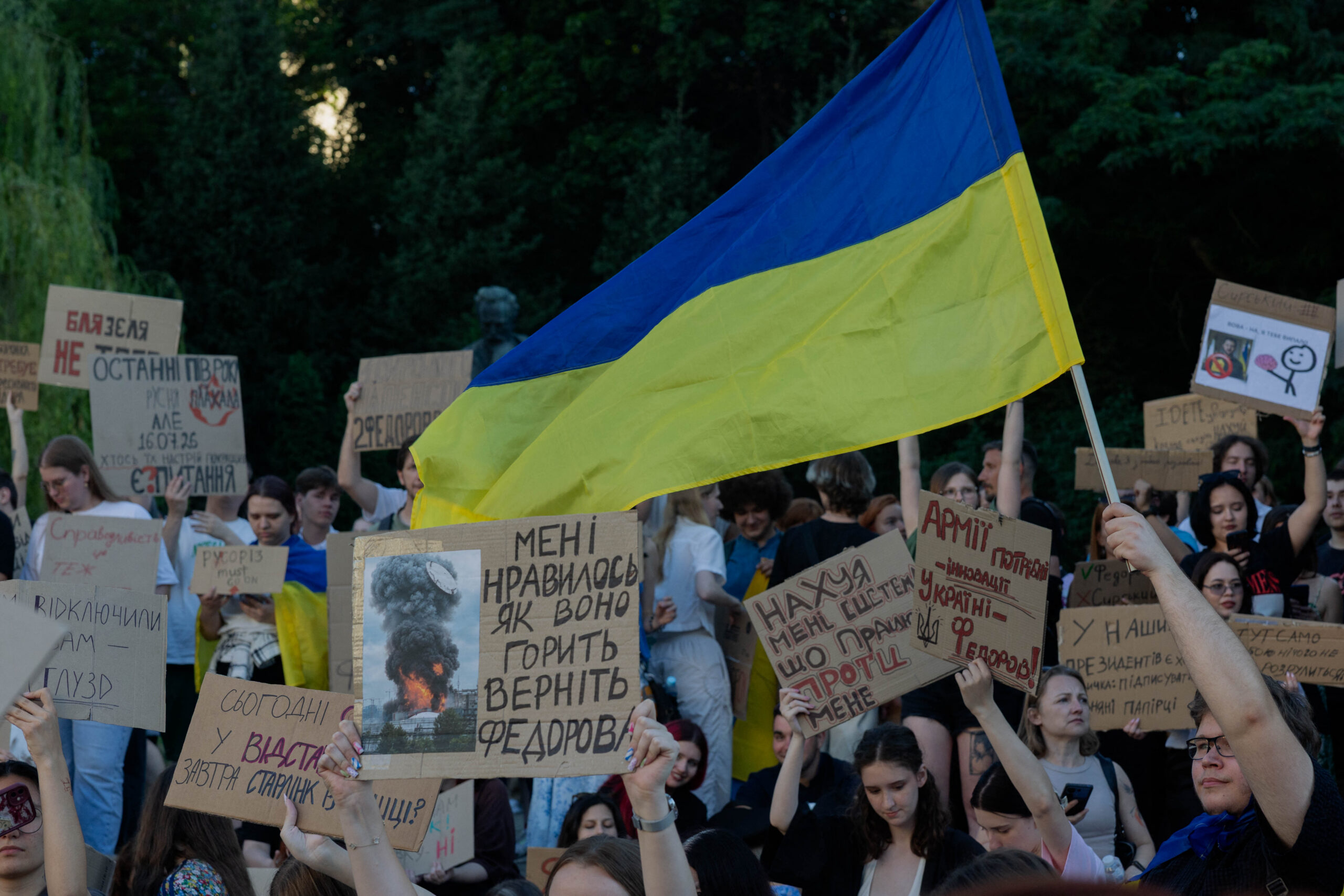
Foreign policy Division and strife are undermining Ukraine’s already troubled war effort. Photo by Tetiana Dzhafarova / AFP via Getty Images On January 14, 2026, Mykhailo Fedorov was appointed Ukraine’s minister of defense. Just six months later, he was dismissed. One of Fedorov’s principal tasks, bigger even than addressing the shortage of Patriot interceptors, had been reforming his country’s recruitment and mobilization system. But manpower shortages remain a chronic issue, forcing the government to resort to unpopular solutions like “busification” (the Ukrainian term for the seizure of draft-age men by mobile patrols). Harsh measures like these led to large protests in the city of Lviv earlier this month, and are a flashpoint in Ukrainian society. But the real reason behind his firing may be something else—namely the risk of exposing the popular myth of how Ukraine has turned the tide both in the war and in its internal fight against domestic corruption. For several weeks, the governments and media of Ukraine and its Western partners have pushed the narrative that, thanks to innovations in drone technology, procurement, and strategy, Ukraine has not only blunted Russia’s advance, but is now actually winning the war. The facts, however, do not bear this out. Successful Ukrainian drone strikes deep into Russia are indeed causing problems for Moscow, but they are not changing the calculus where it counts: the battlefront of eastern Ukraine. While Zelensky distracts public opinion with footage of drone strikes on refineries, Russian troops continue a grinding offensive in the Donbas. Though local conditions vary, in the aggregate Ukraine is consistently losing more territory than it is retaking (Russia has not suffered a monthly net loss of territory since the fall of 2023). The prospect of Russia eventually achieving control of the Donbas—one of its central war aims—remains eminently thinkable. This reality helps explain why Zelensky would seek to remove his defense minister. If the tide were indeed turning in Kiev’s favor, dismissing one of the figures most responsible for this success would make little sense. But when we take in the whole picture—persistent manpower shortages, ineffective counterattacks, a collapsing position in places like the fortified city of Konstantinovka—the move becomes more understandable. And as we have seen, the shift to mid- and long-range drone warfare, one of Fedorov’s key priorities, cannot by itself reverse the situation. (It should also be noted that, as Ukraine’s former commander-in-chief noted recently, “Russia retains the ability to strike back with equal or greater force;” Putin’s retaliation, which includes the use of ballistic and hypersonic missiles, tends to inflict greater damage than Ukraine’s own strikes into Russia.) Fedorov himself had blamed the commander-in-chief of the Ukrainian Armed Forces Oleksandr Syrskyi personally for Ukraine’s escalating battlefield losses. “War has changed completely,” Fedorov said. “Under this arrangement [with Syrskyi as commander], I personally do not know how the war can be won.” Meanwhile, Syrskyi and many of Ukraine’s other senior generals were unimpressed by Fedorov’s drone strategy, instead favoring a focus on more traditional tactics, including casualty-heavy assaults. Fedorov was the face of high-tech drone warfare; Syrskyi was the face of conventional warfare. The battle between the two had become critical. “Well, I cannot allow the ministry of defence and the general staff to be fighting each other while the country is at war. Ideally, both should be replaced. But I cannot do that at the same time,” Zelensky said. It was an untenable situation. “If the sides can’t resolve an issue, I will have to resolve it,” Zelensky conceded, and did so by sacking Fedorov. But this provoked an immense backlash inside Ukraine. So a week later, Zelensky yielded to public pressure (and, perhaps, too, to dissent within the military) and fired Syrskyi as well. In addition to his views on strategy, Fedorov had also stepped on a number of toes by discussing the culture of corruption in defense procurement. The long-range drone program cost a lot of money, and Fedorov found that money by terminating lucrative contracts with companies that were well connected to the government and the general staff. His audit identified billions in overspending, and he blocked heretofore favored defense companies from receiving further contract awards. Subscribe Today Get daily emails in your inbox But perhaps Fedorov’s gravest sin, at least in Zelensky’s eyes, was that his popularity as a talented military reformer was beginning to make him look like a political threat. Syrskyi, meanwhile, was an older, more conventional, and less charismatic figure, with little chance of attracting the attention that Fedorov had gotten both at home and abroad. Zelensky has a history of sidelining potential rivals. Former commander-in-chief Zaluzhnyi was pushed out of the spotlight by being made ambassador to the United Kingdom. Kyrylo Budanov, the head of Ukraine’s military intelligence, had a series of public disagreements with Zelensky (on religious policy, on Ukraine’s capacity for drone warfare, and on prospects for peace), and the end result was his transfer to the position of Zelensky’s chief of staff, thus ensuring he would remain in the president’s shadow and own whatever problems arose. The dismissal of Fedorov can thus be read as a continuation of this trend. It challenges much of the hopeful narrative about Ukraine’s prospects, both for this war and for whatever comes next.
The Meaning of Fedorov’s Firing
Full Article
Original Source
Read the full article at Theamericanconservative →KhanList aggregates and links to publicly available news content. We do not host full articles from third-party sources. Always verify important information with original sources.