
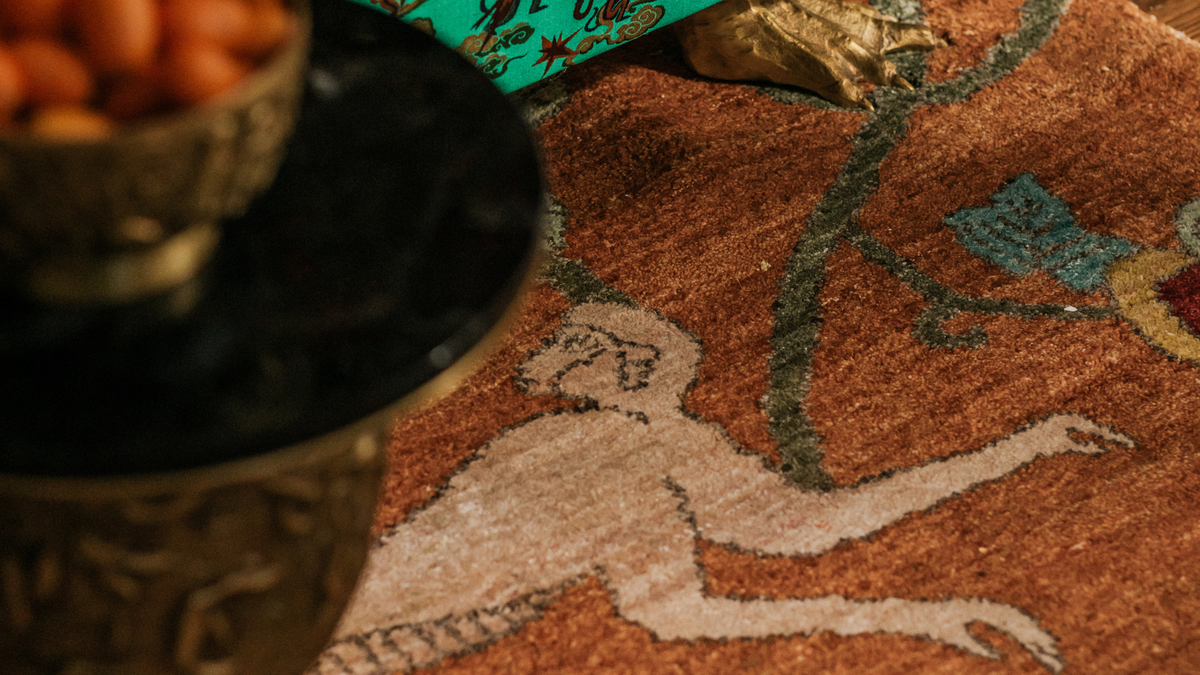
Last month, during London’s Frieze week, Indian designer Vikram Goyal transformed two rooms at 7 Grafton Street into Wings & Tales, a fantastical interpretation of the Ramayana. The Georgian townhouse in Mayfair saw monkeys carrying flags and firecrackers and crocodiles emerging from embroidered brocades.Weeks later, at a dinner in the city, I found myself in conversation with someone from a magazine who was still talking about the salon-style exhibition. It was telling. During a week when Frieze and PAD London increasingly double as social circuits, Goyal had offered something different: time to sit, absorb and understand the stories behind the objects. The choice of a townhouse felt especially fitting for this intimate proposition. As art consultant Tahira Chawla, who attended the exhibition, observed, fairs rarely allow visitors to fully appreciate the craftsmanship or the making of a piece. Art consultant Tahira Chawla | Photo Credit: Getty Images Goyal’s approach comes amid a growing international presence for Indian creatives, from designer Ashiesh Shah’s copper-led Taamr exhibition at Ladbroke Hall to Gaurav Gupta’s theatrical couture presentation at Harrods. Rahul Mishra, too, explored craftsmanship and heritage in conversation with actor Priyanka Chopra Jonas at a London event last year. Yet Goyal made dialogue the very premise of his showcase.Ruth Ganesh, principal trustee of Elephant Family, the U.K.-based NGO dedicated to protecting Asian elephants, put it rather beautifully: “It felt like being welcomed into a home rather than a showroom. The salon setting meant you encountered Vikram’s work up close with time to linger.” She added that having conversation at its heart gave the work “a context and depth you rarely find at an opening”. Perhaps this is where the next chapter of Indian design abroad lies: not simply in presenting beautiful objects, but in inviting audiences into the cultural worlds that created them. “I think Vikram understood that to introduce Indian design to an international audience, you don’t simply showcase beautiful objects. You need to invite people into the world and stories behind them. London is such a wonderful meeting point for different cultures. And this was a cultural experience rather than a commercial presentation. I would love to see more Indian brands embrace this approach. We have such an extraordinary wealth of craftsmanship, creativity and storytelling, and there’s an appetite for that globally.”Anita KaushalCo-founder, Mauli Rituals Ayurvedic skincareBelief in interconnectednessThe exhibition’s starting point was deeply personal. Goyal remembers being five years old, accompanying his parents to elaborate three-hour Ramayana performances. The costumes, makeup and extraordinary half-human, half-bird creatures left a lasting impression. Decades later, those childhood memories resurfaced through Vana Maitri (Friends of the Forest), a sculptural brass screen of twisting, forest-inspired form, with Goyal looking beyond the epic’s central figures to its animals and mythical beings. Vana Maitri screen with Goyal’s signature repoussé techniqu Makara Stool Yet, presenting these stories in London also meant opening them up to audiences who might not share that familiarity. While those acquainted with the Ramayana might recognise its characters, others might be drawn to the animals, landscapes or craftsmanship. Beyond the visual spectacle, Goyal wanted to pose a question: how do the stories we inherit continue to find meaning in different places and times? He also wanted to convey the spiritual meaning of these creatures in Indian traditions, where animals can embody sacred qualities and reflect a belief in the interconnectedness of living beings. Vikram Goyal at 7 Grafton Street in Mayfair | Photo Credit: Taran Wilkhu Monkeys, particularly, became recurring characters. In one scene, they carry musical instruments, flags and rockets, suspended somewhere between celebration and battle. “I was interested in the duality of celebration and conflict within a single image,” he explains. This ambiguity caught the attention of historian and author Sam Dalrymple, who joined the salon’s programme of conversations. Was it heading into battle with a weapon or celebrating Diwali? The uncertainty, he suggests, is precisely what makes the work compelling. Makara Ottoman | Photo Credit: Taran Wilkhu Vana Maitri (Friends of the Forest) Just as the Ramayana has been retold and reinterpreted across generations and geographies, an image can take on different meanings depending on the cultural lens through which it is viewed. “We often forget the infinite numbers of versions of the epic that are told in Thailand, in Burma,” says Dalrymple, whose book Shattered Lands: Five Partitions and the Making of Modern Asia examines the subcontinent’s related past. Sam Dalrymple He also points to an Islamic retelling associated with southwestern Yemen, which, he says, identifies Yemen as Lanka, as well as South Indian and Sri Lankan interpretations that recast the epic through different historical and cultural perspectives. For Dalrymple, this ability to be continually reimagined is what gives such ancient narratives their enduring appeal. He draws parallels with Greek poet Homer’s Odyssey, the Iliad and the Epic of Gilgamesh (from Mesopotamia), which, despite their supernatural worlds, grapple with universal human experiences.Indian miniatures meet Chinese embroideryThe craftsmanship was equally layered. Goyal’s signature repoussé technique, in which metal is hammered from behind to create raised reliefs, appeared alongside intricate mother-of-pearl inlay, hand-embroidered textiles and bespoke brocades developed with an atelier in Varanasi. Rugs made entirely from recycled sari silk portrayed the Ramayana’s realms of land, sea and air. Their visual language borrowed from Indian and Ottoman miniature paintings, Chinese embroidery and porcelain, and Art Deco. Whispers of Madhuvana thaliSuch cultural crossings are hardly new, Dalrymple suggests. India’s position within the Indian Ocean has historically connected it to the Persian Gulf, East Africa, Southeast Asia and beyond.Space for exchangeIf the collection explored how stories travel, its setting considered how they are shared. Rather than a conventional gallery, Goyal recreated the Indian baithak, a drawing room intended for gathering and exchange.Inspired by his home in New Delhi, the interiors brought together rich velvet seating, patterned carpets, sculptural screens and elaborate tableware, creating a lived-in, fantastical world within the Georgian townhouse. “The baithak is a space of gathering and exchange,” Goyal explains. At a time of environmental upheaval and geopolitical conflict, he wanted a setting that encouraged reflection rather than simply the consumption of beautiful objects. Vikram Goyal with Ruth Ganesh “London has a deep, complicated shared history with South Asia, and an audience that is curious and knowledgeable. Pairing design with a historian, a design editor and Gymkhana’s cocktails made it very much a living cultural evening,” says Ganesh. “I think more brands should explore it [because] when you take your designs abroad, the story is the thing that travels best, and a conversation-led format is the most honest way to tell it.”The column is dedicated to dissecting India’s growing presence around the world, against some of the most talked about cultural backdrops.The writer is an independent journalist based in London, writing on fashion, luxury and lifestyle.
The many lives of the ‘Ramayana’ in London
Full Article
Original Source
Read the full article at Thehindu →KhanList aggregates and links to publicly available news content. We do not host full articles from third-party sources. Always verify important information with original sources.