
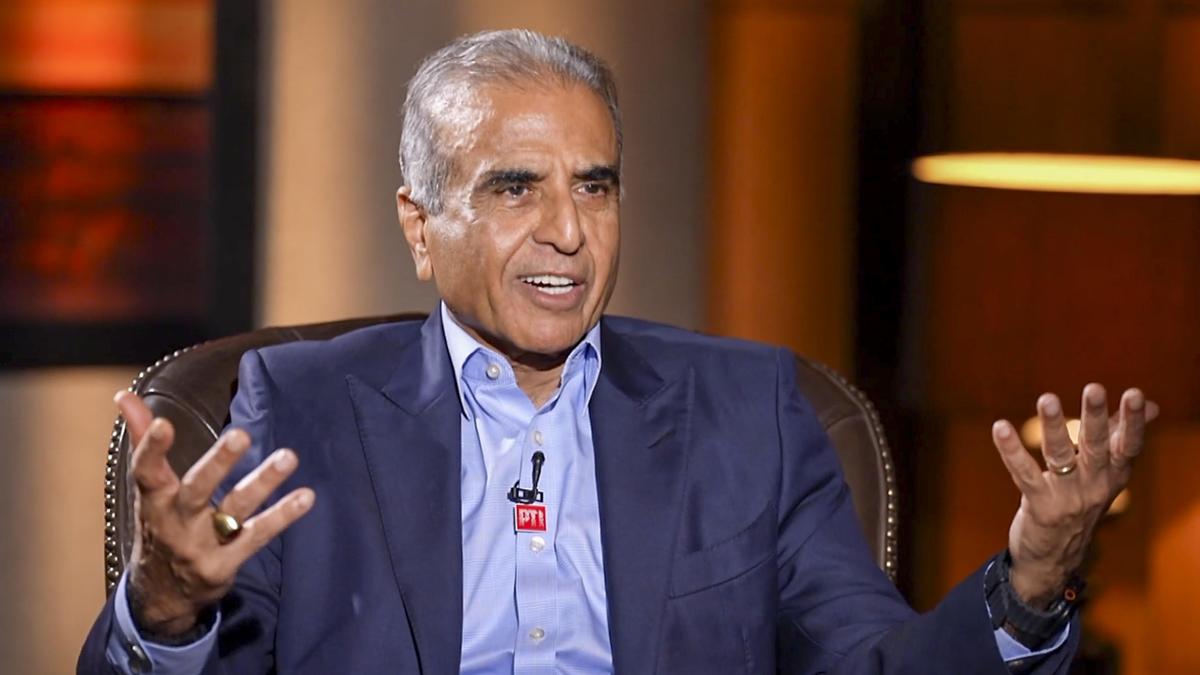
Bharti Airtel founder and chairman Sunil Bharti Mittal has called for India to retain control over the “kill switch” for satellite communications operating in the country, warning against dependence on a single foreign provider as the government weighs security conditions for the launch of satellite broadband services.“The kill switch, as we call it, should not be sitting somewhere else. India must have control over its own space destiny,” Mr. Mittal said in an interview with PTI marking the 50th anniversary of Bharti Enterprises.His remarks come amid an increasingly public contest between satellite operators seeking access to India’s potentially vast market, with Elon Musk’s Starlink and Bharti-backed Eutelsat OneWeb awaiting regulatory clearances to begin commercial operations. The comments also come against the backdrop of a growing dispute over Starlink’s entry into India.Mr. Mittal said OneWeb’s ground infrastructure had been ready for three years and its satellites had been orbiting over India for five years, but the company was still awaiting the government’s signal to begin commercial services.The distinction between a satellite communications licence and operational approval is central to the contest. A licence does not automatically permit commercial operations. Spectrum assignment and compliance with security requirements remain necessary before services can be launched.Three companies — Bharti-backed Eutelsat OneWeb, Reliance’s Jio Satellite Communications and Mr. Musk’s Starlink — have secured satellite communications licences in India. The government has maintained that operators must meet the same regulatory and security requirements, with final operational clearances dependent on compliance. Government sources have reiterated that the rules apply equally to all companies.The national security questionFor Mr. Mittal, however, the issue goes well beyond commercial competition and the allocation of spectrum. Satellite networks are increasingly becoming strategic infrastructure, with implications for national security, military communications and India’s ability to control critical data flows.He pointed to the changing nature of warfare, arguing that satellites would play an increasingly central role in everything from drones and cyber operations to guided missiles.“Whether it’s drones or it’s cyber issues, or indeed guided missiles and all, they’re all going to be managed from space,” he said. “Everybody in the world needs to have control over its security,” he added.He said India would need appropriate safeguards and should not depend on a single country or company for critical communications infrastructure.“Importantly, it may need to have different players. You can’t just depend on one country or one company,” Mr. Mittal said.He said India must be able to monitor the equipment and communications coming down to the ground and ensure that “everything should be routed through India.”The “kill switch” refers to the ability to disable, restrict or throttle satellite connectivity, whether for an individual terminal, a particular region or an entire network.Satellite broadband relies on a combination of user terminals, satellites in orbit and ground infrastructure, including gateways that connect satellite traffic to terrestrial networks and the internet. Control over these systems can determine whether services remain available, how traffic is routed and who can intervene during a security emergency.For governments, such control is an important instrument of national security and lawful oversight. But dependence on foreign-controlled systems can also create vulnerabilities, particularly during military conflicts or diplomatic tensions, when an operator’s decisions could affect connectivity on the ground.Mr. Mittal cited Ukraine as an example of the growing strategic importance of satellite communications. “If Ukraine is using Starlink, it’s also using OneWeb now,” he said, referring to the use of satellite connectivity in the conflict.The war has demonstrated how commercial satellite networks can become critical military infrastructure, supporting communications and battlefield operations. It has also highlighted the risks of relying on privately controlled systems whose service decisions can have consequences beyond commercial customers.Mr. Mittal said the European Union’s efforts to develop secure communications infrastructure through Eutelsat OneWeb had also brought greater attention to the company. He cited European spending of around €14 billion to 15 billion on a secure communications network.The Musk-Ambani spatThe regulatory contest has also become entangled in a public disagreement involving Mr. Musk and Reliance Industries chairman Mukesh Ambani. Mr. Musk recently accused powerful business interests of attempting to block Starlink’s entry into India and preserve what he described as a “monopolistic chokehold” on consumers. In posts on X, he referred to Mr. Ambani as “Prime Minister Ambani,” questioning his influence over government decisions.The Ministry of Communications had rejected suggestions that the regulatory framework or its application is discriminatory, describing such allegations as “baseless and misconceived.”Reliance and SpaceX signed an agreement in 2025 to explore ways of bringing Starlink services to Indian consumers through Jio’s retail network. Reliance is also developing its own satellite ambitions, including a proposed low-Earth-orbit constellation of around 1,600 satellites intended to extend connectivity to some 6 lakh villages.Jio’s existing customer base of more than 524 million and its extensive distribution network give it a substantial presence in India’s digital market, while Starlink would need to establish its own customer base and operating infrastructure.OneWeb awaits the signalDespite the regulatory uncertainty, Mr. Mittal said OneWeb’s services were already technically operational and that the government had occasionally used its terminals for emergency communications.He cited the example of economic adviser Sanjeev Sanyal, who took a OneWeb terminal on a boat trip to Oman and was able to stream throughout the journey. “He was streaming all the way through,” Mr. Mittal said.“We were the first licence given by the government. We have satisfied all their needs, and we just now wait for their signal,” he said, expressing hope that OneWeb would receive the first commercial approval. He said the company was ready to activate services once the government gave the go-ahead.On the contentious question of spectrum allocation, Mr. Mittal argued that satellite spectrum was inherently shared and required coordination between operators. “Everybody dips into the same spectrum,” he said, explaining that satellite operators at different orbital altitudes had to coordinate their use of frequencies. He said OneWeb had the highest priority in the Ku band, requiring other operators to coordinate with it, and added that regulators had understood the technical aspects of the debate.Satellites to complement, not replace, mobile networksMr. Mittal also sought to temper expectations that satellite broadband would displace conventional mobile and fibre networks, arguing that satellite connectivity would remain complementary for the foreseeable future.“It’s very expensive. Satellites need to be replaced every five, six years,” he said, pointing to the capital-intensive nature of building and maintaining satellite constellations.“Where there is fibre, radio cannot compete with it. Where there is a radio, satellite cannot compete with it. But together all of them, just like radio and fibre coexist today, all three will coexist.”The immediate opportunity, he said, lies in connecting areas where terrestrial infrastructure is difficult or uneconomical to deploy. There are still significant connectivity gaps in remote rural areas, forests, hills, mountains and maritime locations, as well as in aviation, he said.Satellite services could provide connectivity to users in such locations, including people travelling through mountainous regions where conventional mobile signals are unavailable.The broader significance for India is that satellite communications are increasingly being viewed not merely as another broadband technology, but as part of the country’s critical digital and strategic infrastructure. The challenge for policymakers will be to balance competition and investment with security, data sovereignty and operational control as global satellite operators seek access to the market.
Mittal says India must hold satellite ‘kill switch’, warns against dependence on single provider
Full Article
Original Source
Read the full article at Thehindu →KhanList aggregates and links to publicly available news content. We do not host full articles from third-party sources. Always verify important information with original sources.