
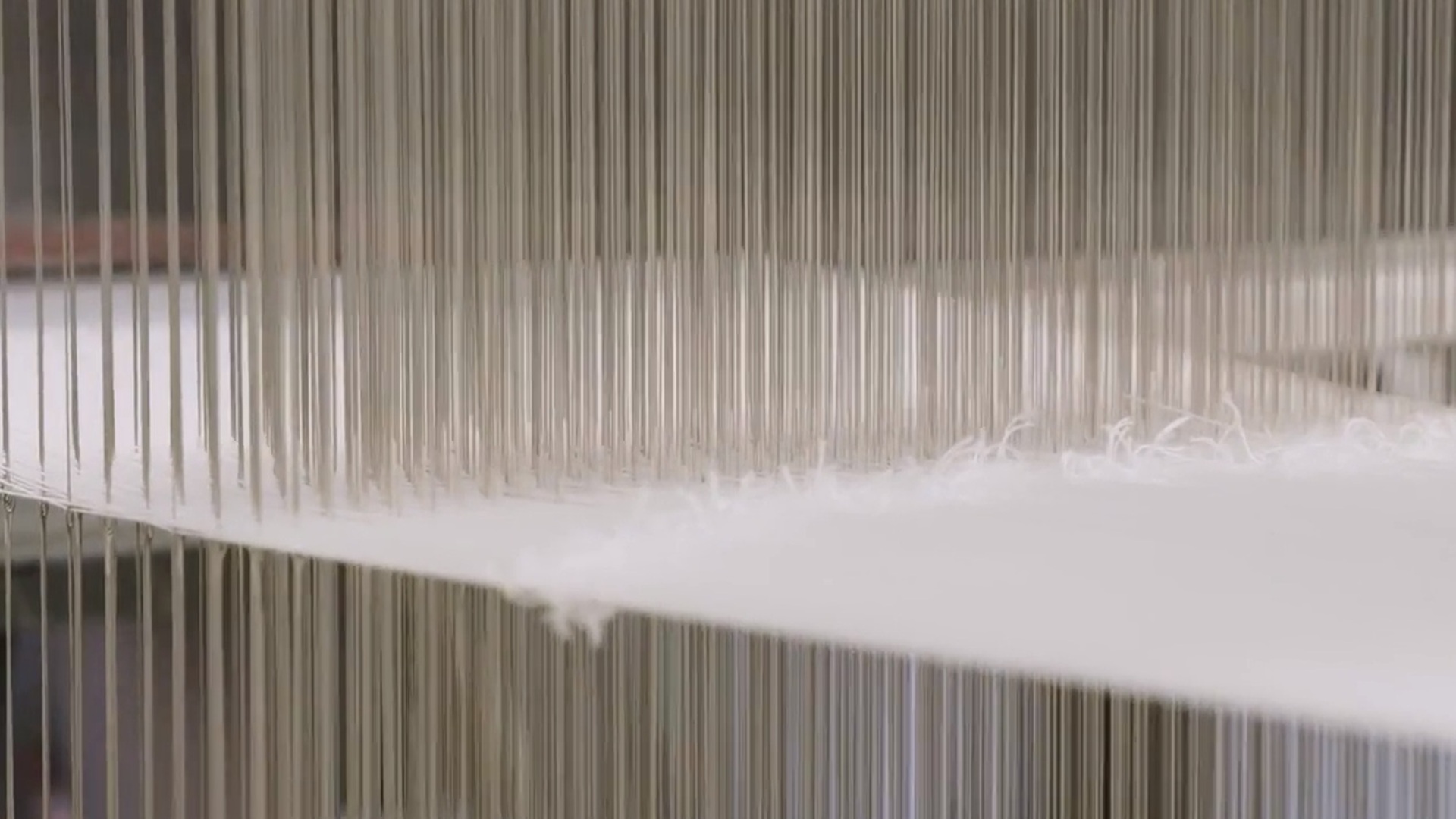
Researchers in the US have designed shape-shifting fabrics, with yarns made from seaweed, shrimp shells and gelatin that can swell, stretch or dissolve upon contact with water. The yarns were developed by Cindy (Hsin-Liu) Kao, PhD, an associate professor of human centered design and director of the Hybrid Body Lab at Cornell University, and her students. Their work led to AquaWeave, a collection of woven textiles that morph into tubes, flaps and domes. Kao believes the findings can create new possibilities for wearable electronics and human-computer interfaces, including devices that can physically alter their shape to carry out various tasks. She stressed that the concept represents an important area of research. “Let’s say your smartphone could change its shape,” she elaborated. “Maybe now it’s in the shape of a phone, but later, you wanted it to give you a neck massage. It could then morph into a massage pad.” Fabrics that shift shape The idea behind AquaWeave started when Kao and her team noticed what initially seemed like serious flaws in their experimental yarns. However, they soon realized these defects could be turned into useful design features. They first tested how each biodegradable yarn responded to different conditions. For instance, seaweed-based yarn swells when exposed to liquids. Shrimp-shell yarn stretches in acidic conditions, while gelatin yarn dissolves entirely. Kao and her team then explored how different weaving patterns could make use of these properties. This allowed them to engineer textiles that changed shape in different ways, with some developing openings as the yarns dissolved. UV Scale, flexible resin-printed scales created by tattoo artist Joe George in 2023, change color under UV light.Credit: Ryan Young / Cornell University To put the concept into practice, the team collaborated with experienced weavers using a computerized TC2 jacquard loom, a digital weaving machine roughly the size of a large upright piano. It can weave complex structures with circuitry, wiring and biodegradable yarns. One weaver designed a ribbed texture by taking advantage of the seaweed yarn’s ability to swell. Another produced a fabric that curled into a pattern, while a third developed a three-layer textile that deformed to reveal its internal structure. Kao praised the weavers’ skills. “We love seeing the creative ways people outside our fields work with these bioyarns,” she revealed. “We learn so much from them, too, and that kind of cross-disciplinary exchange helps move the field forward.” Ancient craft, modern tech Kao shared that her interest in traditional craftsmanship dates back to 2018, while visiting a 1,200-year-old Nishijin weaving workshop in Kyoto, Japan. Now run by its ninth generation of weavers, the workshop inspired her to explore how ancient techniques could improve modern wearable technology. Her team later turned to a centuries-old technique called Spanish lace to develop WovenProbe, a bandage-like device that can track hand movements. It contains seven tiny circuit boards connected by more than three dozen wires woven into the fabric. The method creates openings around finger joints, and allows wearers to move their hands freely. EdemaFlex, developed by Cindy Kao and her team, uses over 36 actuators across the fingers and palm to help reduce swelling.Credit: Ryan Young / Cornell University Kao’s lab has also produced SkinLink, a modular toolkit that allows researchers to assemble skin-mounted electronic devices within minutes. These could spot falls, improve posture or even illuminate a person’s face in the dark. “It is a very intricate weaving process,” Kao said in a statement. “What enabled us to do this was learning from a lot of weaving patterns dating back centuries, to solve some of the issues of these on-body devices, and to have circuitry on the body in a comfortable manner.” Lead author Jingwen Zhu, PhD, now an assistant professor at the University of California, Davis, presented the research on November 4 at the ACM UIST 2026 conference in Detroit. Get the latest in engineering, tech, space & science - delivered daily to your inbox.Based in Skopje, North Macedonia. Her work has appeared in Daily Mail, Mirror, Daily Star, Yahoo, NationalWorld, Newsweek, Press Gazette and others. She covers stories on batteries, wind energy, sustainable shipping and new discoveries. When she's not chasing the next big science story, she's traveling, exploring new cultures, or enjoying good food with even better wine.
Shape-shifting fabrics from seaweed, shrimp could turn smartphones into massage pads
Full Article
Original Source
Read the full article at Interestingengineering →KhanList aggregates and links to publicly available news content. We do not host full articles from third-party sources. Always verify important information with original sources.