
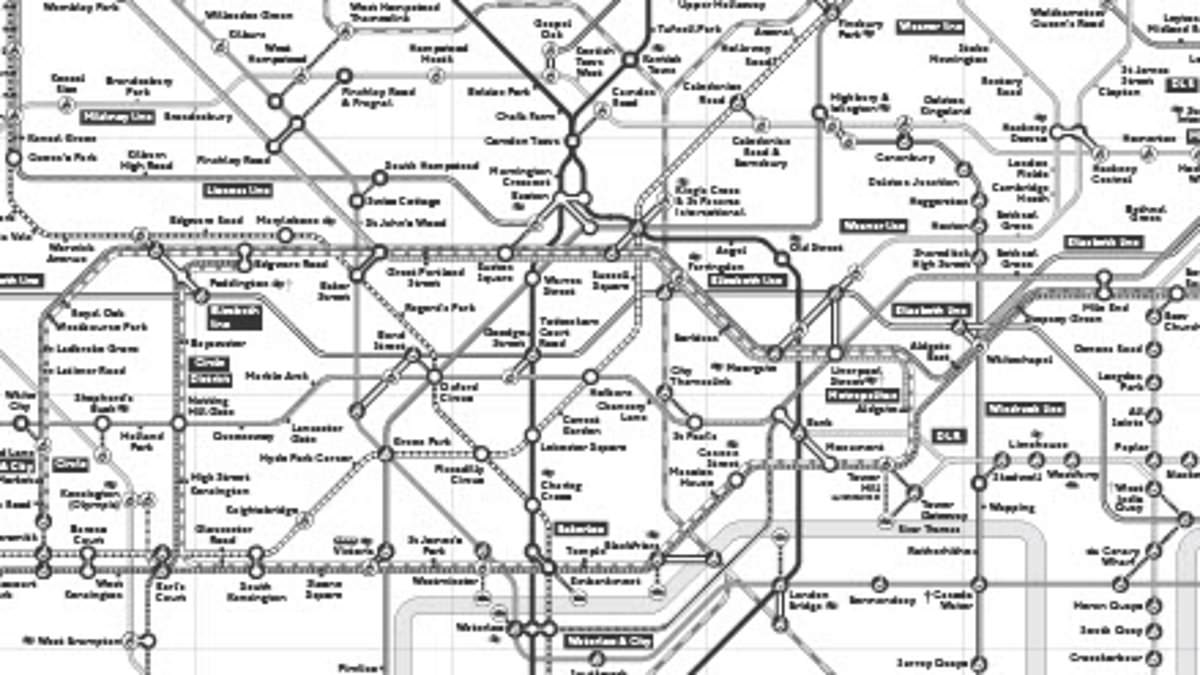
Published: 07:19 EDT, 1 November 2026 | Updated: 07:19 EDT, 1 November 2026 It's one of the most iconic maps in the world. But would you be able to navigate using the London Underground map...if it had no colour?Transport for London (TfL) has a special version of the chart that's aimed at colour blind people. The classic version shows the different lines in different colours – with the Victoria line in blue, the Northern line in black, and the District line in green, for example. Instead, on this version, each line is given a distinctive pattern.Speaking to the Daily Mail, Mark Evers, TfL's lead on Customer Insight, Strategy & Experience, said: 'We want as many people as possible to be able to use our services, and Tube maps are an essential part of understanding how to get from A to B. 'The black and white Tube map is one of the versions of the map that we have available for people with a range of needs, and it uses distinctive patterns to help distinguish between each Tube and train line.' Transport for London (TfL) has a special version of the chart that's aimed at colour blind peopleThe conventional London Underground map relies heavily on colour to help commuters to distinguish between different lines. Instead, the black and white version uses patterns to communicate the same information. These patterns are explained through the map's key, while the line name is also written at the end of each line on the map. Speaking to the Daily Mail, Dr Louise Gow, RNIB's Head of Optometry, Low Vision and Eye Health, and Michelle Lee, RNIB's Accessible Maps, Images and Signage Consultant, explained why the map is so important. 'It is extremely important to make any information accessible – the accessibility of the tube network is only possible for people with sight loss, if the information is provided in a suitable format,' they said. 'Having accessible versions of the tube map is important for people with sight loss to enable independent travel and decision making when planning their journeys.' The conventional London Underground map relies heavily on colour to help commuters to distinguish between different linesWhile the patterns look confusing to many people, Dr Gow and Ms Lee say they 'work well' for people with certain forms of colour blindness. They explained: 'We think this works well for people with red/green colour deficiency and is a reasonable adjustment which works for this group of people. 'For people who are blind or partially sighted, it would not be very useful if it is the same size as the current tube maps, as the text and symbols will be too small. 'We can see it being useful as an online source to pre–plan a journey but again, not much use when on the move which is when a lot of people use them due to cancellations, etc.'The map is available online as a PDF download, and has already proved hugely popular.In the last year alone, there were more than 18,000 downloads, according to TfL. The black and white map is one of several versions of the London Tube map that has been specially designed for people with accessibility needs. Other versions included the audio Tube map, and the step–free Tube map. What is colour blindness? Approximately one in 20 people suffer from colour blindness, a condition that makes the world a duller place to look at.According to the NHS, it affects 1 in 200 women in the world and 1 in 12 men.There are four kinds of colour blindness known as protanopia, dueteranopia, tritanopia and achromatopsia.The retina of the eye has two types of light–sensitive cells; rods and cones.Both are found the layer at the back of your eye which processes images.Rods work in low light conditions, but cones work in daylight and are responsible for colour. People who have colour blindness have a problem with the cones in their retina.
The London Underground map with NO colour: Alternative chart uses patterns instead of colours - so, would you be able to navigate using it?
Full Article
Original Source
Read the full article at Dailymail →KhanList aggregates and links to publicly available news content. We do not host full articles from third-party sources. Always verify important information with original sources.