
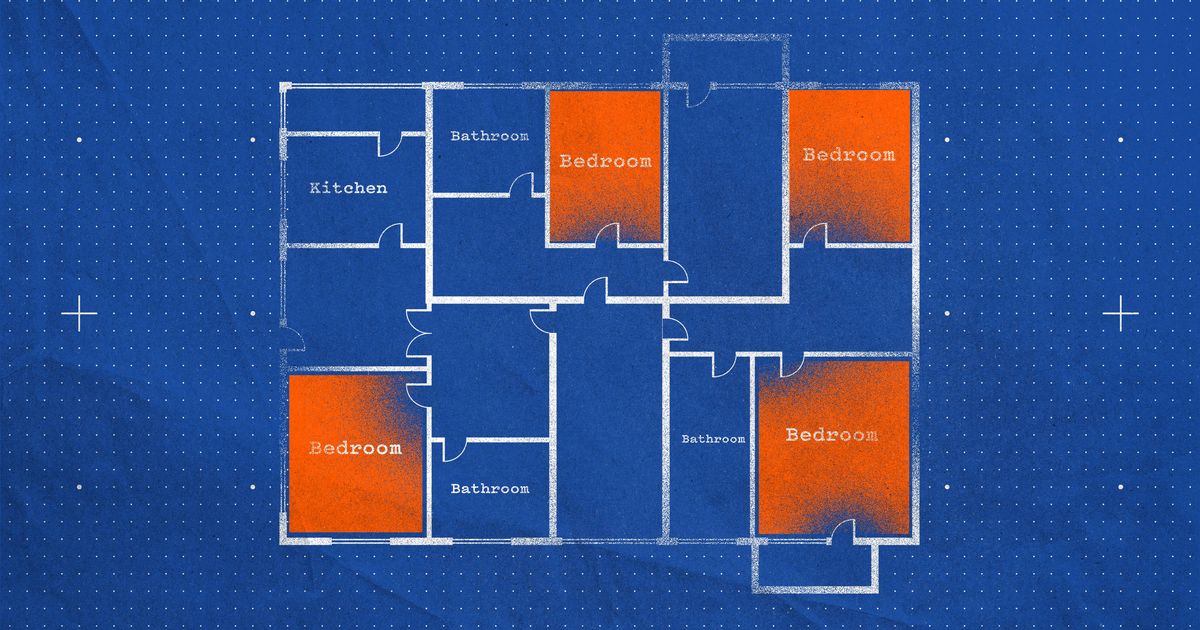
Developers lately have been stuffing new luxury condos with as many four-plus-bedroom apartments as they can feasibly squeeze in. Photo-Illustration: Curbed; Photos: Getty Ahead of their move from the coastal Southern California suburbs to Manhattan this spring, a physician and her businessman husband went searching for suburbia in an Upper West Side condo. Their must-haves were plenty and perhaps unsurprising given their current lifestyle: a laundry room where they could spread out a drying rack; an office for her husband, who sometimes works 12-hour days with early-morning starts; and a guest room for visiting friends and relatives. Also, they had one young daughter and plans for a second child, and they wanted both kids to have their own room. Their ideal home, it turned out, was an $8.9 million four-bedroom apartment at Extell’s 50 West 66th Street. The generous layout, the doctor says, meant they could divide it up, with “sophisticated” and “adult-focused” spaces such as the family room and dining room, and kids-designated areas strewn with toys for the little girl (and, now, her 2-month-old sibling). “We didn’t look at too many places,” the doctor tells me, although that wasn’t exactly by choice. “There weren’t that many options.” The four-bedroom-plus luxury condo has long been just a sliver of the city’s new real-estate supply. Yet that is beginning to change: Even as new condo inventory has plummeted to its lowest level in more than a decade, developers have been stuffing as many of these Goliath layouts as they can into the projects they do build, aiming to win over affluent buyers who’d prefer a McMansion in the sky over its functional equivalent in Rye. According to data from Marketproof, 10 percent of Manhattan and Brooklyn condo proposals accepted by the New York Attorney General’s Office since 2024 — or 17 out of 171 — have had apartment mixes where half or more of the units had four or more bedrooms, up from less than 4 percent, or 28 out of 744, of the condo plans submitted between 2015 and 2023. This is especially the case in blue-chip neighborhoods, where, one person who’s worked on several new development projects tells me, larger layouts are now king. “People in these brackets have a lot of money, and they’re willing to pay for it,” Donna Olshan, who tracks Manhattan’s luxury market, says. “If you can create square footage the size of a house and also have some amenities, it’s an alternative for them.” You can see it in the Myles, the Grid Group’s 14-story boutique condo going up on West 21st Street in Chelsea, which began sales earlier this year. Eighteen of its 22 units were configured as either four- or five-bedrooms, and they’re wrapped up with quite a few nice-to-haves that you’d expect in a suburban Colonial but are rare in apartments, like proper in-unit laundry rooms and built-out pantries with extra freezer drawers. Each gets a designated home-office space; the fourth bedroom is in its own wing with an en-suite bathroom, to house live-in staff or become the kids’ romping grounds–slash–media room. “It really does almost feel like a suburban home,” Corcoran’s Nicole Hechter, who is heading sales here, acknowledges — a sensibility accentuated by the private parking downstairs and the fact that every unit also has some outdoor space with a grill. For Douglas Elliman’s Maya Kadouri, who is the director of sales at the new 60-unit Sky Equity Group development at 260 East 72nd Street, the pitch is similarly about the scale, with Peter Pennoyer Architects–designed apartments that feature “classic layouts” with spacious foyers and 10- to 11-foot ceilings that more or less echo the grand Park Avenue aesthetic, but with zero renovation required. The sales director for the Myles says the apartments “almost feel like a suburban home.” Photo: Francisco Rosario/DDReps/FRoPhoto Inc On top of sprawling interior layouts, the Myles’ condos come with outdoor space and a grill. Photo: Francisco Rosario/DDReps/FRoPhoto Inc Who’s the typical buyer of this sort of property? According to just about everyone I spoke with, it’s mostly whom you might expect: youngish, well-to-do families working in the city with several kids attending private or top-tier public schools. Which, of course, reflects the real way to flaunt wealth in the city, which is by simply having a large family. As Tina Fey memorably wrote in The New Yorker, “Four beautiful children named after kings and pieces of fruit are a way of saying, ‘I can afford a four-bedroom apartment and a hundred and fifty thousand dollars in elementary-school tuition fees each year. How you livin’?’” (Her co-star Alec Baldwin knows something about that.) Post-pandemic, many of the parents in these families have been willing to pay extra for some peace and quiet to get work done in a room where the kids aren’t. “It’s like gold to be able to shut your door,” says Anna, who last year moved from the suburbs of Menlo Park, California, with her and 12- and 14-year-olds into a $4 million four-bedroom condo at the newly converted 450 Washington. (Her agent, Corcoran’s Marilyn Temiz, tells me that she’s also noticed more families “outgrowing” their three-bedrooms, and developers are “really paying attention to that.”) Grand proportions are a big part of the sales pitch at 260 East 72nd Street, where half of the 60 apartments are four-bedrooms or larger. Photo: The Boundary Alongside the 30- and 40-something financiers, lawyers, and soon-to-be-IPOing AI magnates are their parents. Real-estate agents and brokerage analysts say that, rather than downsizing from their 6,000-square-foot mansions in Scarsdale or Upper East Side brownstones, the silver-tsunami contingent are looking to buy comparably sized spaces in the city that have enough room to accommodate all the children and grandchildren during the holidays but don’t require keeping up a house. “They’re used to space,” says Brown Harris Stevens’ Rachel Glazer. “So if they can afford big apartments, they’re buying them.” This may explain why the giant-new-apartment trend is lately expanding beyond the Upper East and West Sides into downtown Manhattan, where, in the past, most buyers who wanted a big space that wasn’t a townhouse had to navigate the multistep dance of holding out for neighbors’ units and then navigating board approval and renovations. “Whether or not their kids live uptown or downtown, I think they want to be able to enjoy the lifestyle components of downtown, the restaurants, the shopping, the retail,” says Charles Snyder, senior vice-president of research and analytics at Douglas Elliman. (That said, there are also more families nowadays who simply don’t mind sending their kids to Avenues instead of Browning or Spence: “We definitely have crossover between downtown buyers and uptown buyers that we never previously did,” Snyder says.) The return for high-bedroom units in new developments, it turns out, can work out really well for the builders. “Developers build what’s most economically feasible, and larger units are the secret sauce,” says Jonathan Miller, director of markets at StreetMatrix. Whereas developers of rentals get more bang for their buck by loading a building up with studios and one-bedrooms, in the sales market, “there’s a premium for larger contiguous space.” Stephen Kliegerman, president of development marketing at Brown Harris Stevens, brought up the 36-unit boutique condo going up at 200 West 88th Street, where half of the units have four or more bedrooms, including five full-floor penthouses. Based on the building’s envelope, he says, the developer, Nortco, “had originally planned to do a more typical unit mix” — that is, a building with one- and two-bedrooms. But after looking at the data, it was clear that larger residences could perform even better, and the smallest layout now is a three-bedroom. The price per square foot, Kliegerman says, was in some cases 50 percent higher than for smaller units in comparable properties, and the absorption rate — how quickly people bought them, giving the developers a better return on their investment — was much faster. Construction costs are lower for this type of arrangement, too, because the buildings need fewer kitchens and bathrooms. Not every site or neighborhood makes sense for this kind of development. Many experts point to Greenwich Village as an example, where you’d be wise to build one- and two-bedrooms that parents have lately been buying for their young-adult children. (This is especially true if the parents are New Yorkers themselves, effectively looking to outsource a few of their rooms downtown.) There also is an obvious risk in stacking a project with huge apartments. “Building 100 average-size one-, two-, and a smattering of three-bedrooms, if all of a sudden the market were to take a drastic turn, like 2008–2009, you could pivot to a rental model and survive,” Kliegerman says. “It would be pretty hard for a developer to pivot a boutique 36-unit building of all large apartments and economically make it work.” Don’t forget that many of the prewar family-size apartments all over the Upper West Side were chopped up into multiple units during the Great Depression, too. Those West Side apartments — not to mention thousands of others in prewar buildings on Park Avenue and the rest of the Upper East Side — were constructed at the tail end of the last Gilded Age, when the income tax was new and tiny, and big families with live-in servants were common among the affluent. Today, the wealth gap is soaring back toward those levels, and amid cries about our local housing crisis, there are of course calls for building more — but a sizable chunk of new apartments have been these very large, very luxury units, accessible to only a tiny slice of the populace. “We’re no longer building smaller apartments because the math doesn’t work,” Miller says, pointing to high construction and land costs today alongside rising interest rates. In the 1980s, he says, a condo-development site on the Upper East Side would’ve had 300 units made up of studios and one- and two-bedrooms, plus a pool on the roof; that same property today would be two-, three-, and four-bedrooms, with some sprawling penthouses on top and the pool now on the ninth floor. “The way the market is structured, it just favors apartments for the more affluent.” In an extreme example from a few years back, the tower at 111 West 57th built atop the landmark Steinway Hall has just 59 apartments in its 1,500 feet, and ten of them have four or more bedrooms. (There are also several three-bedrooms that include an office.) One of the bigger ones is listed for $55 million, in case you’re in the market. The Latest Status Marker Is a 4-Bedroom Apartment Your product is saved! You’ll receive emails when your saved products go on sale. Manage preferences.
The Latest Status Marker Is a 4-Bedroom Apartment
Full Article
Original Source
Read the full article at Curbed →KhanList aggregates and links to publicly available news content. We do not host full articles from third-party sources. Always verify important information with original sources.