
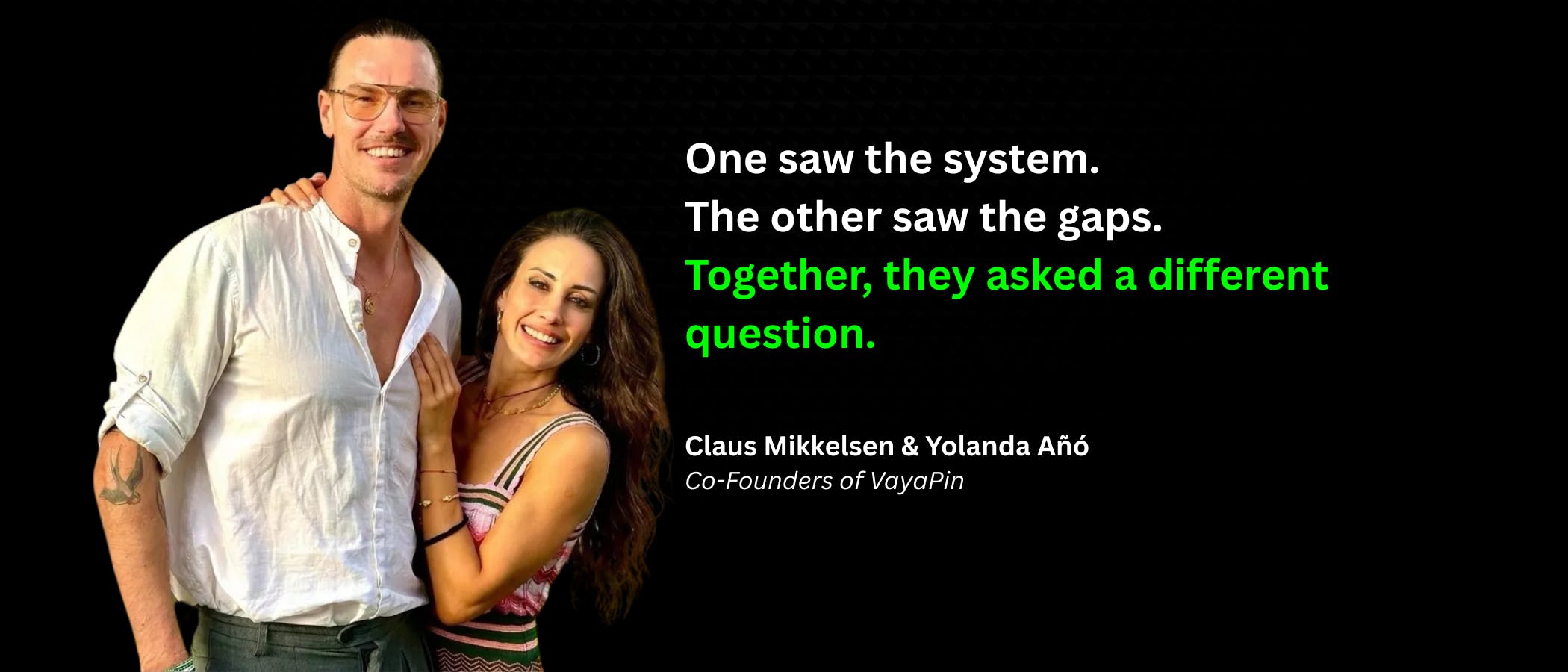
More than 4 billion people globally live without a precise address. Two founders with no technical background set out to change that and ended up rethinking not just their product, but what it means to build a startup in the age of AI. Somewhere in a favela in Rio de Janeiro, a courier circles the same block for the third time, parcel in hand, no door number in sight. In rural Argentina, a mother walks several kilometers to collect medicine because delivery drivers simply can't find her home. In Barbados, thousands of businesses officially have little more than the name of a road. And in Ukraine, millions of people displaced by war have moved so many times that the idea of a permanent home address has become almost meaningless. These aren't isolated inconveniences. They're symptoms of the same invisible problem. According to United Nations estimates, more than 4 billion people worldwide still lack a precise, usable address. For most of us, an address is background infrastructure – we only notice it when food arrives on time, or a taxi finds the right door. But for billions of people, the absence of one shapes everyday life: receiving deliveries, accessing emergency services, opening businesses, applying for financial services, and being found when it matters most. Claus Mikkelsen spent more than twenty years building restaurants, hotels, and nightclubs. His co-founder, Yolanda Añó, grew up in Argentina, where unreliable addressing isn't an abstract infrastructure problem but a daily reality. Before co-founding VayaPin with Claus in 2021, she spent a decade working in project management and marketing across different industries in Europe and the Middle East. She now serves as the company's COO. Neither had ever built software. Together, they made a bold decision to rebuild the world's addressing system. It's the kind of idea that sounds almost unreasonable when you say it out loud. Not because it isn't important, but because it's so fundamental that most people assume someone must have solved it already. Nobody had. The Pattern You Can't Unsee The idea didn't arrive as a flash of inspiration. It arrived as a pattern. Claus and Yolanda had spent years traveling together. The countries changed. The languages changed. The economies changed. The problem didn't. "We've been traveling a lot," Claus recalls. "Looking at a globalized world where AI is improving so many things – how we communicate, how we conduct business – there was just this obvious big gap that hasn't been touched for decades. The address." He laughs before describing the reality many people still live with. "It would be, 'Past the church, take a left, there's a blue stone – that's where I live.' We just thought we could do better." For Yolanda, the issue was never theoretical. "I'm from Argentina," she says. "In my own home country, this is a daily problem. A big percentage of the population is marginalized because of this lack of addressing." Traveling only reinforced what she'd already experienced growing up. "We discovered the same problem – the same lack of opportunities – in many of the countries we visited together." That contrast shaped the company long before a single line of code was written. Claus grew up in Denmark, where the address infrastructure is so reliable that most people never think about it. Yolanda grew up in a place that exposed what happens when that infrastructure is missing. One saw the system. The other saw the gaps. Together, they began asking a different question. Not "how do we improve addresses?" But "what if an address worked more like an email address or a phone number?" Something that stays with you. Portable. Owned by the individual rather than the building. That became the foundation of VayaPin. Instead of treating an address as a street name and house number, the founders imagined it as a persistent digital identity that stays with you wherever life takes you. In practice, users create a unique identifier such as DK:CLAUS or UA:VERONICA linked to a precise location and enriched with whatever information they choose to share: delivery instructions, photos, access notes, or emergency details.Technology matters. But the idea matters more. Because once an address belongs to a person rather than a place, it becomes useful in situations that traditional addressing systems were never designed to handle – from digital nomads and small businesses to refugee families rebuilding their lives one move at a time. Getting Into the Engine Room With No Map Coming up with the idea was the easy part. Building it was something else entirely. "We have zero background when it comes to tech development," Claus says without hesitation. "What I could take from my previous experience was the entrepreneurial spirit: you set yourself a goal, and then you pave the road as you go forward. Yolanda brought her own kind of transferable experience – a decade of project management and marketing across different industries.” He smiles. But I didn't expect this road to be so steep. Software development introduced an entirely different kind of uncertainty.The founders hired developers in different countries. They relied on recommendations, promises, and their gut feelings because they had little else to evaluate potential partners. "When you don't have the necessary insights, you kind of have to trust everybody," Claus says. "You have to trust in people's skill sets, in their good intentions, in their knowledge. And you just have to learn as you go." He pauses. "That has been a very, very expensive lesson." It's an experience many non-technical founders know well but rarely talk about publicly. Building software without understanding software is a little like commissioning a house without knowing how to read blueprints. You can describe the kitchen you want. You can explain how you want people to move through the rooms. But every technical decision requires an act of trust. Eventually, that changed. Claus credits his software development partner with bringing predictability to a process that had often felt anything but. The biggest improvement wasn't just better engineering. It was communication. "We feel confident that we have a very good dialogue," he says. "We can estimate things, and they usually land within our estimations." For a founder without a technical background, that's more than operational progress. It's the moment the product stops feeling like a black box and starts feeling like something you can actually steer. When AI Doesn't Just Change the Product, But Changes the Company By the time VayaPin had evolved from an idea into a functioning platform, another realization was taking shape. The challenge wasn't simply building a better address. It was building an ecosystem where that address actually mattered. Early on, the founders assumed that if people could create a digital address, adoption would naturally follow. It didn't. "We quickly realized that just having VayaPin as an app was not enough if there was not the full ecosystem of how you can use it," Claus says. That realization forced another trip back to the drawing board. Instead of thinking about individuals alone, the team began thinking about everyone who depends on addresses in the first place – couriers, e-commerce stores, logistics providers, emergency responders, NGOs, property owners, and small businesses. The question shifted from "How do people create an address?" to "What makes the entire system want to use one?" For many startups, that kind of pivot feels like failure. In reality, it's often where the real company begins. Then, just as they were rebuilding the product around that broader vision, another disruption arrived.Artificial Intelligence. The Lean Team Gets Leaner AI changed something even more fundamental than the product. It changed the company itself. For decades, startup growth followed a familiar equation. Raise capital. Hire specialists. Build departments. Scale headcount. Repeat. That equation is beginning to look different. Reflecting on VayaPin's early fundraising plans, Claus describes how dramatically their assumptions have shifted. "A year ago, if I made a business pitch, the budgets were intended to go to salaries – to people covering different departments," he says. "Today, many of those workflows no longer require dedicated teams." Research. Content. Planning. Outreach. Documentation. Internal coordination. We've automated pretty much everything. That doesn't mean people have become less important. It means human attention has become more valuable.Instead of asking, "Who do we hire next?" The better question increasingly becomes: "What should only humans be doing?" For VayaPin, that answer lies in relationships rather than repetition. Building partnerships. Understanding customers. Refining the product. Finding distribution. Earning trust. Those are still stubbornly human problems. The result is a company that looks very different from the one the founders imagined when they first drew up their financial plans. "We're trying to figure out where we gain the most traction," Claus says. "We're tightening all the nuts and bolts." It's a mindset that feels increasingly familiar across early-stage startups. Growth is becoming less about adding people and more about increasing leverage. Not every company will shrink dramatically. But many will become dramatically more intentional. Finding the First Domino Even the most efficient company eventually runs into the same obstacle – convincing everyone else. For VayaPin, that means logistics companies, e-commerce platforms, governments, humanitarian organizations, and local businesses – all of whom already operate inside systems that, while imperfect, are deeply entrenched. Claus has no illusions about how difficult that will be. "I know that it will be a struggle to onboard large logistics companies," he says. "It's like moving an elephant." He pauses. "But we just need one." One successful partnership. One country. One ecosystem. The founders deliberately aren't starting with the largest markets. Instead, they're focusing on places where a meaningful percentage of the population could realistically adopt the platform within a relatively short period of time. Small island nations. Communities where addressing gaps are visible. Places where success is easier to observe and easier to replicate. It's an unusually disciplined strategy. Rather than trying to convince the world all at once, they're trying to build one undeniable example. Because if the first domino falls, the next conversation becomes easier. When the Mission Becomes Personal Somewhere along the way, the product stopped being only about logistics. It became about continuity and giving people something stable in situations that aren't. That philosophy became particularly tangible in Ukraine. As millions of people were forced to leave their homes because of Russia's full-scale invasion, the founders saw their original idea in a completely different light. A digital address that stays with someone regardless of where they move next suddenly wasn't just convenient. It could become one small constant in lives defined by constant change. VayaPin decided to offer its Pro version free of charge to Ukrainians displaced by the war. As Claus puts it: "To put that behind a paywall for the people most in need of it would be a contradiction of everything we stand for." The initiative is separate from the company's commercial roadmap. But it reflects the same underlying belief that inspired Claus and Yolanda in the first place – an address shouldn't disappear simply because someone's circumstances do. The connection to Ukraine extends beyond the initiative itself. Much of the platform has been built together with Ukrainian engineers at SPD Technology. For a founder without a technical background, choosing the right engineering partner may have been the highest-leverage decision the company ever made. Looking back, it's difficult to separate the product's resilience from the resilience of the people who helped build it. Sometimes those become the same story. The Discipline of Knowing What You Don't Know Many founders talk about traction as though success is already inevitable. Claus and Yolanda don't. When asked about adoption, they readily admit that the company spent years almost entirely in what they call "the engine room" – building, rebuilding, and figuring out what the product actually needed to become before trying to scale it. Their early consumer campaigns taught them difficult lessons about customer acquisition. Instead of forcing growth, they pulled back. "We quickly realized that it was very, very expensive to do B2C advertising," Claus says. "We're just going to pause it until we actually have all these things solved." Even when asked about partnerships, his answer is refreshingly unpolished. "Please ask me that question again in a month," he says with a laugh. "I hope I have better numbers." It's an unusual level of honesty in a startup ecosystem that often rewards certainty more than reflection. But perhaps uncertainty is exactly where early-stage founders are supposed to be. The important part isn't pretending to have all the answers. It's becoming better at asking the right questions.The Last Analog System Artificial intelligence may reshape almost every digital experience over the next decade. Software will become easier to build. Agents will buy products, book appointments, negotiate prices, and interact with services on our behalf. Yet all of those systems still need to answer one surprisingly simple question. Where? Where should the ambulance go? Where should the medicine be delivered? Where should the package arrive? Where does this person actually live today? Those questions become trivial when an address exists. They're remarkably difficult when it doesn't. Listening to Claus and Yolanda, it's tempting to think this is a story about addresses. It isn't. It's a story about noticing infrastructure that has become invisible simply because those who benefit from it rarely have to think about it. Innovation doesn't always begin with inventing something entirely new. Sometimes it begins by questioning something so ordinary that everyone else stopped seeing it years ago. For VayaPin, AI didn't replace the original mission. It simply changed how that mission would be built. The company may still be searching for its first large-scale breakthrough. It may still be looking for the first logistics partner willing to move the elephant. But the founders aren't really betting on a feature. They're betting that, in a world obsessed with building the next AI breakthrough, one of the biggest infrastructure problems on Earth has been hiding in plain sight all along.
The Last Analog System: Fixing the World's Addresses
Full Article
Original Source
Read the full article at Hackernoon →KhanList aggregates and links to publicly available news content. We do not host full articles from third-party sources. Always verify important information with original sources.