
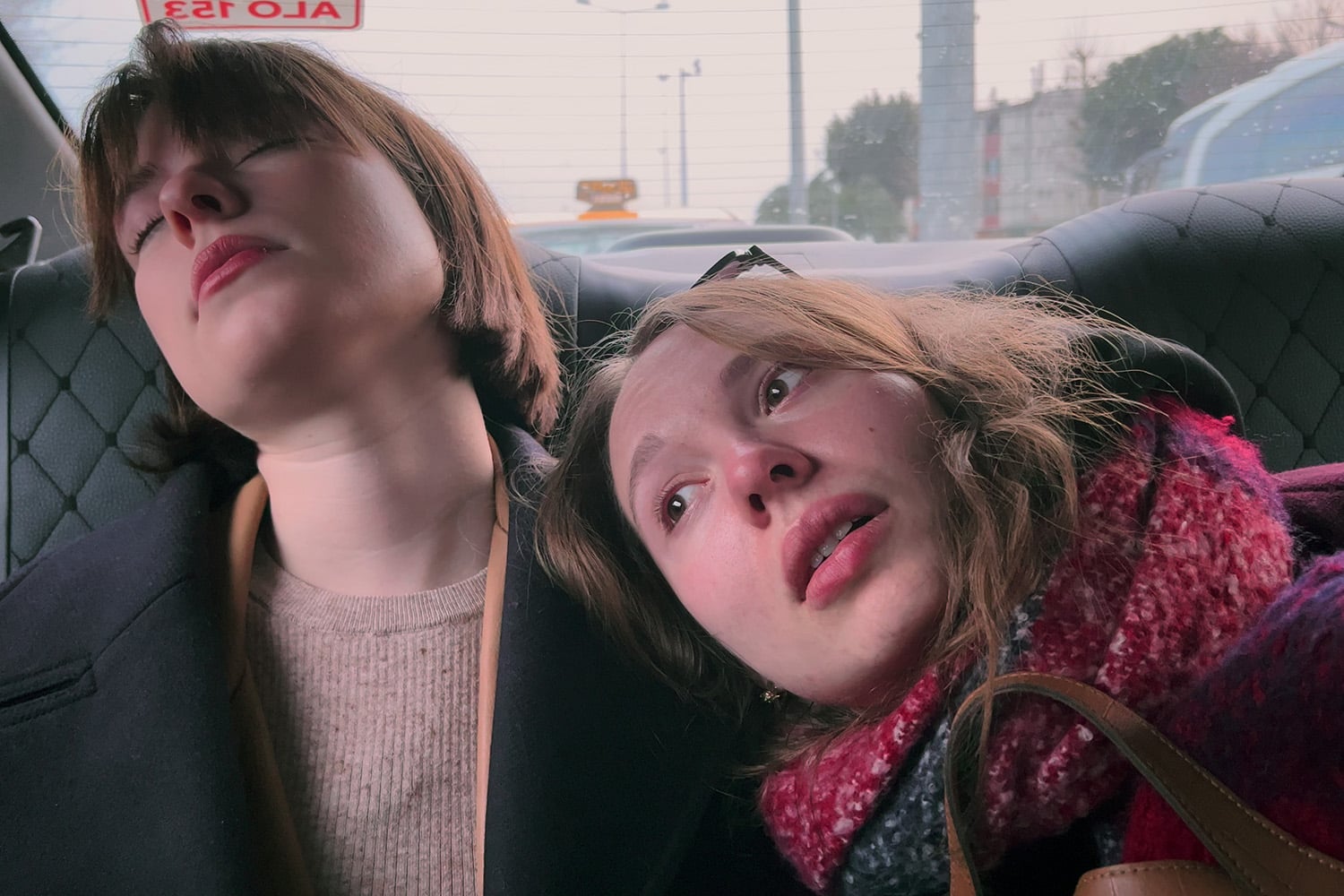
What does a citizen owe to their country? And what if that country is Russia? Such is the moral dilemma afflicting the characters of My Undesirable Friends: Part II – Exile, Julia Loktev’s sequel to her acclaimed 2024 documentary about the unraveling of Russia’s last independent television channel, Dozhd (or TV Rain), in the wake of the full-scale invasion of Ukraine. The first installment chronicles the channel’s final days in Moscow in March of 2022, and Part II follows its journalists into exile. Loktev’s protagonists, almost all women, fled as Russia imposed censorship laws that made their already dangerous jobs punishable by up to 15 years in prison. Within days of Dozhd’s disbandment, sometimes hours, they scooped up their laptops, pets, children, and underwear and flew wherever they could without a new visa—Istanbul, Tbilisi, Prague, Tel Aviv. They resisted Russian President Vladimir Putin and his government, yet wherever they go, they remain citizens of a country that is invading and killing its neighbors and are held responsible for the war it wages in their name. “You feel like it’s 1941 and you’re simultaneously the German and the Jew” says journalist Anna Nemzer, as she reloads her vape cartridge. Loktev’s subjects are buffeted by cognitive dissonance and must constantly explain themselves—to their Georgian and Latvian hosts, who urge them to “tell Putin to stop the war”; to their Ukrainian sources, who resent the very language that they speak; to their Russian parents who tell them to stop writing anti-government “bullshit” and come home; and even to themselves, wondering what they could have done differently to stop their country’s slide into fascism, and whether their work matters when Russian missiles continue to rain down on Ukraine. Loktev, who shot the film herself on an iPhone, gives these questions room. At six hours, this film is even longer than its predecessor—a bold choice—but the sheer accumulation of ordinary moments makes this exploration of exile intimate and compelling. For viewers willing to grapple with existential dilemmas and lucky enough to live near an art-house cinema, the movie’s length may be a boon. After all, its central questions are ones that take a lifetime to sort out. Perhaps no one takes up these questions more bluntly than Elena Kostyuchenko of the recently shuttered Novaya Gazeta, where, during her tenure, four of her colleagues were murdered. “All of us … spent many years, thoroughly, in great detail, in very good, well-written articles describing the coming of fascism in Russia,” she says. “Well, there you fucking go. So we wrote all those articles.” Elsewhere, she is just as unsparing about the failure to stop Putin from turning Russia into what it is today: “We didn’t want to sacrifice our comfort.” Alesya Marokhovskaya expresses similar unease as she recalls watching someone get beaten at a protest. “My job is to film,” she says. “You don’t rush in to defend the person. You film them, because, well, that’s your job.” Despite those doubts, the journalists keep doing journalism. They provide truthful coverage of the war to Russian-speaking audiences through YouTube channels, podcasts, and eventually live broadcasts from Riga, Latvia, where Dozhd secured a broadcasting license. But they are walking on eggshells. A series of on-air missteps that led to questions about the station’s allegiances ultimately cost Dozhd its initial broadcasting license, forcing it to relocate to the Netherlands, where it operates today. A close-up of a woman in a black shirt holding a red pen near her mouth while looking down at a glowing smartphone screen. Irina Dolinina continues to work in exile from Prague.Cinetic The hope of finding safety outside Russia does not last long. Alesya and her best friend Irina Dolinina, investigative journalists with IStories (or Important Stories), now based in Prague, receive oddly specific anonymous threats. The senders know their passport numbers, flight reservations, even about Alesya’s “snorting” bulldog. New friends are not always who they say they are: A supposed human rights lawyer Irina befriends previously worked for Moscow police. Alesya’s father, meanwhile, doesn’t understand why his daughter left. The war is in Ukraine, he says, not Russia. But for most of these women, war is everywhere. From a temporary shelter in a Swiss village, where cathedral bells mark the hours of another peaceful day, Kostyuchenko recounts the symptoms of what she believes was a deliberate poisoning in Munich in October 2022: foul sweat, disorientation, nausea, swollen extremities. Months before, reporting from the Ukrainian city of Mykolaiv, Kostyuchenko had visited a morgue overflowing with victims of Russian shelling, which she wrote about with brutal clarity. “In the fridge, the bodies are stacked in layers. Two girls lie on top of each other. They’re sisters. The older one is 17—in the heap of bodies, all I can see is her hand, long thin fingers with a neat pink manicure. The younger is 3—she lies on top of her sister. … Her body is dotted with red shrapnel wounds. The girl looks alive.” Despite atrocities that should have stopped the world in its tracks, life goes on, and Loktev’s film captures that well. Kostyuchenko loves, and loves deeply. Her partner is Yana Kuchina, a Moscow book editor turned disability-rights advocate who followed Kostyuchenko into exile. A newcomer to Loktev’s saga, Yana delivers some of the film’s most chilling insights into how Russia treats its own. Her cerebral palsy, she says, is considered an “intellectual inadequacy” in the eyes of the authorities, barring her from getting a driver’s license, becoming a doctor, or adopting a child. Two women sit in chairs on a stage, smiling and holding microphones during a discussion. Ksenia Mironova and co-director Julia Loktev speak after a screening of My Undesirable Friends: Part II: Exile at the New York Film Festival on Sept. 27.Michael Loccisano/Getty Images Besides Yana, Kostyuchenko loves her mother—whose birthday she is missing for the first time—and her country. Her life there, she felt, was real. “I worked at the best newspaper on Earth. … All around me was my country, which I … value and love still.” Her love is definitely not blind, but for Ukrainians, whose country Russia is destroying, it may be difficult to comprehend, much less forgive. Unlike Elena and Yana, former Dozhd reporter Ksenia (Ksyusha) Mironova walks the road of exile alone, a melancholy kaleidoscope of taxi rides, dark staircases, and endless rented rooms; her fiancé, the journalist Ivan Safronov, is still being held in a Moscow prison on fabricated charges of high treason. Ksyusha returns to Russia for his sentencing, a trip Loktev also documents. Ivan gets 22 years. In the midst of so much loss, there are brief moments of tenderness. In a rented apartment abroad, Ksyusha and her Dozhd friends sing along to a Russian song: “When you return … I hope we recognize each other … and I am not your wife and not even your girlfriend.” It is probably the most Russian scene in the entire movie—elegiac, haunting, yet oddly hopeful. In a dimly lit room, a woman in a red plaid shirt rests her chin in her hand in the foreground while a man and a woman hug behind her. After leaving Russia with her family, Anna Nemzer spent time in Tblisi, Georgia.Cinetic Ksyusha is neither a victim nor a tragic heroine; behind her soft, girlish looks is a rod of steel. No longer with Dozhd, she moves from country to country, taking whatever freelance jobs she can find to keep herself afloat and working as an independent journalist covering political prisoners, their families, and the lives of Russians in exile. In 2025, we see her in the United States reporting on President Donald Trump’s second inauguration. “It’s really strange I’m now in America and the same things are happening here,” she says. She now works with Nemzer to archive independent journalism, including to preserve two decades of coverage in Russia against the Kremlin’s attempts to erase it. Sonya Groysman, another Dozhd journalist, finds ingenious ways to report on Russia from exile, directing anonymous camera operators, including wedding videographers. One of her reports features Sasha Skochilenko, an artist who was sentenced to seven years in prison for replacing price tags in a St. Petersburg supermarket with anti-war messages. The camera zooms in on a black-and-white tag above the coffee cans reading “Russia’s Army bombed Mariupol art school where 400 people hid from shelling.” It’s yet another reminder that in Russia, the price of truth is your freedom. Or your life. A sizable part of the documentary is devoted to the 2024 death of opposition leader Alexey Navalny. Dozhd, broadcasting from Amsterdam, ran videos of him from the day before his death, where he looks energetic and fairly healthy. In their coverage, the presenters called his death in prison what many in Russia knew but were afraid to say: a killing. Navalny went to prison to change people’s minds, says tearful Valeria Ratnikova, a Dozhd news anchor, between the airings of her show. He was a beacon for many. Now, all she sees is “total blackness ahead.” A woman with long brown hair, wearing a dark coat and a red patterned scarf, sits on a bed with a blue tufted headboard in front of patterned beige wallpaper. Valeria Ratnikova stays in a hotel in Istanbul after fleeing Russia.Cinetic The only characters spared this Dostoyevskian moral anguish are, unsurprisingly, Ukrainian. “We don’t have the energy and time to worry and panic,” says Nataliya Gumenyuk, a prominent Ukrainian journalist and war correspondent who is married to a longtime former Dozhd journalist. “We live in our own country and continue to do our work.” Among the movie’s most striking images is that of Ukrainians dancing in a square in Kharkiv, where entire blocks are flattened by air strikes, the sound of Ukrainian folk songs mixing with the howling of the air raid sirens. Nataliya’s Russian husband, Peter, resolved his moral dilemma by joining the Ukrainian army and now records his Fuck the War! podcast between missions. From its new home in the Netherlands, the “optimistic channel,” as Dozhd was once known, still reaches 13 million as of 2023, according to Dozhd. Because coverage of the war not aligning with Kremlin narratives has been all but silenced, most watch through VPNs and proxies. For journalists, reporting on Russia’s war means living the Russian reality. This makes integration into their new countries nearly impossible; they are neither here nor there. But going home is not an option. Ratnikova, for one, was sentenced to seven-and-a-half years in prison in absentia by a Moscow court. Loktev records her hearing over a video call, where “witnesses” explain how the “false information” about the war “confused” them. This is how Russian justice works. For now, Ratnikova has a visa, a job, a place to stay. That could change overnight. Political exile is not war, but that’s a low bar for young men and women who could have lived a relatively normal life. By reporting independently, first in an increasingly authoritarian state, then from exile, often at considerable risk to themselves, they have given more to their country than its perpetually silent majority. One of Ratnikova’s colleagues likens their mission to Sisyphus pushing his stone uphill: not as punishment, but by choice. They keep at it, hoping their work might still change minds in a country that seems irretrievably lost. Loktev’s immersion in their lives leaves us with hope for them, if not for Russia’s future.
The Journalists Who Left Russia—But Can’t Escape It
Full Article
Original Source
Read the full article at Foreignpolicy →KhanList aggregates and links to publicly available news content. We do not host full articles from third-party sources. Always verify important information with original sources.