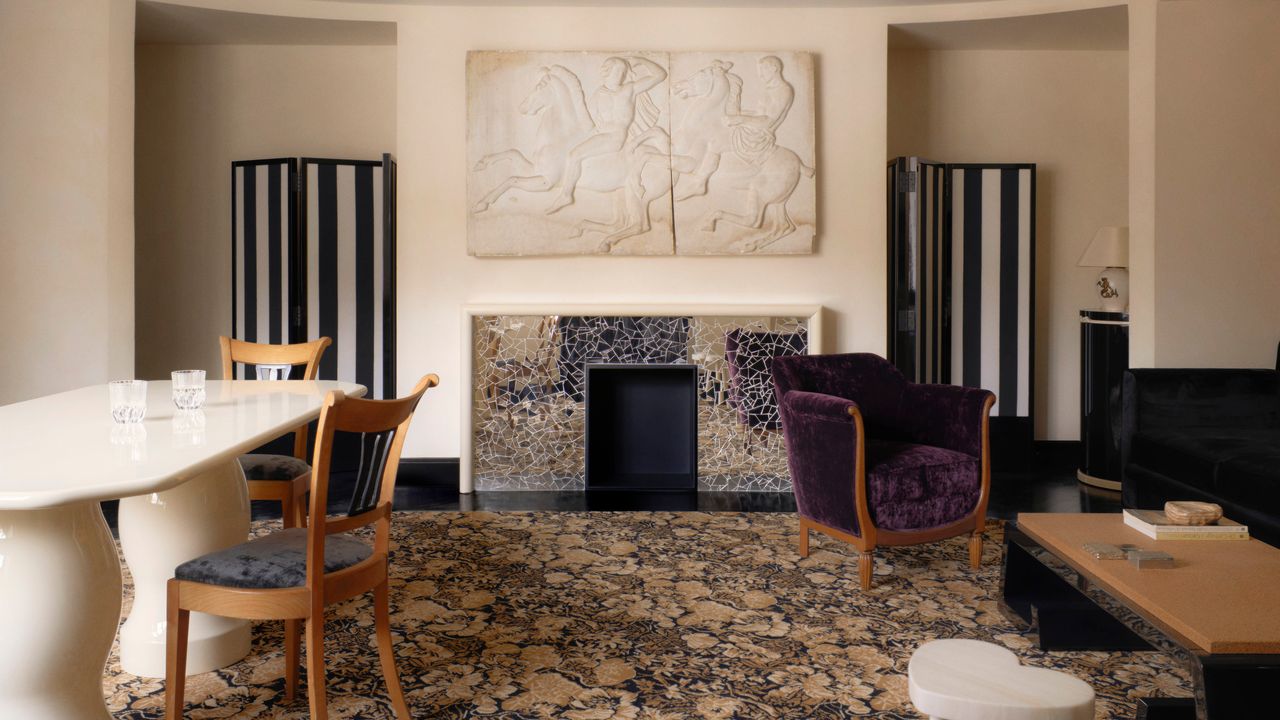
Spend enough time around interior designers, and you’re likely to hear someone compare a chandelier to a gem-encrusted cocktail ring or cabinet hardware to everyday earrings. Decorating and accessorizing share a common language, and for some designers, a successful space is similar to a well-curated jewelry collection.More than a neat metaphor, the jewelry-box approach offers a useful framework for decorating: Start with dependable foundations, layer in pieces with history, and reserve a little room for something that commands attention. The result is a space that feels collected rather than coordinated and personal without becoming chaotic.The analogy resonates with AD100 designer Laura Gonzalez. “I often think of interiors as compositions of treasured objects,” she says. Charm bracelets assembled over time, gifted lockets, and one-of-a-kind finds from travels all have their counterparts in interior decor. Summer Thornton, founder of the Chicago-based AD PRO Directory firm agrees, noting that truly great schemes are in some way special, much like precious jewels. “They have just the right amount of sheen and glimmer, beautifully rich colors, and a mixture of new pieces and antiques so that it feels collected and timeless,” she adds.A guest room at the Hotel Saint James Paris, designed by Laura Gonzalez. Photo: Matthieu Salvaing What does this look like in practice? The first step is the equivalent of a simple gold chain or diamond studs. These are a base layer, worn every day. They aren’t meant to be noticed immediately, but they work quietly in the background.“I often start with a rug to establish a field within which all the other pieces can converse,” says Paris-based designer Maxime Bousquet. “It can definitely hold a room together and allow eccentricity even though it might not be the first thing people notice.” But the foundation doesn’t need to be an object; it can also be a color or even a texture that appears repeatedly throughout the room.For New York-based Mieke ten Have, the gold chain or pair of studs is also about comfort. “I think no matter how beautiful the art, objects, and window treatments or wallpaper are in a room, if you don’t have the perfectly comfortable chair to sit in or you don’t feel at ease in the space, you haven’t made the room succeed,” she says. “You have to nail the basics.”Mixing is essential too: Layering, creating dialogue between different eras, materials, and references. “A room becomes memorable when it feels layered rather than coordinated,” says Gonzalez. “Just as a jewelry collection might combine an inherited diamond with a playful costume piece, an interior can mix fine craftsmanship with unexpected finds, contemporary art with historical architecture, or luxury with humor.” That tension makes a room interesting.Basics create cohesion; heirlooms give a room its stories. The decorative equivalent of a grandparent’s gold wristwatch might be a grandfather clock, handed down from one generation to the next. For Lucy Mayers of London firm Sibyl Colefax & John Fowler, these are items that you “may not have chosen but love, and fit in, and work the scheme or outfit around.” It can be a work of art, piece of furniture, or tabletop object from a relative or friend. But the very reason they create conversation is because they come with their own memories.The study at Sibyl Colefax & John Fowler interior designer Lucy Mayers’s home. Photo: Boz Gagovski And if there’s one part of this theory that comes as no surprise, it’s the showpiece—the surprising statement that creates the room’s most eye-catching moment. “In jewelry terms, I imagine it as a bold cocktail ring—a piece with confidence and character that changes the way you see everything around it,” says Gonzalez. It can be a daring color or an eccentric artwork—any piece that feels almost theatrical. “I think of decorative lighting in this way,” adds Thornton. “A chandelier can be like a statement necklace, instantly defining the mood of a room.”But more isn’t always more. “Without restraint you just have mess, nothing sings within its own space, and the eye cannot rest in a room,” says Mayers. “Anyone who practices maximalism also exercises restraint.”Of course, like any great jewelry collection, the contents of a space should reflect the person who assembled it. “The most meaningful rooms are rooms layered over time with pieces that have meaning for our clients—the jewelry box itself is the room, and everything put inside—heirloom pieces, beautiful lighting, trinkets from across travels—makes the curation personal and all your own,” says AD100 interior designer Brigette Romanek.Without a distinct point of view, even the most beautiful room can feel like an empty jewelry box. Its value lies in what you choose to put inside.
The Jewelry-Box Theory Explains Why Some Rooms Feel So Personal
Full Article
Original Source
Read the full article at Architecturaldigest →KhanList aggregates and links to publicly available news content. We do not host full articles from third-party sources. Always verify important information with original sources.