
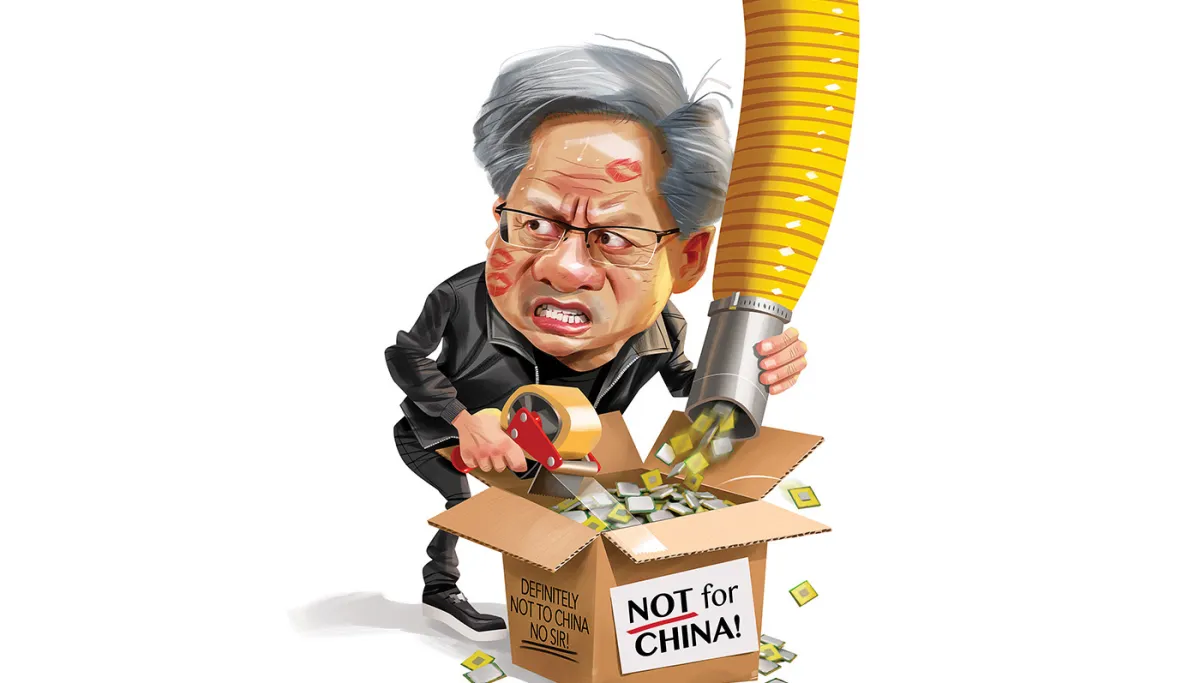
The founder and CEO of Nvidia, the world’s most important chipmaker and, until November, the world’s most valuable company, made his remarks to the Financial Times on the sidelines of the newspaper’s “Future of AI Summit” and quickly had to clean them up.“It’s vital that America wins by racing ahead and winning developers worldwide,” the tech magnate hastened to elaborate on X. Earlier, he had explained that “we want the world to be built on American tech stack. Absolutely the case. But we also need to be in China to win their developers. A policy that causes America to lose half of the world’s AI developers is not beneficial in the long term, it hurts us more.” Huang had long favored engagement with China and, for years, had pushed U.S. officials to allow Nvidia to sell its most advanced graphics processing units, the semiconductor chips that power AI applications, to Beijing on the dubious theory that his company could lure China into a dependency on his processors and other American tech, thereby winning the AI race, security risks aside. The Biden and Trump administrations unevenly held the line, though, prohibiting Nvidia from exporting its GPUs to the Chinese Communist Party.(Illustration by Dean MacAdam) But this already uneasy status quo has exploded over the past month, as Huang and Nvidia, along with the entire American AI ecosystem, have been rocked by an extramarital affair Huang admitted to carrying out with Alice Huang, an executive at the Singaporean tech company Megaspeed, who has been accused of acting as a Chinese asset. Both Jensen Huang and Alice Huang have vigorously denied the espionage allegations. Nvidia sold GPUs to Megaspeed, and those chips have apparently made their way to China. Others suspect that Alice Huang extracted critical information from Jensen Huang and relayed it to her Beijing paymasters.The scandal has also once again highlighted the AI competition between Washington and Beijing and lent new urgency to the ongoing battle for technology supremacy and geostrategic preeminence. It’s also upended an already tumultuous Trump administration, whose principal apparently received warnings about Huang’s exposure but declined to take action,So how did l’Affaire Huang unfold? What does the alleged honeypot operation mean for the American economy? Most importantly, what should policymakers do about it?Chips on the table: How the scandal happened In late October, the New York Times broke the story, reporting that various government officials suspected Alice Huang of being a spy and noting that, “roughly a year ago, Mr. Trump was briefed about the intelligence findings, which have not been previously reported, and chose not to do anything with the information.” A few weeks later, the outlet followed up with a specific claim that President Donald Trump “was told aboard Air Force One in May en route to China that the United States had obtained sensitive intelligence showing that Nvidia’s chief executive was in a relationship with a woman believed to be a Chinese spy.” The paper said national security adviser and Secretary of State Marco Rubio delivered the message to Trump personally with Huang. A few days later, the Washington Post revealed that Rubio drafted a memorandum addressing the allegations that he shared with the White House. Federal agents also reportedly told lawmakers on Capitol Hill that Huang had been “the target of a foreign intelligence effort.”China has long coveted Nvidia’s most advanced chips. As my American Enterprise colleague Ryan Fedasiuk found, even in 2021, the Chinese military “was already relying heavily on U.S.-designed computer chips—and especially those made by Nvidia—to fuel its nascent AI and autonomous weapons programs.” Huang’s deep belief in his strategy of addicting Beijing to the American tech stack may well have been authentic, but it was also profoundly self-serving, and it ran contrary to the much more China-skeptical approach espoused by mainstream geopolitical and economic officials.It then became clear that a major rift had formed between the Commerce and Treasury departments over exactly this issue. According to CNN, Commerce Secretary Howard Lutnick, whose department bears responsibility for export controls, had cultivated close ties to Huang and “failed to crack down on chip shipments to companies suspected of passing them on secretly to China.” Megaspeed, with the connivance of Alice Huang, has allegedly transferred as many as thousands of Nvidia GPUs to China-linked entities. Singaporean authorities barred her from leaving the country last year, but Lutnick reportedly slow-walked the investigation.At left, Nvidia CEO Jensen Huang and his wife Lori Huang arrive for a state dinner at the White House hosted for China’s President Xi Jinping, Sept. 24, 2026; at right, Alice Huang with Jensen Huang at a restaurant in Taipei, Taiwan, May 22, 2025. (Carolyn Kaster/AP; TVBS/AP) Meanwhile, Treasury Secretary Scott Bessent vented his frustration with the Commerce Department. “I am frustrated when President Trump made it very clear that China should not receive any Nvidia chips above H100s,” Bessent told CNBC on Nov. 13, referring to an older-generation GPU. “And so any leakage is very frustrating because it hurts our great companies in the AI race [and] gives the Chinese an advantage.” When pressed about how the debacle came about, he pointed the finger at Lutnick. The Commerce Department “has the pen,” he said, “and you will have to ask them about their internal process.”It should be noted that Alice Huang’s espionage status remains a matter of dispute. “I don’t know that she is a spy,” Trump told reporters in November. “Usually, what happens with that is that any woman coming to the country that’s a beautiful woman that comes from China, they say she’s a spy.” The president also continues to insist he won’t replace Lutnick.So what has Jensengate wrought?A riven tech and governance landscape and an emboldened China The scandal’s fallout has been prolonged and painful for Nvidia and the broader tech market. Following the revelations and reports that Jensen Huang had engaged in at least two other extramarital affairs, both with Nvidia employees, the embattled CEO resigned his post. (Since then, Trump appeared to support his reinstatement. “I think he learned a big lesson,” Trump said before departing for Asia. “It was not put at risk, and our country is now stronger than ever before.” Initially, Nvidia’s board quickly poured cold water on such a prospect, with its chairman insisting on a Nov. 17 earnings call that the company “unanimously accepted his resignation and does not intend to reinstate Jensen as CEO.” But on Nov. 23, the board reversed course and reappointed Huang as chairman, stating it was “satisfied with respect to Mr. Huang’s candor and ability to lead Nvidia.”) The company’s interim CEO said it had stopped shipping advanced GPUs to China altogether, at least for the time being.As these events unfolded, the company’s stock plummeted nearly 40% from its all-time high in October, while the tech-heavy Nasdaq fell 7% and the broader S&P 500 declined by 5 points. Huang’s company dropped behind Apple as the most valuable in the world by market capitalization and, in mid-November, barely led Microsoft and Alphabet, Google’s parent company. It has since recovered somewhat.But even larger challenges lie ahead for governance and for the economy. The New York Times reported that “the public airing of the fight over China policy inside Mr. Trump’s cabinet shows how much the fallout of the Nvidia scandal has deepened fissures inside the government, forcing into view a debate about how the United States should reckon with Beijing.” As Trump himself said in November, of Bessent and Lutnick, “One wants to be friendly with China, and one wants to have a blowup with China. Both are acceptable, but they’re different views.” An administration perennially suffering from barely controlled chaos has succumbed to even more of it.Jensen Huang speaks to the media as he attends a meeting between Chinese Premier Li Qiang and U.S. business representatives in Beijing, May 14, 2026. (Go Nakamura/AP) Even after the dust clears, it will be difficult to know exactly what cutting-edge technology the CCP managed to extract from Nvidia, both in terms of illicitly transferred GPUs and trade secrets downloaded directly from Jensen Huang’s brain. Writing in the Free Press, former deputy national security adviser Matt Pottinger and Liza Tobin, a former National Security Council China director, lamented the “story of brazen regulatory capture” embodied by “how Jensen Huang gained personal, persistent access to the president of the United States, the secretary of commerce, and other key officials—and how he used that access to advocate policies that have put America’s foremost adversary, the People’s Republic of China, within reach of becoming the dominant power in artificial intelligence.” Beijing’s technological ascendancy would spell disaster for American political and economic power, as well as that of the rest of the free world.And make no mistake about it: China is hell-bent on achieving AI predominance. As Pottinger and Tobin astutely observe, Chen Yixin, China’s minister of state security, essentially its spy chief, wrote an April essay in the CCP’s influential Qiushi journal reiterating the country’s commitment to “win the initiative in global technological competition,” including by mounting a “struggle against blockades,” such as American export controls.In addition, as I’ve documented in this space on several occasions, China-linked entities have stoked the backlash against AI data centers in the U.S. This covert effort has included exploiting U.S. tech titan OpenAI’s models to, in the company’s words, “manipulate a legitimate debate about American AI and wider tech policies” and, in particular, to generate “social media comments and images claiming that data center buildouts for AI were increasing electricity prices for average families.” More recently, the Washington Free Beacon reported that a successful Atlanta-area movement to block a proposed $1.6 billion data center was “aided by a nearby chapter of the Party for Socialism and Liberation, a Marxist-Leninist group which has links to China,” as was a similar effort in suburban Washington. All this activism has coincided with Beijing’s lightning-fast expansion of its own data centers: In a recent report by the bipartisan U.S.-China Economic and Security Review Commission, Chairman Randy Schriver concluded that “China increasingly views data not simply as information, but as a strategic asset that can drive economic growth, accelerate artificial intelligence, and strengthen national power.”What, then, should the U.S. government and the American tech industry do to reduce the risk of Chinese access to technology while still fostering a robust innovation ecosystem stateside?Where we go from here Fortunately, help appears to be on the way.On Nov. 16, the Bureau of Industry and Security issued “new rules to prevent certain foreign actors from leveraging advanced computing power based on U.S. technology to threaten U.S. national security and foreign policy interests.” Specifically, under these guidelines, which are not yet final, “a license will be required to export, reexport, or transfer (in-country) advanced semiconductors to Indonesia, Malaysia, Singapore, Thailand, or Brazil,” which the bureau characterizes as “countries which present a higher-than-normal risk of diversion.” The new strictures represent a direct shot at Megaspeed — and a shot across the bow at companies tempted to follow its lead.“This rule sends a message to the CCP that America is serious about closing dangerous export control loopholes China has been exploiting for years,” Rep. John Moolenaar (R-MI), who chairs the House Select Committee on the Chinese Communist Party, said in a statement. “Our most advanced AI chips are simply not for sale to our foremost enemy. This new rule is an important step in keeping chips out of ill-intentioned hands, strengthens our national security laws, and will help protect America’s lead in the AI race.”Similarly, White House spokesman Matthew Middleton asserted that “this action will help ensure that America’s most advanced chips go first to U.S. [AI] innovators, not Chinese shell companies. The Trump administration will continue to take decisive action to protect America’s technological edge, strengthen our national security and ensure the future of [AI] is built in America.”These guidelines are a good place to start. They will stymie circumvention of export bans by cracking down on gray-market chip sales and reimportation to China. But the White House can go much further by taking initiative on this issue, breaking the deadlock between the Commerce and Treasury departments, and strictly prohibiting sales of our most advanced chips to Beijing or its allies.The legislative branch, especially a new Congress on its way to town, eager to make an impact immediately, also has a crucial role to play. For instance, Fedasiuk strongly urges passage of three pending bills aimed at tightening American control over technology: the Chip Security Act, which would “require the Secretary of Commerce to issue standards with respect to chip security mechanisms for integrated circuit products, and for other purposes”; the Remote Access Security Act, which would broaden “the scope of the U.S. export control system to include remote access,” such as access “by a foreign person through a network connection, including the internet or a cloud computing service, from a location other than where the item is physically located”; and the Multilateral Alignment of Technology Controls on Hardware Act, which would “provide for export restrictions on certain semiconductor manufacturing equipment and components therefor.”Congress also can and must exercise its oversight authority to determine how and why things seemed to go so wrong. Happily, Moolenaar’s committee announced that Huang and Nvidia general counsel Tim Teter agreed to appear before them — as well as before the House Foreign Affairs, Intelligence, and China committees. “We look forward to hearing from Jensen Huang and Tim Teter on their roles in a potential breach of our national security,” the three committee chairmen said in a joint statement. “The American people need answers on Mr. Huang and Nvidia’s role in allowing dangerous PRC actors to access our most advanced chips, as well as the role of a potential Chinese intelligence asset in this scandal.”At the same time, the tech industry cannot afford to take its foot off the gas, and policymakers must do everything in their capacity to bolster continual innovation in AI and related fields. Both Huang and the company he built are shining examples of American success stories and deserve immense credit for adding immeasurable value to the U.S. economy. The White House and Congress must do everything in their power to facilitate the emergence of the next Nvidia while the current Nvidia under a chastened Huang has a reckoning coming.THE CHINA-US AI WAR HEATS UPThen, too, the U.S. must continue to leverage relationships with friends and partners among liberal democracies to ensure China does not outflank any of us. Lawmakers at the federal, state, and local levels must work cooperatively with tech companies to responsibly and constructively build data centers that benefit local communities and industry titans. And within those tech giants, a renewed culture of discretion and responsibility needs to be inculcated lest further trade secrets, know-how, and goodwill be exploited by hostile actors.In November 2025, when Jensen Huang predicted China would win the AI race, he appeared to mean it as a warning, not a prescription. His actions, alas, may well have hastened the transformation of his prediction into a reality. Only careful, forceful, concerted action by tech and government leaders can prove that prediction wrong.Michael M. Rosen is an attorney and writer in Israel, a nonresident senior fellow at the American Enterprise Institute, and author of Like Silicon From Clay: What Ancient Jewish Wisdom Can Teach Us About AI.
The Jensen Huang-Nvidia affair turns up the heat on the US-China AI race
Full Article
Original Source
Read the full article at Washingtonexaminer →KhanList aggregates and links to publicly available news content. We do not host full articles from third-party sources. Always verify important information with original sources.