
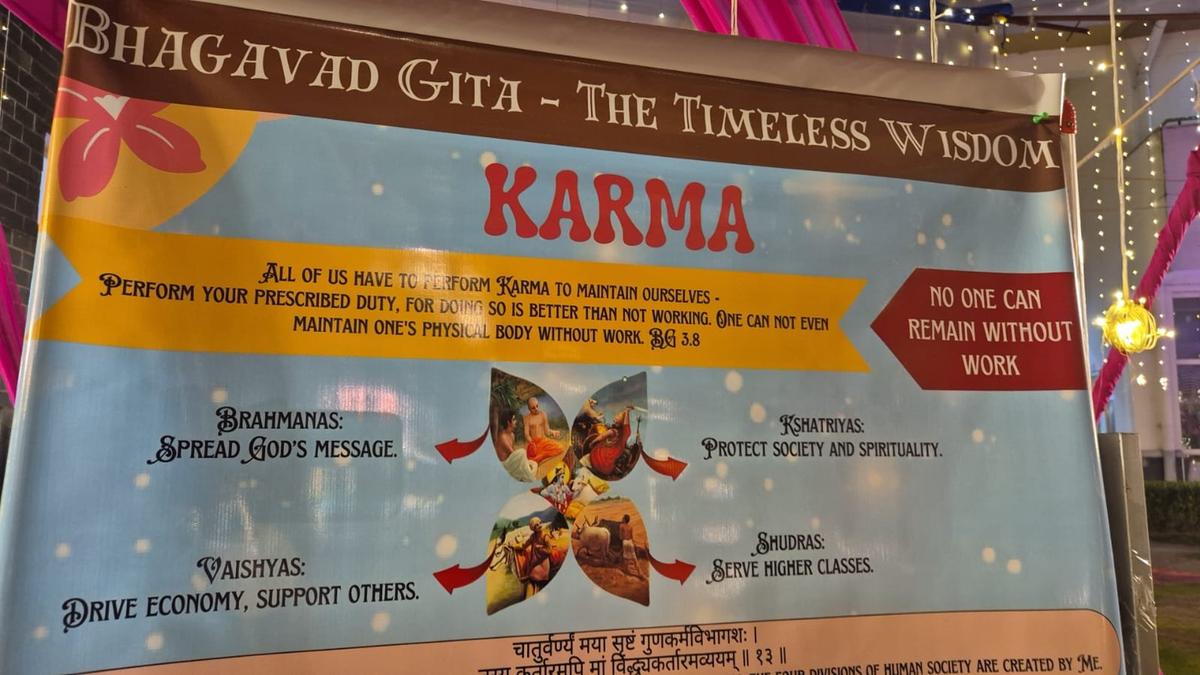
A poster at IIT-Mandi on September 4, 2026, during Krishna Janmashtami celebrations, depicting the caste system with the four ‘varnas’. | Photo Credit: Special Arrangement All humans must be treated equally. That is a moral and constitutional position. It is not a scientific position because science does not carry moral or constitutional authority.The normative system laid out in the ‘Manusmriti’ expresses the ‘principle’ that the birth of a person says something essential about who that person is supposed to be, with persons born into specific social categories to be assigned a place in the division of labour and a set of permitted relationships and social rights. Modern constitutional thinking is radically different. Per the Magna Carta, the English Bill of Rights and the constitutional democracies of today, individuals possess rights that depend on more than their place in a social hierarchy. After all, the fundamental rights of the Indian Constitution are attached to persons and citizens, not to inherited social functions.Yet a poster that turned up at IIT-Mandi on September 4, 2026 said the role of “Brahmanas” is to “spread god’s message”, that of “kshatriyas” to “protect society and spirituality”, of “vaishyas” to “drive economy, support others”, and of “shudras” to “serve higher classes”.Science, which underlies the technologies the IITs are primarily concerned with, offers another conception paralleling the constitutional view, rooted in a different kind of authority.The authority of scienceWhile some defenders of the caste system have claimed that it is based on inherited biological differences, the system is really the cause of the differences, rather than their inheritor. The human organism develops as its genes interact with its environment, and caste-based discrimination affects these environments. Studies on the social determinants of health have revealed caste-related inequities in healthcare and access to healthcare while social epigenetics has found that social circumstances can induce biological changes via mechanisms that affect the way genes are regulated.People of Black African heritage and Indigenous peoples in Asia, say, have non-identical genomes for this reason. By applying science’s methods, we know the differences between these peoples do not excuse a caste-like system. Instead, the differences in these people’s social circumstances through history — including societies of which they were part practising a hereditary, hierarchical system at any point — affected the way they developed.In a landmark 2009 study, geneticists reported that most present-day Indians descended from two differentiated ancient populations, which mixed extensively before endogamy took root, and present Indian groups contain mixes of these ancestries. The team also said there are substantial genetic differences between various communities today thanks to a long history of endogamy. Other studies of Indian populations have also reported strong founder effects (when a new population emerges from a small group of individuals and inherits the lack of genetic diversity) due to endogamy. The genome does not announce that these people were ordained to marry one another but records the fact that they elected to do so for reasons beyond scientific wisdom.The human nervous system is also very plastic: it constantly rewires itself in response to every experience in a life-long process. Not everyone is good at everything, but plasticity means the neurological system develops together with each human’s environment, interests, temperament, and individual choice, giving rise to a variety of abilities among people.No matter how well-equipped, the practice of science could never say whether all humans are equal. That is a political and ethical proposition it cannot test or prove. However, it does say that all humans are members of one species, that their development is shaped by their experiences, and that social environments can become embodied.Just as caste constrains the plasticity of the human brain, it also constrains the human capacity for culture. Homo sapiens can accumulate knowledge and pass it on so that other H. sapiens do not have to learn from scratch. Caste-based discrimination, however, restricts the spread of knowledge and narrows the social range over which one of the defining capacities of our species can operate — as if a student’s ability to solve a differential equation has anything to do with the status of their ancestors.This clash of possibilities is what makes the appearance of a message reinforcing the caste system at a centre of scientific learning particularly tragic. Published - September 08, 2026 01:00 am IST
The incongruity of caste and science
Full Article
Original Source
Read the full article at Thehindu →KhanList aggregates and links to publicly available news content. We do not host full articles from third-party sources. Always verify important information with original sources.