
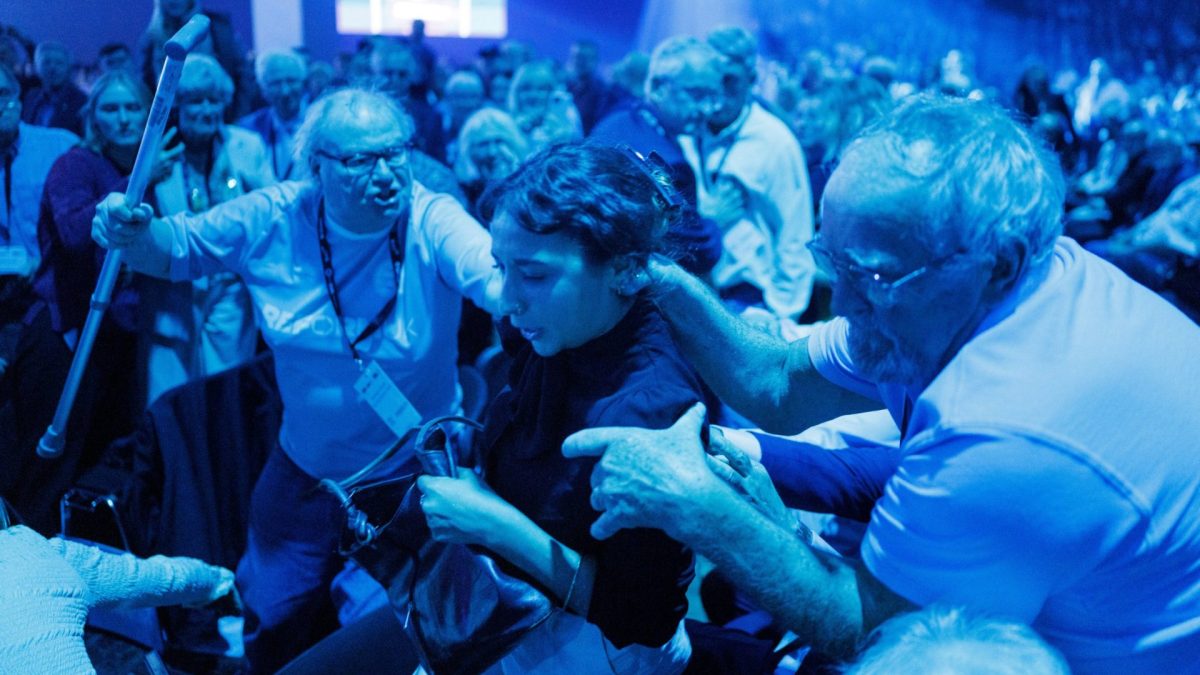
Protests at party conferences are fairly routine. Yet at Reform UK’s conference, when protesters disrupted Nigel Farage‘s speech on Saturday, this habitual feature of party conference season exposed something ugly. While organised, trained security was on hand, the crowd itself intervened more rapidly and more violently. Regular attendees grappled with a petite female protester. Some grabbed her round the neck, others pulled her hair, while another whacked her with a walking stick. The footage is shocking. It looks like a rage-filled mob rather than an attempt to manage the situation. Many of Reform’s leaders have revelled in the incident. Newark MP Robert Jenrick’s reaction was a sarcastic “boohoo”. Reform chairman Lee Anderson suggested a whip round for a new walking stick. It is red meat for those inside the hall, the most dedicated of Reform’s supporters, but it goes against what we expect from politicians. Violence is normally a red line. Politicians condemn it. They don’t get swept away in the fervour, or mock the victims – even if they find them annoying. Polling has repeatedly shown that the Reform base is at odds with the broader public. Those who voted for the party in 2024 are more likely to be vaccine sceptics than the rest of the population. They have a higher opinion of Donald Trump and are less likely to support Ukraine or believe in global warming. According to one poll, the party’s voters are even more willing to believe in ghosts and witches than those of other parties. This difference doesn’t just extend to their views. The recent scandals involving Reform suggest a reticence to play by the rules of regular politics. Nigel Farage remains under investigation for the £5m personal gift he received before the last election, though he denies any wrongdoing. Last week, Dan Jukes, Farage’s aide, and James Orr, the party’s head of policy, stood down after an undercover investigation into alleged breaches of political donation rules. Farage claimed the party had “broken no laws”. In his centrepiece speech at the conference, Farage promised a Reform government would use a national emergency to remove the ability of judges “to lean on outdated conventions such as the European Convention on Human Rights”. It appears that Reform is a party that doesn’t think the normal rules should apply to them. The violence, and response to it, also reinforces the party’s blokey image. From Farage’s pints-and-fags bonhomie to the casual indulgence of violence, there’s an aggressive swagger to Reform. Previous scandals have shown this too. Their candidate for Makerfield was exposed for endorsing lewd tweets. James McMurdock, one of their 2024 MPs, had prior convictions for assaulting his then-girlfriend (he has now lost the whip for unrelated scandals), while a Kent councillor, elected in May 2025, was later jailed for coercive behaviour. While every party has its black sheep, Reform has a recurring problem with crudeness, and worse, towards women. Reform’s base often seems to like the party because of its failure to respect the traditional way things are done, rather than in spite of it. But away from this captive audience, the scandals are becoming a limiting factor on their growth. In the last year, Farage’s personal polling has plummeted, and the party has shed nearly a third of its support since its polling peak. If the party aims to become the new political force on the right, it must reach beyond its norm-breaking base. Properly supplanting the Conservative Party means peeling away not just angry, anti-politics voters in left-behind areas, but those in the comfortable suburban middle classes. These, as the Tory collapse in the wake of Partygate showed, often quite like propriety and decent behaviour. So far Reform has especially failed to win right-leaning women voters – a vital demographic bloc who are unlikely to be swayed by crude comments about women and macho posturing about violence. Reform’s core voters and hardcore activists might like the footage from Birmingham. Many of them are anti-system voters, driven by rage at the status quo. Seeing a lefty get what-for gives them a thrill, and the party endorses it. Away from the hall, however, the wavering voter sees an angry mob attacking a young woman, led by a man surrounded by financial questions – and it looks like a party they don’t want to get behind. Farage has spent his political career walking a fine line between the margins of politics and respectability. He barred the BNP from UKIP, and knew that hooliganism would undermine his reach into Home Counties Tories. Yet the rise of Restore is dragging his base rightwards, and the potential for success is emboldening them. Farage increasingly looks like he is following the base, not leading it. The other reality of party conferences is that few things get remembered, and an image like this can easily be a defining moment. Reform is easily stereotyped as the party of angry, older people. Pensioners grappling with a young protester only reinforces it and could cause lasting damage to the party. If it does, Farage and his leadership will regret indulging it.
The image that will haunt Farage
Full Article
Original Source
Read the full article at Inews →KhanList aggregates and links to publicly available news content. We do not host full articles from third-party sources. Always verify important information with original sources.