
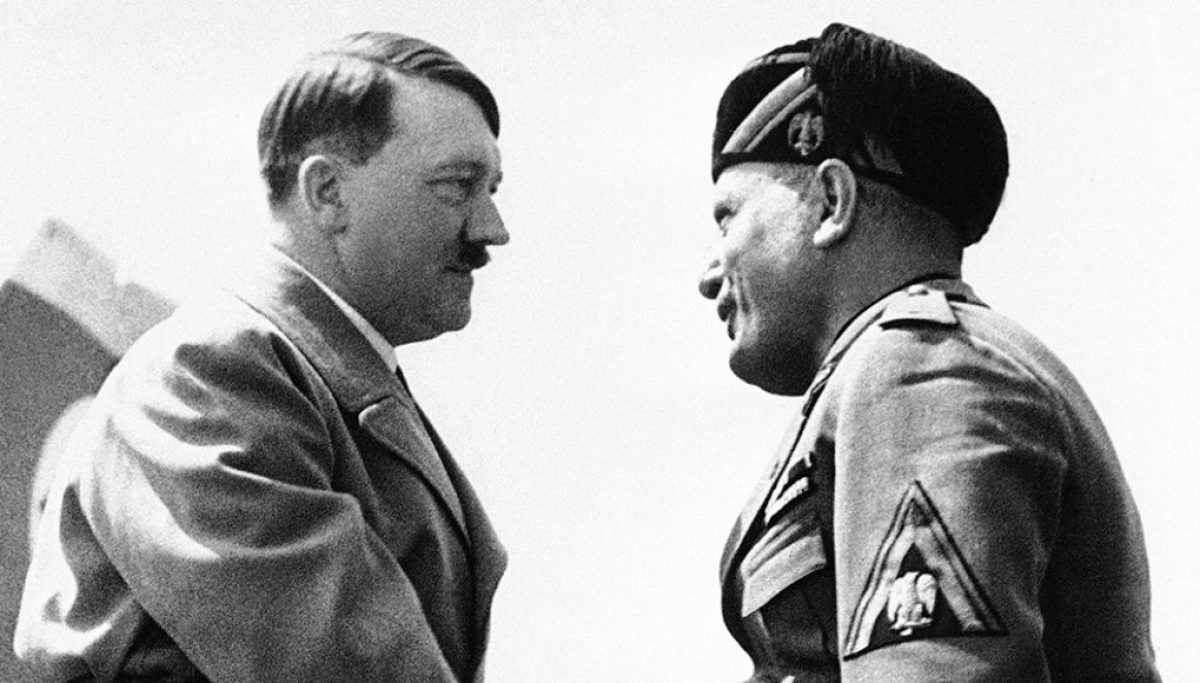
Adolf Hitler was no Bob Ross. “Und vee put zee little tree here. Maybe ah little smoke from ze cabin in za voods.” Long before he built a totalitarian horror, he was a struggling artist in Vienna. He was rejected by the Academy of Fine Arts — first in 1907, and again in 1908. He eventually scraped together a living peddling local watercolor scenes, harboring deep grievances while convincing himself he was destined to reshape history.He was hardly the only despot with a creative side. Benito Mussolini played the violin and recited poetry. Pol Pot studied the violin as a student in Paris. Saddam Hussein wrote romantic prose and political novels, while Mao Zedong turned out poetry throughout his entire political career. Apparently, the international tyrant poetry slam had a pretty strong lineup. Of course, if we widen the category of extracurricular activities, both Kim Jong Il and Kim Jong Un had a penchant for basketball — you know my boys like to go hard in the paint. A coffee-table book of tyrannical side projects would make for great reading. Oh, those whacky art house children.But the interesting question is not whether political movements and their leaders have artistic ambitions. They all seem to. Every movement wants to repaint the social canvas. The difference is in the instructions: some offer a broad palette and invite people to experiment; others arrive with a color chart, a numbered canvas, and a detailed explanation of why the previous painting was historically oppressive. Obviously, being an artist, studying political theory, or belonging to a socialist organization does not make someone a dictator. The interesting question is what happens when anyone — artist, activist, revolutionary, or politician — becomes convinced that his particular vision is the only legitimate picture of the future. Hitler’s problem was not that he wanted to paint. It was that he eventually decided he could repaint civilization itself — and that everyone else needed to get out of the way. The canvas was enormous, the palette was ideological, and there was no room for an art critic.There is something revealing in the contrast between grand historical ambition and the mundane mechanics of actual painting. The artist can imagine a masterpiece, but the paint still has to be mixed. Blue is still blue. Red is still red. Too much water ruins the watercolor, and too much paint muddies the canvas. Sometimes the composition simply doesn’t work, and the responsible thing to do is admit that the picture needs to be changed.Political movements face a similar temptation. They can develop elaborate theories explaining why society is structured as it is, identify the forces responsible for injustice, and envision an entirely different social order. But eventually somebody has to pick up the brush. To be clear, the following is not meant as a false equivalence.Take, for instance, the Democratic Socialists of America. The organization’s educational materials argue that Americans are taught a “very distorted version of history” that hides the reality of class struggle. To fix this, DSA promotes political education designed to build a “shared language, understanding, and a vision” to challenge capitalism and replace it with a socialist framework.There is nothing inherently sinister about political education. Republicans, Democrats, labor unions, and religious groups all teach their members how to advocate their values. But political education is, in one sense, an exercise in color theory. Give people a particular vocabulary, and they begin to see the canvas differently. Terms such as capitalism, exploitation, bourgeoisie, and hegemony don’t merely describe objects sitting independently on the canvas. They organize the picture. They tell the viewer what to look at, what matters, what belongs in the foreground, and what can be safely painted over. At some point, political education begins to look more like a rigid paint-by-numbers method.And this is where high-minded political theory collides with the unglamorous mechanics of paint. Hegemony sounds impressive until it’s squeezed onto a palette — at which point it usually means one color dominates the whole composition simply because someone keeps reaching for the exact same tube. Dialectics sound even better, right up until two opposing colors mix to produce a messy compromise neither side intended.The point isn’t that political science is literally watercolor chemistry. It’s that movements get so focused on explaining the grand structure of society that they forget actual politics is just ordinary people holding brushes: disagreeing, making mistakes, and occasionally realizing the person next to them has a point.The real power of political education, then, is not simply that it teaches people what to believe. It gives them a framework for interpreting what they see. Adherents stop merely supporting a policy; they adopt an identity built around a historical struggle. The world becomes a painting in which some colors are assigned moral significance before the brush ever touches the canvas.This isn’t to say the DSA is a dictatorship or that its members are future autocrats. The DSA explicitly describes itself as a member-led, “unusually small-d democratic” organization with elected leadership and robust internal debate. Again, this isn’t an attempt to draw a direct moral equivalency. Two things can be true simultaneously: a movement can operate through democratic consensus while harboring an intellectual impulse that treats society as a canvas to be single-handedly repainted. History demonstrates that democracy itself isn’t immune to overreach once power accumulates. Foundational change requires organization, and DSA’s persistence is evident in its growth: from roughly 5,000 members in 2016 to over 100,000 nationwide today. As any movement grows, the central questions shouldn’t just be about its stated ideology, but about its internal culture. Can its members tolerate disagreement? Can its vocabulary be questioned? Can it view political opponents as merely incorrect rather than evil? And, crucially, can it accept losing?A painter has to learn this lesson early. Sometimes the color or composition is wrong. Sometimes the entire painting is wrong. The responsible response is not to declare the canvas bourgeois and burn the studio. You scrape the paint off, start again, try another color, or admit that the person holding the other brush may have noticed something you didn’t.Authoritarianism need not begin with a grand decree. It can begin with habits of political thought — a compelling historical narrative, a theory of grievance, an identified enemy, and an unwavering belief that society must be transformed at all costs. The danger isn’t having a frame. The danger is forgetting that the frame is not the picture.THE PARTY OF NAZI ACCUSERS IS AWFULLY SILENT ABOUT JEW HATRED AFTER NYC SYNAGOGUE TERRORIZEDThat is the real art lesson: political movements can paint vivid pictures of the future, but they must remain willing to question the frame, change the colors, and accept that someone else may see the picture differently. The danger isn’t having a vision. It’s believing the vision is so perfect that disagreement itself becomes illegitimate.And with the holidays fast approaching, if you happen to have a disgruntled revolutionary relative at the dinner table, skip the political debates. Perhaps buy them a paint-by-numbers kit instead. Make sure it comes with plenty of red paint, very clear instructions, and little room for creative interpretation.Andrew Moore is a small-business owner and author of the Primus Aeternus series.
Art lessons for Hitler: Why every radical ideology wants to repaint civilization
Full Article
Original Source
Read the full article at Washingtonexaminer →KhanList aggregates and links to publicly available news content. We do not host full articles from third-party sources. Always verify important information with original sources.