
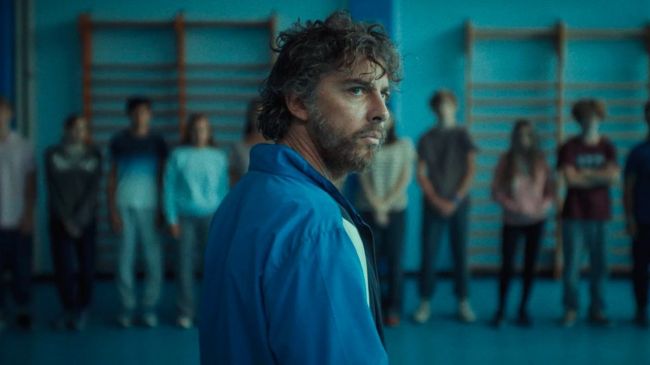
In March 2009, a train crash kills 46 people near a picturesque village nestled deep within the Italian Alps. In the present day, an alcoholic gym teacher named Sergio (Michele Riondino) — nursing some recent grief of his own — is relocated to Remis, only to find that the surviving townspeople have never been happier, despite the shared tragedy that would seem to overshadow their lives. It’s uncanny. It’s disturbing. It’s what Sergio wants for himself more than anything in the world. And he’s told that all he has to do to make the pain go away is to hug “The Holy Boy” mentioned in the English title of Paolo Strippoli’s third feature, a slick and effectively spine-tickling horror movie about the harm sown into people convinced they can avoid their own hurt. (It’s also one hell of a calling card for the young Italian director, whose recent festival hit “The Spiral” will receive an Oscar-qualifying release later this year, and an English-language remake sometime after that). For a time, Sergio becomes one of those people. When he first arrives in Remis, sobbing in his car as it chugs up the curvy mountain roads, it feels like a cruel joke that the surly ex-Judo champion has been relocated to a place known as “The Valley of Smiles.” He’s a belligerent asshole to the kids in his P.E. class, acts violently toward the beautiful waitress (Romana Maggiora Vergano as Michela) at the local bar, and generally brings a “Bad Santa” energy to a town with more of a “Pleasantville” vibe. But from the start, it’s clear Remis hides a secret darkness — a darkness so deep that none of the residents can see clearly that they live in a horror film. It isn’t normal for a weasel-eyed man to stand in the bushes and glare at the village high school all day. It isn’t normal for everyone to meet in a barn on the outskirts of town in the middle of the night and participate in a vaguely Catholic ritual that sees them all line up for a chance to lay their hands on a sullen 15-year-old kid (Giulio Feltri as Matteo). It isn’t normal for them to feel like they might go insane, or worse, if they go too long without his touch. Give people a panacea for their pain, and they’ll do anything to keep it, logic be damned. Of course, logic is hardly the only thing that’s damned in “The Holy Boy,” whose concussive soundtrack, broadly demonic symbology (e.g., dropped coins transforming into bloody egg yolks), and genre-inflected visual motifs (lots of upside-down camerawork and clever uses of soft focus) help consecrate this high-altitude “Twilight Zone” story’s rather literal approach to elevated horror. But Strippoli’s script, co-written by Jacopo Del Giudice and Milo Tissone, isn’t content to settle for mere social allegory, even if the movie tacks harder in that direction with every new detail we learn about Matteo’s effect on the people who touch him. On the contrary, the film’s excellent second act — during which Sergio is fully seduced by the town’s healing power and even settles into a sexual relationship with Michaela — leverages its premise in service of a tenderly ominous character study. Closeted, sanctified, and at the mercy of a purpose that he never chose for himself, Matteo struggles to see his gift as a miracle; if anything, he worries that it’s more like a curse in disguise. It was, perhaps, easier for him to live with (and be used for) when he was a child, but the self-determination of teenage desire has complicated his relationship to the power he embodies. It’s not just that nobody understands Matteo, or cares to — he also struggles to understand himself. If the local bully is so mean to him at school every day, why does Matteo touch himself when he thinks about him at night? The answer may be obvious, but it doesn’t bring peace to the boy’s tormented heart, which pumps with a pain no one else in town allows themselves to feel. Not even Sergio, whose curiosity toward Matteo proves humanizing — and the basis for a real friendship — even as he grows addicted to the child’s power himself. It’s here, between the smiling eeriness of its first act and the somewhat “Akira”-coded psychic collapse of its third, that “The Holy Boy” settles into its skin-crawling purpose. The film is at its most confident and secure as a “Thelma”-like coming-of-age story that weaponizes teenage growing pains against the world at large, as Matteo’s limitless potential is poisoned by the unmet needs of the wanting and selfish people around him. In his own way, and despite his best efforts, Sergio is such a person himself, even if he’s still close enough to his own heartache to see Matteo more clearly than most. But Strippoli is only interested in Sergio as a way to push back against Matteo’s power (and therefore escalate things to the wild places they go before arriving at the film’s satisfying final beat). A richer pas de deux that probes deeper into the grown man’s loss — and his rather complicated history of fathering teenage boys — is gradually sacrificed at the altar of social commentary. Religion and fascism are Strippoli’s most obvious targets, but “The Holy Boy” is wary of anything that people rely on to absolve them of their pain, and of how the things we turn to for comfort are liable to control us the moment we convince ourselves to believe in miracles. Touched by evil from the moment it starts, Strippoli’s film never invites the kind of faith from its audience that it abuses from its characters en masse, but I didn’t have any trouble believing the moral of its twisted sermon: Keep your pain alive, as it might be the only thing protecting you from something so much worse. Grade: B “The Holy Boy” will be available to stream on Shudder starting Friday, November 27.
‘The Holy Boy’ Review: A Teenage Boy Heals People with His Touch in an Eerie Italian Horror Movie About the Price of Avoiding Your Pain
Full Article
Original Source
Read the full article at Indiewire →KhanList aggregates and links to publicly available news content. We do not host full articles from third-party sources. Always verify important information with original sources.