
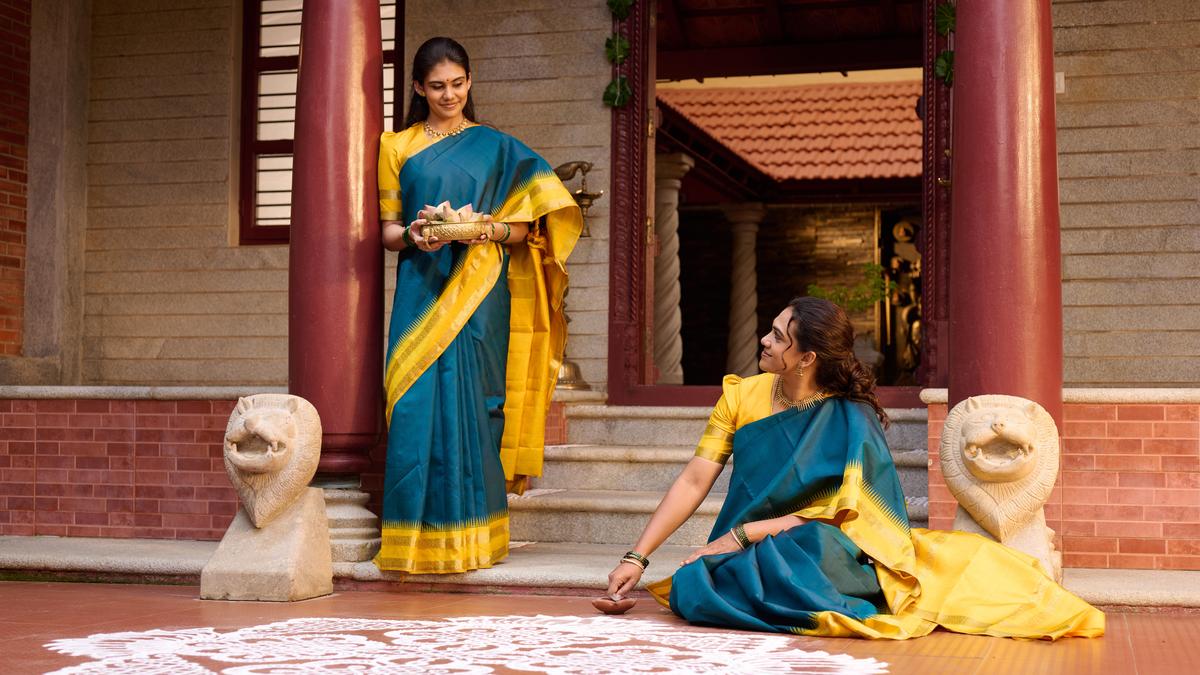
Resplendent in a silk sari with her nose pin catching the light and her voice enthralling audiences, MS Subbulakshmi was perhaps the most recognised figure in Indian classical music circles, whether one had a penchant for Carnatic music or not. Popularly known as MS, she was an unwitting style icon whose wardrobe shaped the tastes of women and dictated market trends at a time when saris were not mass produced.Aikyatha, a silk showroom in Bengaluru has launched Suswaram, an archival collection, recreating seven of her iconic saris and named them after musical notes. And the models showcasing these creations are none other than S Aishwarya and S Saundarya, her great granddaughters.Carnatic musicians in their own right, the granddaughters of Radha Vishwanathan, were spotted at Aikyatha and its co-founder Yeshwanth Sunku says their conversation veered towards MS Blue, a colour so named by the industry as it was often requested by the singer. “MS would regularly ask for this particular shade of blue in sari stores as it photographed well, especially under the stagelights. I was curious to know if it was exclusive to a particular brand,” says Yeshwanth.He found the colour had only been recreated by stores as per their designs; it was originally woven by Muthu Chettiar, a weaver from Kancheepuram. Yeshwanth asked MS’ family if they still had the sari, and when he had a chance to see it firsthand, he asked permission to recreate it. MS Subbalakshmi and Radha Vishwanathan. | Photo Credit: Avinash Pasricha Similar saris were specially woven for MS and Radha, who often performed together. Yeshwanth says he got to examine 22 of them, from which he chose seven to recreate. “I made my choice taking into consideration iconic moments and the events they wore these saris to, as well as weaving specifications.”For instance, Dha in teal and turmeric is a replica of the sari worn by MS and Radha in the image captured by legendary photographer Avinash Pasricha, while Re in green and violet is a recreation of what MS wore while accepting the Bharat Ratna from then President KR Narayan.Yeshwanth admits there was a sense of discovery and experimentation in his quest. “The original saris were woven on dobby looms, which are rare today. Besides, there aren’t too many weavers who have the technical know-how to create these pieces.”He continues, ”Earlier, saris were woven with two colours for the body, and two for the border. I found three weavers who specialised in this craft and got it done. It was only because we had access to the originals that we were able to replicate them exactly.”Aishwarya says her favourite from the collection is Ga, a creation of blue and red stripes, while Saundarya’s is Re. “As a family, we only have a few saris of my great-grandmother’s; she used to donate a lot of what she had, including the remunerations she received. We were happy to share what we had with Aikyatha,” says Aishwarya. Ni from Aikyatha | Photo Credit: Special Arrangement For both the sisters, the tastefully done photoshoot was a glimpse into MS’ life and the quiet charm of that era. Aishwarya, who was nine at the time of MS’ demise, had attended only two of her concerts. “But I do recall a concert where my grandmother was wearing one of the saris she had while on stage with Ammu Patti (the sisters’ name for MS),” she says.She continues, “We were quite excited about the saris’ curation; the script for the shoot depicted the saris as a symbol of the culture, music and values passed on to us from Ammu Patti. It was an amazing experience.”Born a few months after MS passed, Saundarya felt the shoot was a chance to channel all that she had heard about the legend, but never had a chance to be part of. “For a while it was akin to living in an era I would have loved to have been a part of. My grandmother had told me a lot about Ammu Patti and the photos are a peek into the beautiful traditions of those times.”“Ammu Patti would wear cotton saris and glass bangles at home. We too, wear Kancheevarams for concerts, and Mysore silks or cottons for pujas and family functions; we felt a definite vibe and emotional connect at the shoot,” adds Saundarya. MS accepting the Bharat Ratna from then President KR Narayan | Photo Credit: Special Arrangement Needless to say, the original saris are carefully preserved by the family and donned only during special occasions sans safety pins.Both sisters began their musical training at age four and are busy as musicians today, performing together. “The musical journey of our grandmother and great grandmother was extraordinary, but at the same time, it belongs to a different era. Our intention is not to recreate it, but honor and understand it, and keep it alive in meaningful ways so the next generation can connect with their music, values, and the cultural richness they represented,” says Aishwarya.“At the same time, we believe it is important to explore new ideas and create experiences that speak for today’s world.”Saundarya continues, “I believe the greatest thing we can carry forward is their love and support for music. As Carnatic musicians ourselves, we understand how much dedication, discipline, and devotion it requires, and we hope to continue learning, growing, and contributing to this beautiful tradition of melody.”Set to musicApart from the Archival Collection, Aikyatha also created a Raga Edition of five saris inspired by the ragas MS was known for. Re from Aikyatha | Photo Credit: Special Arrangement “MS was known for her rendition of the Shankarabarnam Raga. We have picked up similar ragas and have converted them into saris as an ode to her,” says Yeshwanth, adding that this sari is blue in colour because the raga is in praise of Lord Nataraja who is also known as Nilakantan. “On its border is the bilva leaf which is sacred to Lord Shiva. Other motifs on the body and pallu suggest it is a depiction of the Shankarabarnam Raga.”“Basically, Kanchivarams are inspired by temple architecture. Sadly, today many saris sport random designs without any structure. This is why we decided to delve into these ragas and converted them into design.”While only the Shankarabarnam has been released, the others — Saveri, Kalyani, Khamboji and Bhairavi — will be launched shortly with announcements on Aikyatha’s socials.
Bengaluru-based sari boutique pays homage to MS Subbulakshmi with archival collection
Full Article
Original Source
Read the full article at Thehindu →KhanList aggregates and links to publicly available news content. We do not host full articles from third-party sources. Always verify important information with original sources.