
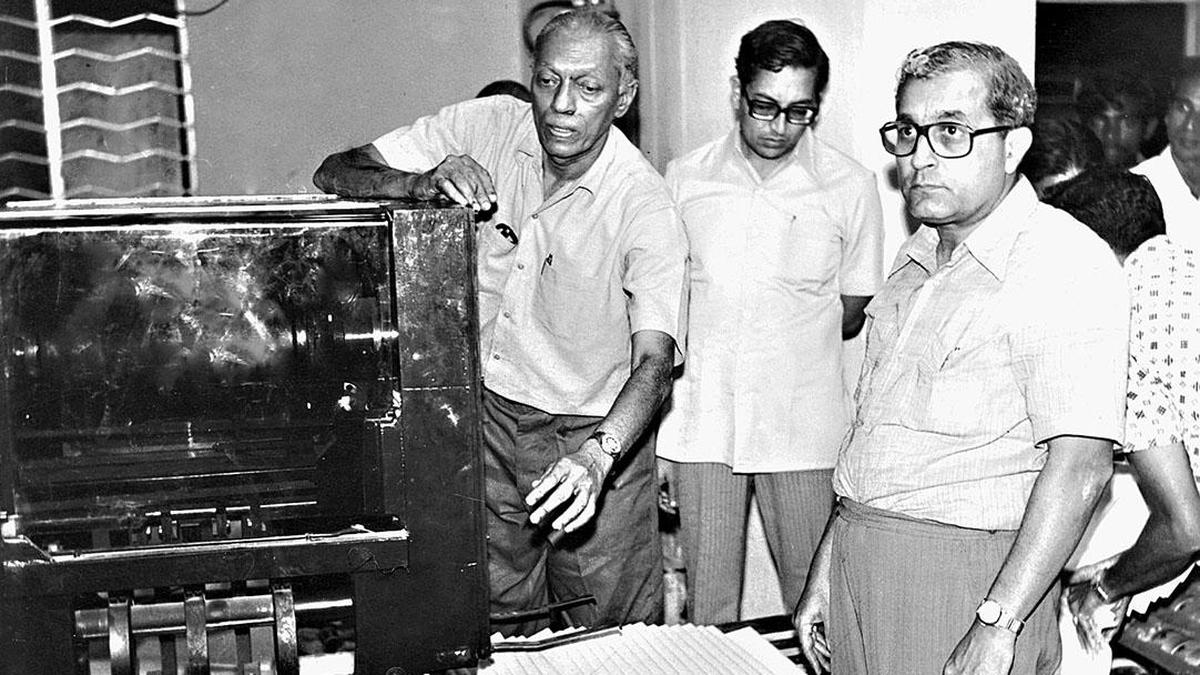
When The Hindu, my Hindu, asked me to write a nostalgic piece for the golden jubilee year of its Hyderabad edition, I felt both humbled and honoured. The gesture touched a sentimental chord in someone like me whose association with the edition spanned more than a quarter of a century.September 1, 1979 — the day I joined the Hyderabad bureau on transfer from Kurnool — seems like yesterday. So does September 30, 2005, when I retired.The Hyderabad edition rolled out in August 1976 from Begumpet, on land belonging to G. Pulla Reddy. There were hardly any shops or hotels around. The street-corner Friends Café served as an oasis for us reporters, who subsisted on chai and biscuits.Two huge trees stood like sentinels on either side of the gate. They eventually fell to the Baldiaman’s hatchet during a road-widening exercise some years later. The single-storey building housed the editorial and business departments, along with the printing and electronic departments.As The Indian Express correspondent, I had covered the formal launch of the edition by Governor R.D. Bhandare and Chief Minister J. Vengal Rao in September 1976. The legendary G. K. Reddy and K. S. Shelvankar, the London correspondent-turned-diplomat, were also present.Minutes before the function, a heavy downpour inundated the compound. The ceremony was hurriedly shifted inside the building. It was seen as an auspicious sign — and indeed, it turned out to be one. Soon, The Hindu became a big hit.G. Kasturi, our Editor, was personally involved in setting up the edition and hand-holding it through its baby steps. He would turn up at 10 a.m. and stay on until well past midnight, when the first edition rolled out.He would then retire to his room at Hotel Blue Moon across the road. The dingy, dark photography room, with an old sofa, was where he would relax whenever he was not busy in the printing section. A team of French engineers stayed on to help install the printing equipment.Sportstar and Frontline, known for their superb colour quality, were initially printed in Hyderabad. The printing staff and French consultants communicated through an interpreter.One of the exclusive editorial privileges in those days was a steaming cup of Nescafe, three times a day., mixed and served by one of the assistants. Dinner was served to the night-duty printing staff, who lived in B.S. Maktha across the road.The Hindu in those days was strictly men and men only. Even the sweepers were men. The gender imbalance was rectified in later years.Another floor was added in the late 1980s to accommodate the expanding editorial and business sections, as well as a guest house. A few years later, the building underwent another round of renovation. To facilitate the work, the editorial and business sections moved back to the ground floor and functioned amid the deafening sounds of sledgehammers, trucks bringing in material and labourers shouting to one another. In short, we functioned in a warehouse-like atmosphere.The turn of the century saw an ultra-modern corporate office taking shape, with spacious cabins and cubicles. Meanwhile, the editorial department was divided into the State and City bureaus, while MetroPlus and other features were added. A Regional Desk, headed by a news editor, was also set up.There is one thing I still find amusing. As I mentioned earlier, none of the prominent establishments that now dot Begumpet Public Road — Axis Bank, several jewellery shops, Hotel Grand Kakatiya and the like — existed in the mid-1970s. The Hindu building then stood alone, rather royally.It could quite rightfully have projected itself as, say, the Begumpet Badshah, or something equally grand. Instead, it remained content with its self-effacing identity: “next to Pulla Reddy sweet shop”, “next to Axis Bank” or “next to the petrol bunk”. Not many may know that before moving to its own premises, The Hindu office was housed on Old MLA Quarters Road in Basheerbagh. Before that, it occupied Craigmore, an old-fashioned bungalow at the foot of Naubat Pahad, opposite the AG’s Office.From Craigmore to Begumpet, from a lone building surrounded by empty spaces to a modern corporate newsroom — the journey of The Hindu in Hyderabad has mirrored, in many ways, the transformation of the city itself.(The writer retired as Chief of Bureau/Deputy Editor of The Hindu united AP in 2005)
The Hindu and a changing city
Full Article
Original Source
Read the full article at Thehindu →KhanList aggregates and links to publicly available news content. We do not host full articles from third-party sources. Always verify important information with original sources.