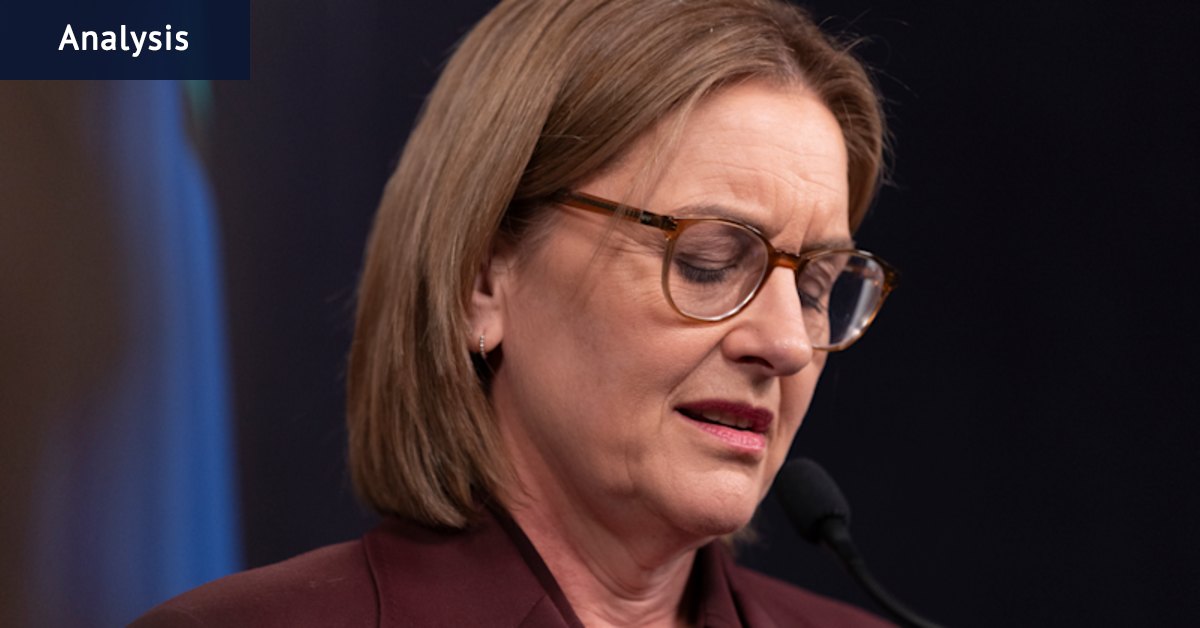
A Labor MP this week relayed her exasperation at knocking on doors in their electorate, trying to talk to constituents. Throughout what used to be safe Labor streets, one door was slammed after the next.“They hate her,” she said flatly.This has been the experience of government MPs for months.Jacinta Allan’s unpopularity had made her leadership untenable. Jason SouthA visceral loathing of Jacinta Allan had seeped into the state, making it impossible for her caucus colleagues to have door-step and train-station conversations about cost-of-living relief and schools and local transport.Some of this was unfair. Some of it odious and misogynistic. Some of it was hand-me-down hatred inherited from Daniel Andrews. For government MPs, the rights and wrongs mattered less than the need to find a way to connect with people who, in four months, will decide whether they keep their jobs.Put simply, Allan’s unpopularity had become a dead weight on her government’s re-election prospects.This is the reason, more than any other, that a majority of Labor MPs were convinced the time had come to dump Allan and install a new leader.That the new leader is Ben Carroll matters less than he is not Jacinta Allan or her equally loathed predecessor. Carroll made this much clear in his first public comments as premier: “Let me make one thing clear: I am not Daniel Andrews. I am not Jacinta Allan.”This is also the reason why the elevation of Carroll and his deputy, Gabrielle Williams, while not a panacea to the government’s electoral ills, will encourage some voters to look at Labor again.To people outside politics, these may seem like harsh things to write about a woman who served for 27 years in parliament, all but four in government, and led this state. People inside politics know these observations are more based in electoral science than sentiment.There is a reason that all respected pollsters play close attention to the relative popularity of party leaders. Jim Reed, the founder of the Resolve Political Monitor surveys published by this masthead, says that when it comes to determining how someone will vote, attitude towards a party leader counts for more than whatever they think about any given policy.“Our vote driver analyses consistently point to the leader being by far the biggest factor in people’s estimation of the party options, way beyond any single achievement, policy offering or candidate,” he explains.“That’s particularly true at a state level where the leader is really the party personified. Many voters struggle to name a minister or a shadow.”Allan’s approval rating according the most recent Resolve survey, published earlier this month, was wallowing at minus 36.This is the kind of number that former prime minister Scott Morrison dragged into the 2022 federal election. In the final stages of that campaign, his effect on undecided voters had become so toxic he was kept in a plane for as many hours as possible, criss-crossing the nation to seats the Coalition had already lost or could never win.The best that can be said about Carroll is that, according to a Resolve survey published in April, only one out of five voters know enough about him to have formed a view one way or another. This may seem like faint praise, but it gives Labor a faint chance in November.Some say you are better to stick with the devil you know but when you are a third-term government plagued by building industry corruption and laden with debt, it is time to pull in your horns.Start the day with a summary of the day’s most important and interesting stories, analysis and insights. Sign up for our Morning Edition newsletter.From our partners
The hatred of Jacinta Allan was unfair. But it had become visceral
Full Article
Original Source
Read the full article at Smh →KhanList aggregates and links to publicly available news content. We do not host full articles from third-party sources. Always verify important information with original sources.